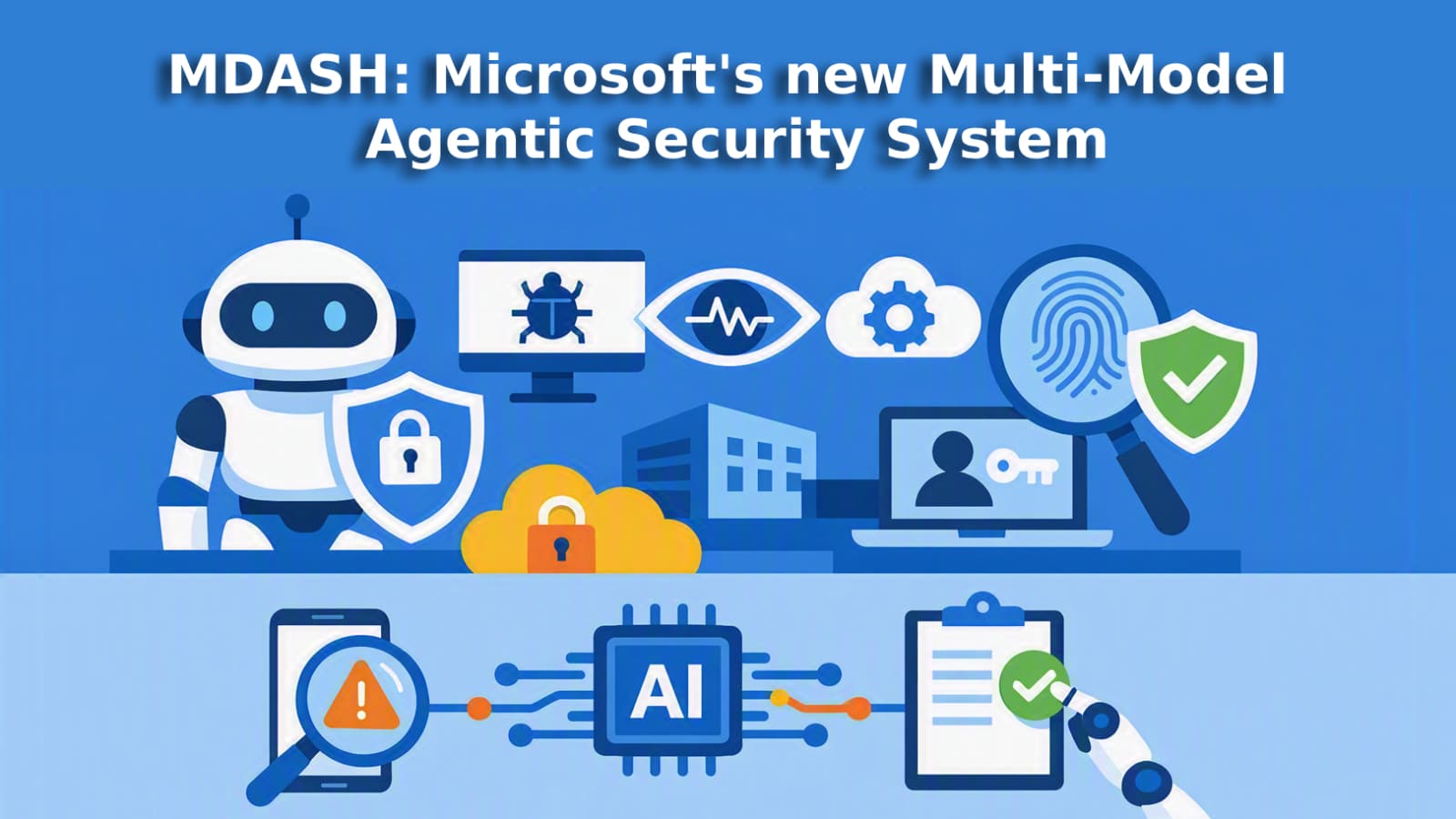
Cyber threats are entering a new era where attackers are leveraging artificial intelligence (AI) to scan systems, find vulnerabilities, and launch sophisticated attacks quickly and automatically. To combat these evolving threats, security teams need technologies capable of analyzing software, identifying risks, and responding with equal speed.
MDASH (Microsoft’s Multi-Model Agentic Scanning Harness) is an AI-powered security system developed by Microsoft Security to accelerate vulnerability discovery through the collaboration of multiple AI models, rather than relying on a single Large Language Model (LLM). This system coordinates AI agents with different levels of expertise to collaboratively analyze, plan, and iteratively examine software to discover complex vulnerabilities. This multi-model approach enables Microsoft to discover vulnerabilities more efficiently, supporting security researchers and engineers in enhancing software security on a broad scale.
Why Traditional Security Testing Is No Longer Enough
Modern software development moves faster than ever before. Organizations continuously release new applications, APIs, cloud services, and AI-powered solutions.
While this accelerates innovation, it also creates new security challenges:
- Larger Codebases
- More Open-source Dependencies
- Complex cloud architecture
- Shorter software development cycles
- Cyber attacks are becoming more sophisticated and intelligent
While traditional vulnerability scanning tools remain important, many vulnerabilities require reasoning analysis and contextual understanding, which goes beyond pattern matching or static rule detection.
AI is therefore playing a role in helping security researchers find vulnerabilities that may not be detectable with traditional tools.
What is MDASH?
MDASH is a Microsoft internal platform that uses Multi-Model Agentic Scanning to help automatically find and analyze software vulnerabilities.
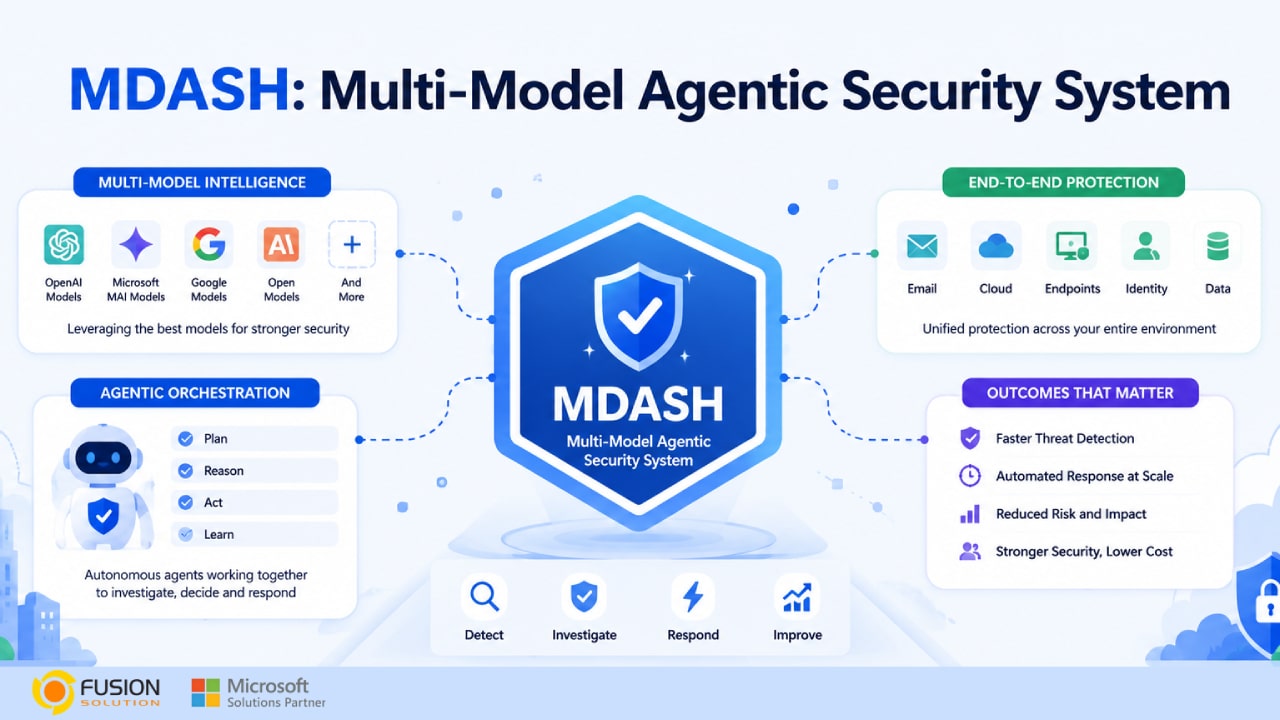
Instead of assigning every task to a single AI model, the system coordinates the work of multiple AI models, each with specialized expertise, to work together throughout the security analysis process.
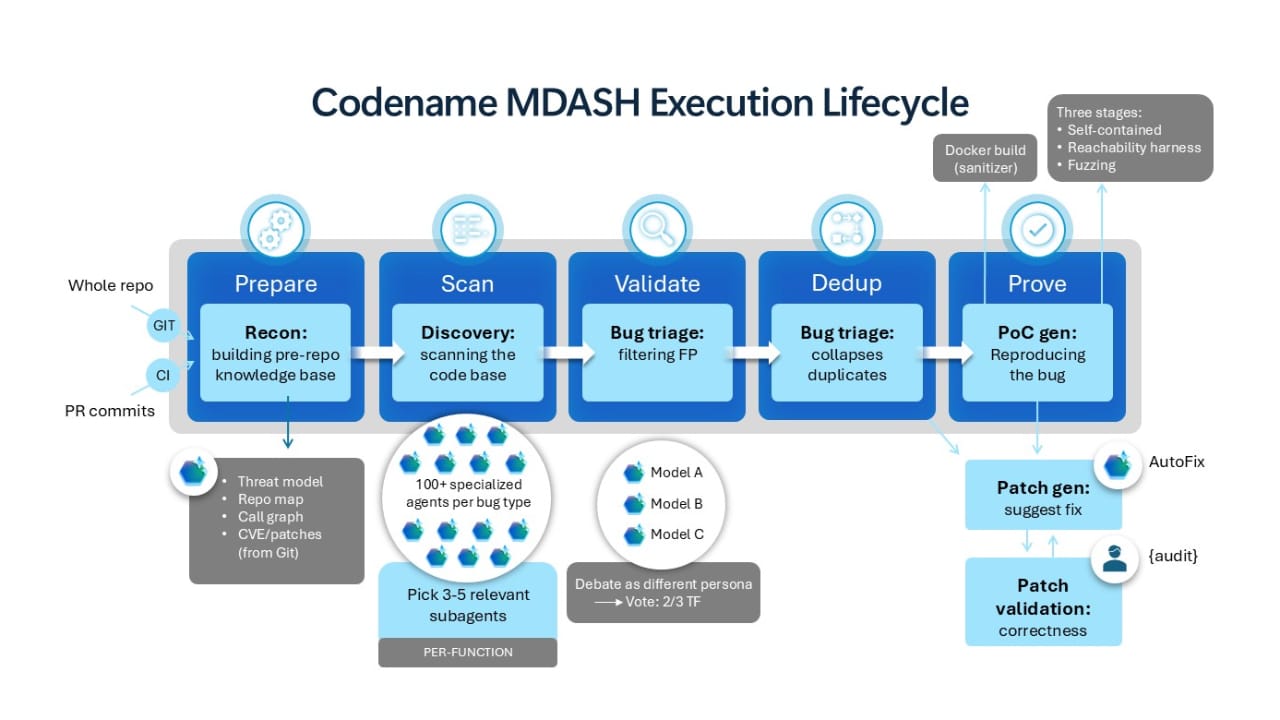
These AI agents can:
- Analyze source code
- Explore application behavior
- Generate security hypotheses
- Test potential Attack Paths
- Validate security findings
- Refine investigations based on previous results
This collaborative workflow allows the system to investigate security issues more intelligently than traditional automated scanners.
Understanding the Multi-Model Approach
One of the key innovations behind Microsoft's security research is the use of multiple AI models instead of depending on a single model.
Different AI models often have different strengths. For example:
- One model may excel at code understanding.
- Another may perform better at logical reasoning.
- Others may specialize in planning, exploration, or validation.
By combining the strengths of each model, Microsoft can create an AI system that provides more comprehensive security analysis while overcoming the limitations of using a single model.
Furthermore, this approach opens up opportunities to integrate newer generations of AI in the future.
Agentic AI for Security Research
Agentic AI differs from typical AI assistants because it can continuously perform multiple steps to achieve a set goal.
Instead of simply answering questions, AI agents can:
- Plan investigations
- Execute analysis steps
- Review intermediate results
- Adjust strategies
- Continue exploring until sufficient evidence is collected
For vulnerability research, this creates a much more adaptive and thorough investigation process.
Rather than stopping after one scan, the system continuously improves its understanding of the target software throughout the analysis.
Key Benefits of MDASH
Faster Vulnerability Discovery
AI agents help reduce the time spent searching for vulnerabilities by automating repetitive tasks, allowing security teams to focus more on investigating and fixing vulnerabilities.
Improved Security Coverage
The use of multiple AI models provides a variety of analytical perspectives, resulting in more effective discovery of various types of vulnerabilities in complex applications.
Continuous Learning
The system can adjust its analysis approach based on new information discovered during the verification process, rather than adhering to rigid scanning rules.
Scalable Security Research
Large organizations that manage numerous applications and services can use AI to help expand their vulnerability detection capabilities, while still maintaining security experts as oversight.
AI support does not replace security experts
Although AI's capabilities are constantly increasing, Microsoft views MDASH as a tool to enhance the abilities of experts, not to replace them.
Experienced researchers continue to play critical roles by:
- Validating AI findings
- Investigating complex attack scenarios
- Prioritizing remediation
- Making security decisions
- Improving defensive strategies
The combination of AI speed and human expertise enables more effective security operations than either could achieve independently.
Why Multi-Agent Security Matters
Cybercriminals increasingly automate attacks using AI.
To keep pace, defenders must also embrace automation.
Multi-agent AI systems provide several advantages:
- Faster analysis
- Better scalability
- Continuous investigation
- Reduced manual effort
- Improved detection accuracy
As threats continue evolving, collaborative AI systems will likely become a standard component of modern security operations.
Potential Enterprise Applications
The technology behind Microsoft's security research can be applied in many areas, such as:
- Improve Secure Software Development
- Strengthen application security testing
- Accelerate vulnerability management
- Enhance Cloud Security Assessments
- Support security operations centers (SOCs)
- Reduce security response times
These capabilities can help organizations identify risks earlier and strengthen overall cyber resilience.
Responsible AI in Security
While AI offers significant advantages for cybersecurity, responsible implementation remains essential.
Organizations should combine AI-powered security tools with:
- Human oversight
- Secure development practices
- Governance policies
- Compliance controls
- Continuous monitoring
AI should enhance existing security programs rather than replace established security processes.
The Future of AI-Powered Cybersecurity
The introduction of multi-model agentic systems represents a significant shift in how vulnerability research is performed.
Rather than relying solely on manual investigations or traditional scanning tools, future security platforms will increasingly combine multiple AI models that collaborate, reason, and adapt throughout the investigation process.
This evolution enables organizations to detect vulnerabilities more efficiently while keeping pace with increasingly sophisticated cyber threats.
Summary
As software ecosystems become more complex and cyberattacks continue to evolve, organizations need security solutions that can operate at AI speed.
MDASH represents Microsoft's next step toward AI-driven vulnerability research by combining multiple specialized AI models into a coordinated agentic security system. Through collaborative reasoning, adaptive investigation, and scalable automation, it enhances vulnerability discovery while supporting the work of human security researchers.
For organizations preparing for the future of cybersecurity, technologies like MDASH demonstrate how artificial intelligence can strengthen software security, accelerate vulnerability management, and help defenders stay ahead of increasingly advanced threats.