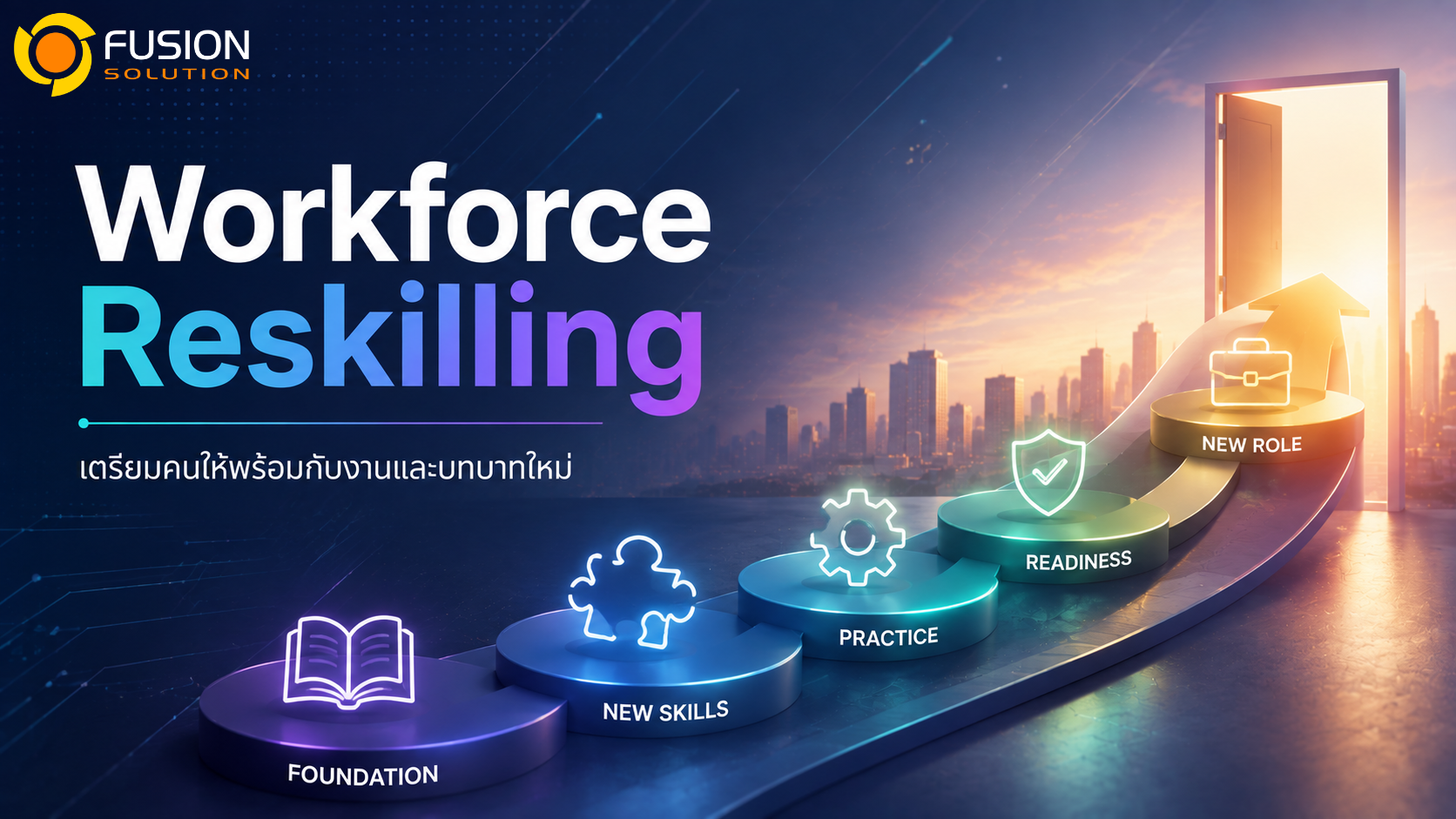
Many organizations continuously invest in learning and training; yet, when the business requires new skills, they still resort to external hiring because they lack confidence in their existing employees' readiness to transition to new roles.
The issue may not be a lack of desire for development among employees; rather, it could stem from a program that fails to link with target roles, transferable skills, practice opportunities, and internal career prospects.
The crucial question, therefore, is not merely whether employees have finished their training, but whether they are applying those skills to their new tasks—and whether the organization has paved the way for them to step into those roles.
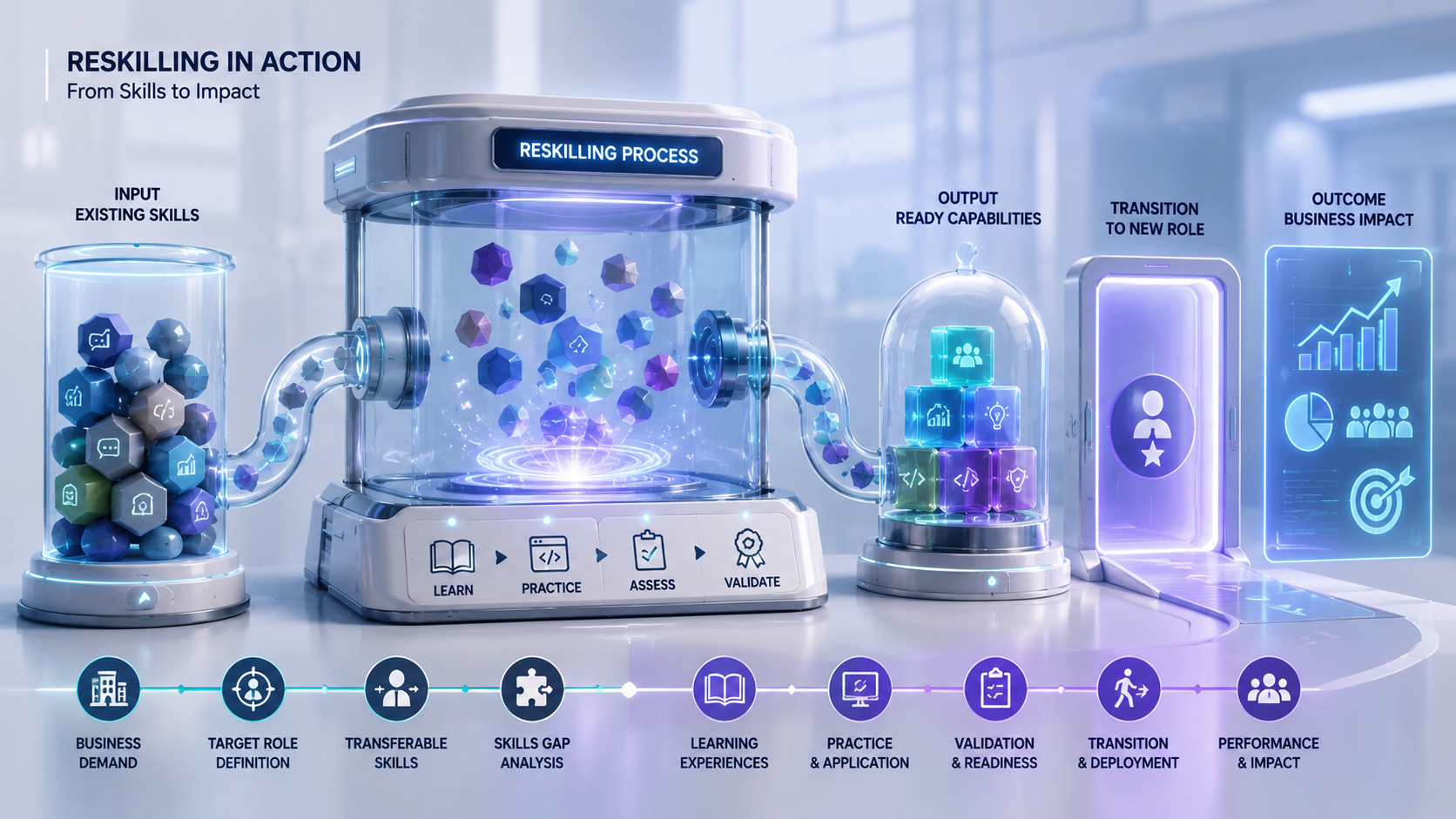
Business Change ↓ Target Capabilities ↓ Reskilling Path ↓ Real Work Practice ↓ Readiness ↓ Role Transition ↓ Business Outcome
When extensive training still fails to prepare the workforce
Learning is a crucial component, yet course completion alone does not guarantee an employee's ability to perform a new role. Organizations must comprehensively define the target role, identify skill gaps, and establish mechanisms for practice, feedback, readiness criteria, and future opportunities.
- I’ve finished my studies but don’t know how to apply what I’ve learned to a job.
- The manager does not allocate time for professional development.
- The learning path is the same for everyone.
- There are no projects or assignments for practice.
- The Business Unit has not prepared a role to support this.
- Measure only the completion rate.
- Program graduates do not yet have an internal opportunity.
What is workforce reskilling?
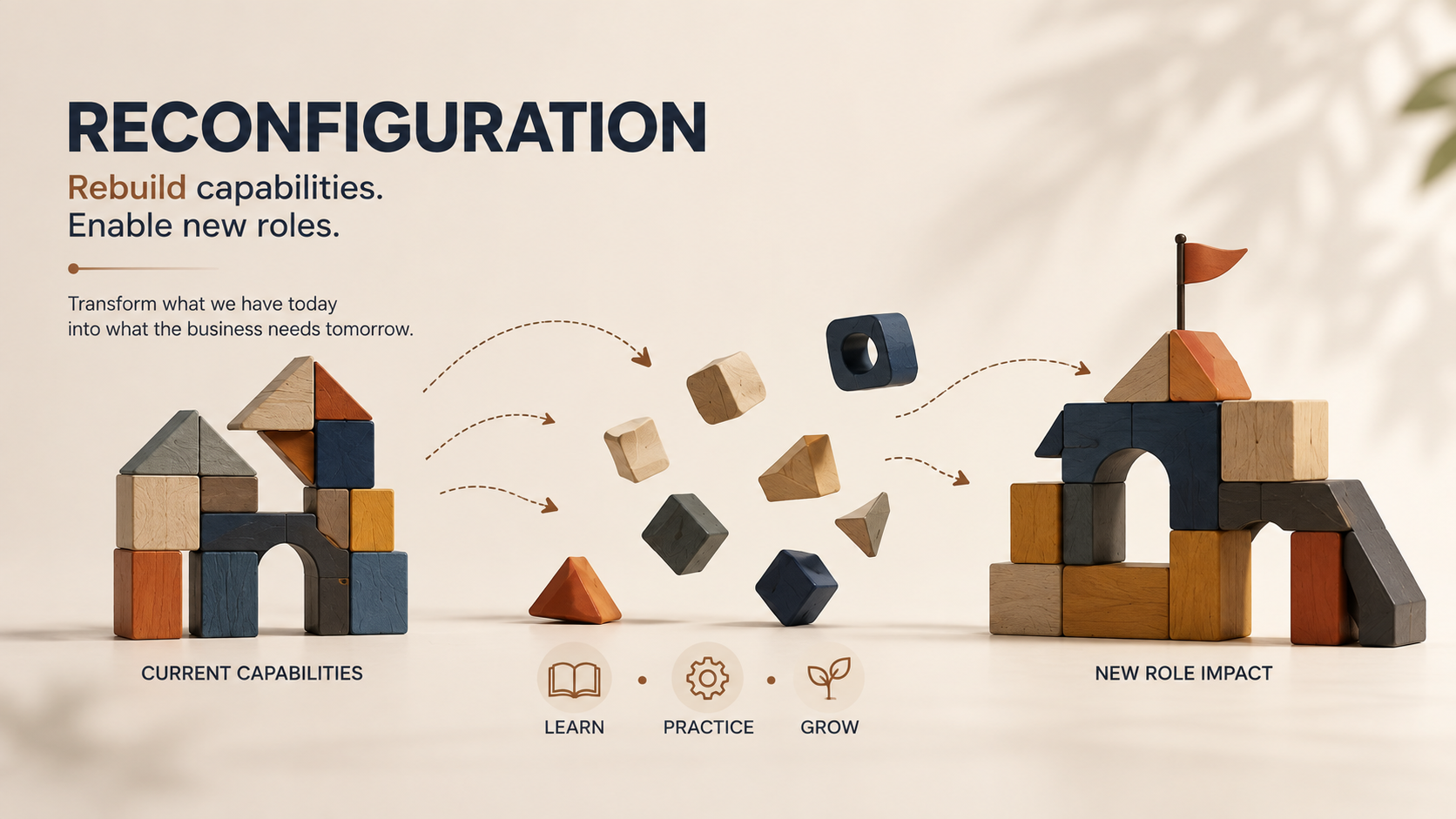
Workforce reskilling is the process of developing employees to acquire the skills and capabilities needed for new jobs, roles, or ways of working—changes often driven by technology, AI, business models, operating models, or job redesign.
The goal is not merely to accumulate courses, but to enable the performance of new tasks, facilitate role transitions, drive productivity, and help bridge the workforce gap.
How does it differ from upskilling?
Upskilling | Reskilling |
Deepen your skills in your current role. | Builds capability for a different job or role |
Supports growth in the existing career path | May move into another job family or function |
Prepares for greater responsibility | Prepares for new work or a new operating model |
Extends current expertise | Uses transferable skills to build a new capability set |
Example: A data analyst learns advanced analytics | Example: An HR operations employee moves into HR analytics |
Key Elements of Effective Reskilling
- Business Demand
Key Elements of Effective Reskilling
- Target Roles
Define a role, project, assignment, or redesigned job as the destination.
- Transferable Skills
Identify existing strengths that can apply in the new context.
- Skills Gap
แยก Missing Knowledge, Technical, Business และ Behavioral Skills
- Personalized Learning Path
Integrates Foundation, Role-Based Learning, Mentoring, Simulation, and Coaching.
- Practice through Real Work
Utilize stretch assignments, job shadowing, internal gigs, or real-world projects.
- Assessment and Validation
Use work samples, project outcomes, certifications, or manager reviews.
- Role or Project Transition
Connect program graduates with internal roles or projects that utilize their new skills.
- Manager Support
Schedule time for feedback, opportunities, handovers, and backfilling.
- Outcome Measurement
Measure Skills, Transition, Productivity, Retention, and Business Value.
Transferable Skills สำคัญอย่างไร?
Employees do not need to start from scratch; skills such as problem-solving, customer understanding, process knowledge, communication, stakeholder management, and domain expertise can be leveraged for new roles.
Current Capabilities + Transferable Skills + Missing Skills = Reskilling Path
Starting from strengths helps reduce development time, boosts confidence, opens up career paths, and preserves organizational knowledge.
How to Design a Reskilling Journey
- Current Role and Skills Baseline
Understanding the role, experience, skills, and career interests. - Target Role
Define responsibilities, capabilities, and expected outcomes. - Transferable Skills and Gaps
Distinguish between what already exists and what needs to be developed. - Learning and Practice
Combine formal learning with projects, practice, and coaching. - Readiness Validation
Use evidence relevant to the work; do not rely solely on completion. - Transition
Prepare the role, manager, team, workload, and support. - Business Outcome
Measure capacity, skills coverage, productivity, and delivery.
Technology ช่วยสนับสนุนอย่างไร?
- Skills Profiles และ Skills Intelligence
- Skills Gap Analysis
- Personalized Learning Recommendations
- Learning Paths และ Assessments
- Talent Marketplace
- Internal Opportunity Matching
- Internal Mobility Workflow
- Progress Tracking
- Workforce Analytics
- Strategic Workforce Planning
Technology enhances visibility and coordination, but it cannot—on its own—define target roles, schedule learning sessions, or ensure managerial support for mobility.
Why do reskilling programs often fail?
No destination role
The employee does not know which task the program leads to.
Focuses on training but lacks practice.
Possesses knowledge but lacks evidence from actual work experience.
The manager does not support it.
Employees do not have time to learn or transition to the new program.
The learning path is the same for everyone.
Regardless of current and transferable skills
Not linked to internal mobility.
No transition route supported.
Opportunity lacks transparency.
Employees do not see the role or project requiring the capability.
The business unit does not accept talent after the program.
Lack of confidence in readiness criteria
Measured solely by completion
I don't know who is ready to take on the new job.
Employees do not see the career value.
The program is not linked to Opportunity or Recognition.
How to Get Started with Workforce Reskilling
- Select Business Priority
- Identify the roles that are changing.
- Define target roles
- Analysis of Transferable Skills
- Create a Learning and Practice Path
- Link to a project or internal role.
- Define Readiness Criteria
- Prepare Managers and Transition Support
- Measures both skills and job outcomes.
How should results be measured?
Dimension | Example Metrics |
Participation | Enrollment, Active Participation |
Learning | Completion, Practice, Assessment |
Skills | Skills Gained, Validation, Gap Closure |
Transition | Role Movement, Project Placement |
Speed | Time to Readiness, Time to Productivity |
Retention | Retention after Transition |
Business Value | Reduced Hiring Dependency, Critical Skills Coverage |
Effective reskilling must pave the way to real jobs.
If employees invest time in learning but lack the specific roles, projects, or opportunities to apply those skills, their confidence in the program will diminish. Therefore, organizations should establish target roles, transparent criteria, job-related assessments, managerial support, and transition plans, while ensuring that communications do not make unrealistic promises.
Summary
Workforce reskilling begins with business demand and target roles, subsequently linking transferable skills, skill gaps, learning, practice, readiness, and the transition process. The ultimate goal is not merely completing a course, but successfully performing the new role and delivering business outcomes.