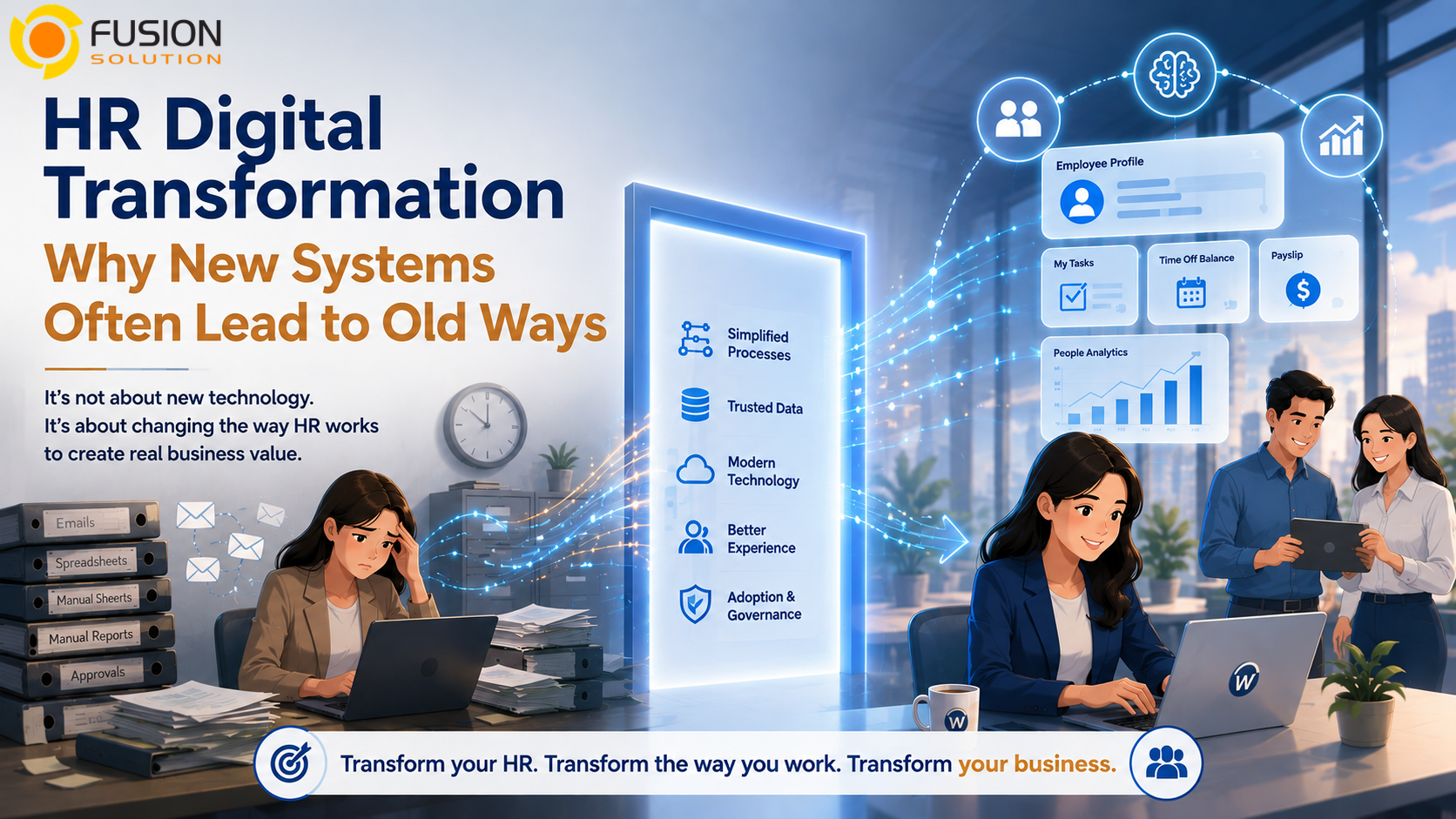
Many organizations invest in new HR systems with the expectation that work will be faster, easier, and allow HR to work more strategically. The new system may replace paper documents, spreadsheets, separate databases, or older Employee Portals.
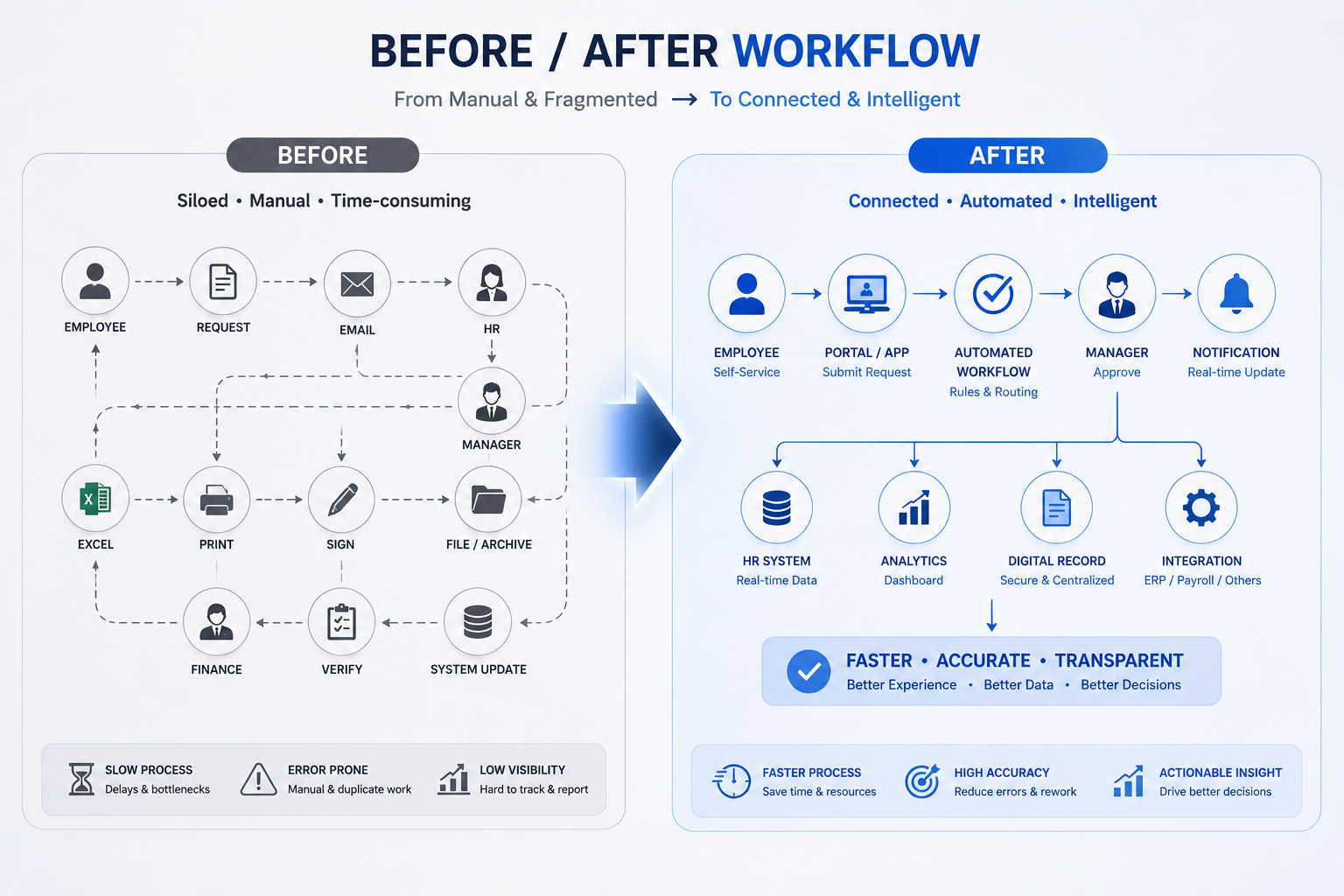
However, after going live, some organizations found that employees were still emailing HR to ask basic information, managers were still requesting manual reports, and the HR team was still exporting data to edit or merge into Excel. The multi-step approval process remained the same. The technology has changed, but the way of working hasn't.
This problem arises when organizations migrate entire old processes to a new system without reviewing whether those steps are still necessary, effective, or aligned with the desired experience they are creating.
The key question, therefore, is not just which system an organization should buy, but how HR processes, data, services, roles, and decisions should change to better support employees and business goals.
Business and Workforce Goals ↓ Process Redesign ↓ Connected Data ↓ Digital HR Platform ↓ New Ways of Working ↓ Adoption and Governance ↓ Measurable Business Value
When changing the system doesn't change the way we work.
System transformation is a crucial part of a business transformation, but the system alone doesn't guarantee results. If the workflow has unnecessary approval steps, configuring every step on a new platform is simply creating the same problems in a digital format.
HR Digital Transformation is the redesign of processes, data, technology, employee experience, and ways of working to enable HR to support people and business goals more effectively.
- Simplify your HR processes.
- Create reliable employee data.
- Integrate HR and Finance data.
- Add Employee and Manager Self-Service.
- Improve HR Service Delivery
- Use Analytics to support decision-making.
- Defining roles in the HR Operating Model.
- Prepare users for a new way of working.
- Create governance for continuous improvement.
The goal is not just to move jobs online, but to reduce complexity, increase accessibility, create a better experience, and free up HR time for Workforce Strategy, Talent, Organization Capability, and Business Advisory.
How is it different from HR Digitization?
HR Digitization | HR Digital Transformation |
Convert manual documents into digital format. | Design new processes, services, data, and workflows. |
Reduce paper | Reduce steps and friction. |
Often, only the tools are considered. | Connecting Process, Data, People, Experience, and Technology. |
Perform the same work through a new channel | Change the way services are delivered and decisions are made. |
Check if the system is working | Measure Adoption, Experience, Efficiency, and Business Value. |
It might affect only one process. | It might change the entire HR Operating Model. |
For example, converting a paper-based leave request form to an online form is digitization. Transformation, on the other hand, asks whether the requested information is necessary, whether employees can see their remaining balance, whether the workflow can be routed automatically, and whether employees can track their status without asking HR.
Why is HR Digital Transformation important?
The HR process affects almost every employee and manager. If the process is slow, information is scattered, or services are difficult to understand, the impact doesn't stop with the HR team.
- Reduce manual and repetitive tasks.
- Improve data consistency.
- Make HR information more accessible.
- Add Employee and Manager Self-Service.
- Reduce HR Service and Approval time.
- Enhance Reporting and Analytics.
- Connecting Talent Decisions with Business Priorities
- Establish cross-departmental process standards.
- Building a foundation for AI and Automation.
- Increase HR capacity for strategic tasks.
Value, therefore, is not solely based on operational efficiency, but also involves employee experience, manager decision-making, and the workforce's ability to respond to business changes.
Key elements of the transition.
- Business and Workforce Strategy
Start with your desired business outcome, such as Growth, Employee Experience, Self-Service, Trusted Data, Workforce Planning, or AI Readiness.
- Process Redesign
Review which steps are still necessary, which approvals create value, which tasks are repetitive, and which should be standardized or automated.
- Connected and Trusted Data
Clearly define Data Owner, Definition, Quality Rule, Integration, Security, and Reporting Governance.
- Digital HR Platform
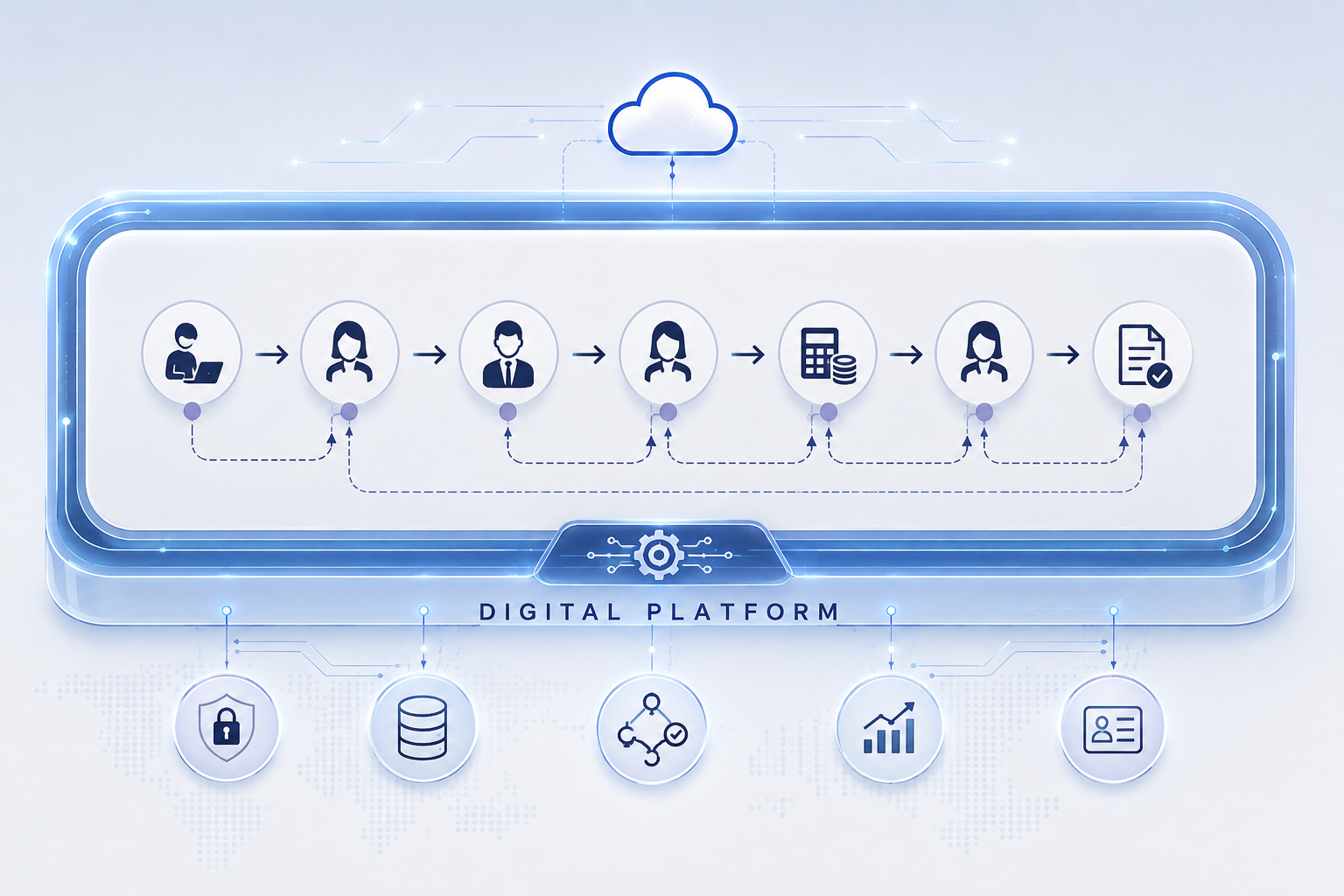
Connect Core HCM, Recruiting, Onboarding, Performance, Learning, Skills, Talent, Compensation, Service, Analytics, and Planning as appropriate.
- HR Operating Model
Define the roles of HR Operations, Shared Services, HR Business Partners, Centers of Excellence, People Analytics, HR Technology, Managers, and Employees.
- Employee and Manager Experience
Designed to provide users with clear guidance, fewer steps, relevant information, transparent status, and access to human support when needed.
- Change, Adoption, and Governance
Prepare Sponsorship, Communication, Role-Based Training, Manager Readiness, Support, Adoption Monitoring, Process Ownership and Release Management.
Focusing on only one element can limit the value of the entire project. For example, a good platform cannot compensate for low data quality or complex processes without an owner.
How is technology changing the role of HR?
Digital transformation reduces the time HR spends migrating data between systems, answering repetitive questions, or preparing routine reports, freeing up time for higher-value tasks.
- Workforce Planning
- Organizational Design
- Talent Strategy
- Skills Development
- Manager Advisory
- Employee Experience
- Change Management
- People Analytics
- HR Governance
Digital transformation reduces the time HR spends migrating data between systems, answering repetitive questions, or preparing routine reports, freeing up time for higher-value tasks.
Why do transformations often fail to produce the expected results?
Start with Technology instead of Business Problem.
The project became a feature item without clearly indicating what business value it would create.
Merge the existing process to the new system.
The complex workflow remains; only the channel has been changed.
Fixing Data Quality is too slow.
Migration cannot resolve duplicate, missing data, and definition issues.
Think about integration later.
Disconnected systems create duplicate work, delayed data, and inconsistent reports.
Lack of Executive Sponsorship
Changes to Policy, Roles, and Decision Rights are postponed or avoided.
Start Change Management nearing Go-Live.
Users don't have time to understand the new responsibilities and how things work.
Training involves simply pressing a button.
The user can perform the transaction, but doesn't understand why the process has changed.
Measure success based on Go-Live.
Enabling the system does not prove an Adoption or Business Outcome.
How to Start HR Digital Transformatio?
- ระบุBusiness Problem และ Transformation Goals
กำหนดสิ่งที่ต้องปรับปรุงและเหตุผล เช่น ข้อมูลกระจัดกระจาย Service ช้า หรือ Manager Self-Service ต่ำ
- ประเมินCurrent Process, Data และ Technology
สำรวจ Workflow, Manual Steps, Pain Points, Data Issues, Integration Gaps และ Reporting Limitations
- ออกแบบTarget Employee and Manager Experience
กำหนดสิ่งที่ผู้ใช้ควรทำได้ ระดับความพยายาม และจุดที่ยังต้องมี Human Support
- ปรับProcess ก่อน Config ระบบ
ลด Approval, Duplicate Entry, Handoff และข้อยกเว้นที่ไม่สร้างคุณค่า
- กำหนดData Ownership และ Integration
ระบุ Source, Owner, Quality Standard, Security และ Access Rights
- วางChange, Communication และ Training
แบ่งกลุ่มผู้ใช้ตาม Role และ Impact พร้อมเตรียม Support และ Adoption Metrics
- เริ่มจากScope ที่สร้าง Value ชัดเจน
ใช้ Phased Approach เพื่อแสดงผลลัพธ์ เรียนรู้จากผู้ใช้ และลดความเสี่ยง
- วัดAdoption และ Business Outcomes
ตรวจทั้งการใช้งานจริงและผลลัพธ์ ไม่ใช่จำนวน Account หรือ Transaction เท่านั้น
- ปรับปรุงต่อเนื่องหลังGo-Live
ใช้ Feedback, Service Issues, Data และ Platform Updates เพื่อพัฒนากระบวนการต่อเนื่อง
How should results be measured?
Dimension | Example Metrics |
Efficiency | Cycle Time, Manual Steps, HR Case Volume |
Adoption | Self-Service Usage, Manager Adoption, Active Users |
Data | Data Quality, Duplicate Records, Reporting Time |
Experience | Employee Effort, Service Satisfaction, Resolution Time |
Business Value | HR Capacity, Workforce Insight, Cost, Talent Outcomes |
องค์กรอาจ Go-Live ได้ตามแผนแต่ยังสร้างคุณค่าได้น้อย หาก Adoption ต่ำหรือผู้ใช้ยังกลับไปใช้ Email และ Spreadsheet วัดผลจึงต้องครอบคลุมทั้ง Technology, Behavior, Process และ Outcome
Going live is the beginning, not the end.
Go-Live is the day the system starts being used, but Transformation happens when behavior, processes, and decisions actually change.
After system launch, organizations should monitor User Adoption, Process Cycle Time, HR Case Volume, Data Quality, User Feedback, Manager Behavior, Integration Performance, and Business Priorities, along with governance for prioritizing changes, testing improvements, and managing releases.
Without continuous improvement, the platform could become complex again due to exceptions, local workarounds, and additional requests. Therefore, organizations must maintain the principles of transformation while allowing solutions to evolve as the business progresses.
Summary
HR Digital Transformation คือการออกแบบ Process, Data, Technology, Employee Experience และ Ways of Working ใหม่ เพื่อให้ HR สนับสนุนคนและเป้าหมายธุรกิจได้ดีขึ้น แนวคิดนี้กว้างกว่าการ Digitize เอกสารหรือเปลี่ยน Platform เทคโนโลยีเป็น Foundation สำคัญ แต่ Transformation ต้องมี Process Simplification, Trusted Data, Clear Operating Roles, Change Leadership, Adoption และ Governance ร่วมกัน องค์กรจึงควรถามไม่เพียงว่า Implementation เสร็จตามแผนหรือไม่ แต่ต้องถามว่าวิธีทำงานเปลี่ยนและสร้างคุณค่าที่วัดได้จริงหรือไม่