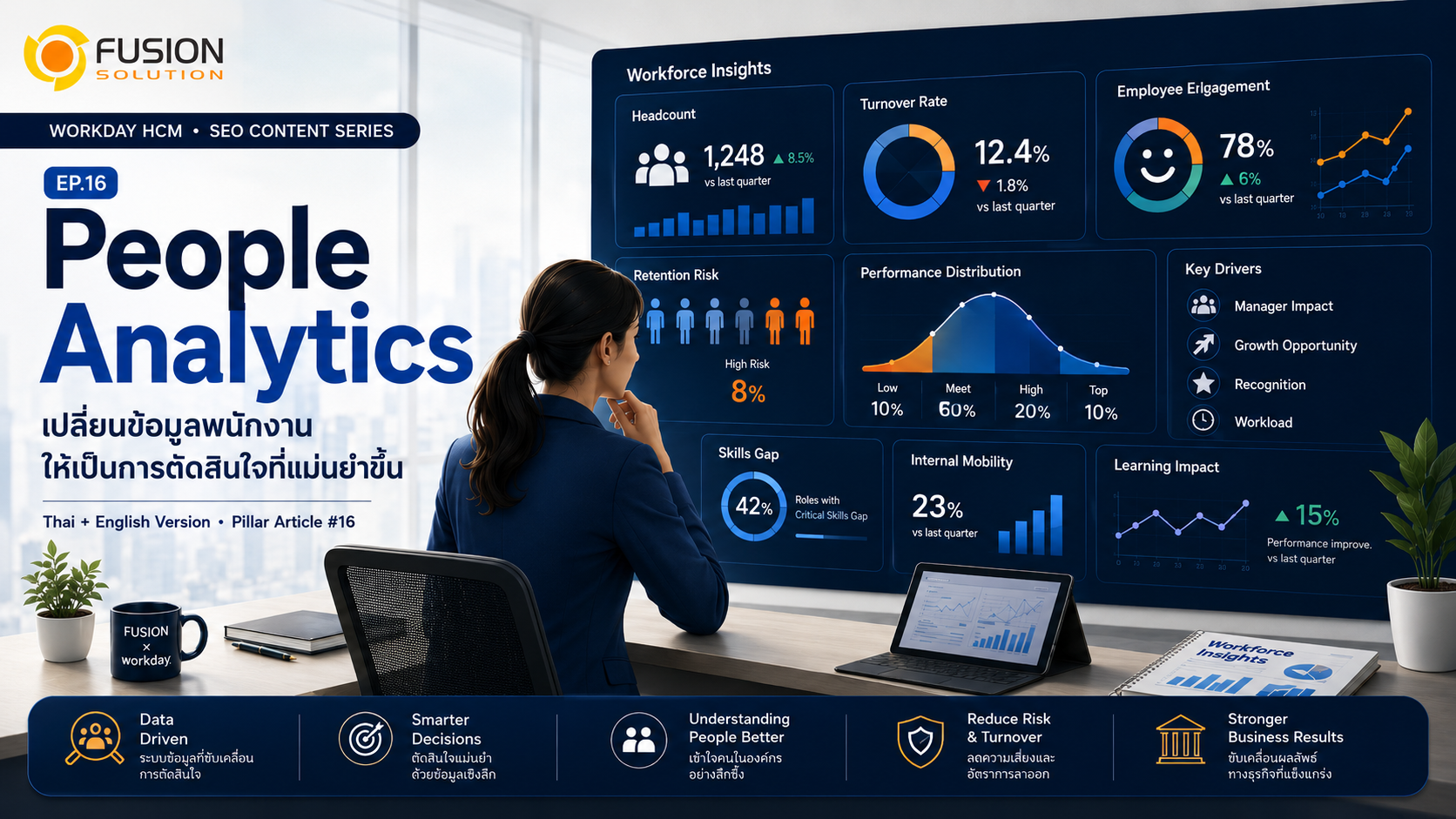
Many organizations have more HR data than ever before, including headcount, turnover, retention, engagement, performance, learning, skills, absence, compensation, and internal mobility.
But having a lot of data doesn't always mean an organization will make better decisions.
Often, HR departments have numerous reports, multi-page dashboards, and regular data for management to review, but they still fail to answer crucial business questions. These include: Why do talented individuals leave? Which teams are at high risk? Or are the invested learning programs actually improving performance?
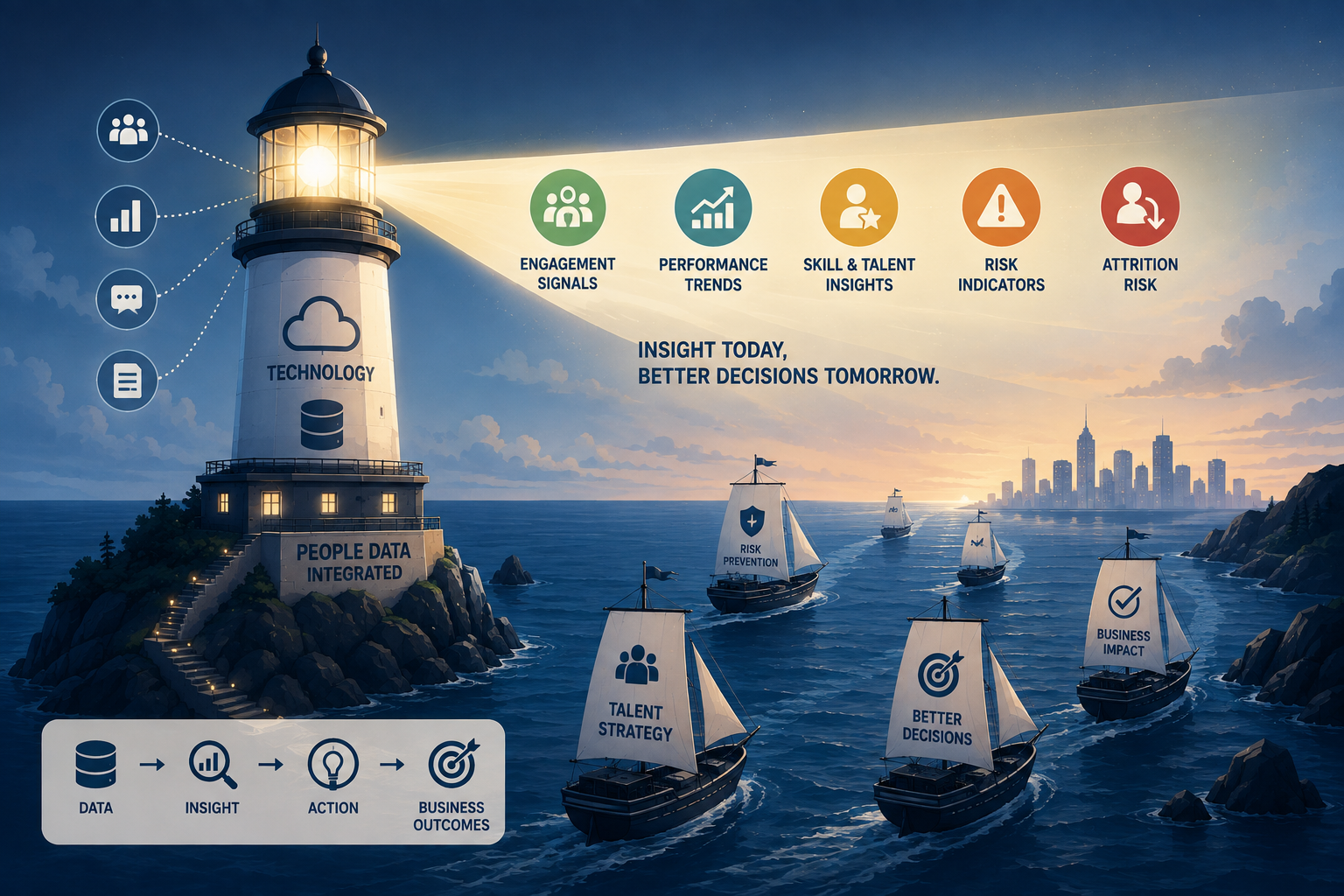
This is where employee data analysis becomes a crucial tool for modern HR. The goal isn't to create more reports, but to transform existing data into insights that help organizations make more accurate human resource decisions.
Data ↓ Insight ↓ Decision ↓ Action
When employee data becomes a business tool.
Every organization already has data about its workforce, including information on employment, turnover, development, and performance.
The challenge isn't having too little information, but understanding what that information is telling us and how to use it to make decisions.
The concept of transforming employee data into insights is called People Analytics. This approach uses data to analyze trends, problems, risks, and opportunities in people management to support HR and business decision-making.
- Employee information
- Recruitment information.
- Resignation information.
- Engagement data
- Performance data
- Learning information
- Skills information
- Compensation Data
- Absence data
- Internal Mobility Data
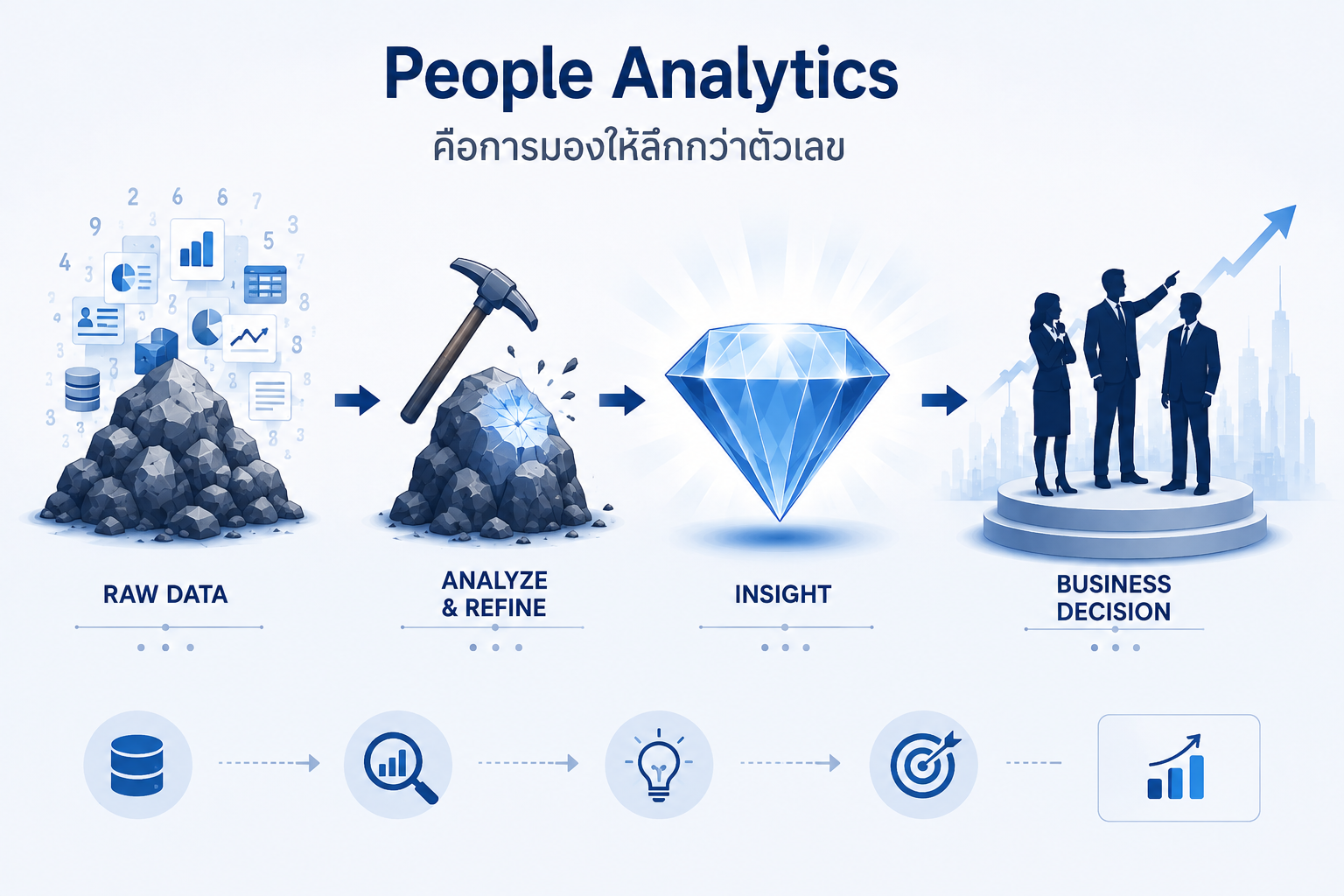
The key is not to gather as much information as possible, but to ask the right questions and then use that information to find answers that lead to real decision-making.
- Why do some employee groups resign more than others?
- In which team has low engagement?
- Does the manager have an impact on retention?
- Which type of learning path helps improve performance?
- Does internal mobility help reduce turnover?
- Which skills are impacting productivity?
- Is Workforce ready for next year's business plan?
How is it different from HR Reporting?
HR Reporting | People Analytics |
Report what happened | Analyze why it happened |
Focus on past figures | emphasize Insight และแนวโน้ม |
Use to view status | Use to aid in decision making |
Mention artistic direction: Headcount Report | Mention artistic direction: Attrition Driver Analysis |
Report for awareness | Analysis leads to action |
The report may show an increase in turnover compared to the previous month, but a deeper analysis will help answer questions such as which groups experienced an increase, what factors might be involved, and what actions the organization should take going forward.
Reporting helps to show what happened, while analysis helps to understand the causes and courses of action.
Why is analyzing people data important?
People-related decisions directly impact businesses, including hiring, skills development, talent retention, workforce planning, and investment in employee experience. If decisions are based solely on feelings, organizations may miss crucial signals hidden within the data.
- Reduce decision-making based on feelings.
- To see trends and risks more quickly.
- Gain a deeper understanding of the workforce.
- Connect HR Metrics with Business Outcomes
- Plans Talent Strategy has become more accurate.
- Support management's decision-making.
- Elevate the role of HR to become a Strategic Business Partner.
What types of data should be analyzed??
Headcount and Workforce Composition
This helps to visualize the number of employees, team structure, departments, locations, and workforce composition.
Attrition and Retention
Help analyze which employee groups are turning over more, and what factors might be related to this turnover.
Employee Engagement
Please help examine the relationship between engagement and retention, productivity, and performance.
Performance
Help analyze the performance trends of employees, teams, or departments.
Learning Effectiveness
Help assess whether the learning program you've invested in is actually helping to develop skills or improve work performance.
Skills and Skills Gap
It helps organizations visualize existing skills, skills that are lacking, and skills that need to be developed.
Internal Mobility
Analyze how internal job transfers can improve employee retention or skill development.
Hiring and Talent Acquisition
Please help track Time to Fill, Offer Acceptance, Source Quality, and Candidate Pipeline.
How many levels of people are there in data analysis?
1. Descriptive Analytics
Answer the question, "What happened?" Mention artistic direction: Turnover increased or Headcount decreased.
2. Diagnostic Analytics
Answer the question, "Why is this happening?" Mention artistic direction: Increased turnover due to lack of career growth or decreased engagement in some teams.
3. Predictive Analytics
Answer the question, "What might happen next?" Mention artistic direction: Which group of employees might have a higher risk of resigning?
4. Prescriptive Analytics
Answer the question, "What should we do next?" Mention artistic direction: How should we design the Retention Plan, Learning Program, or Manager Coaching?
Organizations don't need to start with predictive analytics immediately, but should begin with quality data, clear questions, and the ability to deliver actionable insights.
How can technology help?
When employee data is voluminous and comes from multiple systems, analyzing it solely with spreadsheets may be insufficient. Modern HR technology supports this through the following capabilities:
- Workforce Dashboards
- Automated Insights
- AI-Generated Narratives
- KPI Monitoring
- Attrition Insights
- Talent and Performance Insights
- Skills Insights
- Engagement Dashboards
- Data Security and Governance
Technology shouldn't just be a tool for creating graphs; it should help HR and management understand what the data is telling them and how to proceed.
How to get started in an organization?
1. Starting from Business Question
Start with the questions that need answers. Mention artistic direction: Why do talented people leave? Or does engagement affect retention?
2. Choose the relevant metrics.
Select only the indicators that help answer the question; it's not necessary to use every number.
3. Check data quality
The information must be accurate, up-to-date, and have a shared definition.
4. Linking data from multiple sources.
The data may come from Core HCM, Learning, Performance, Engagement, Compensation, and Recruiting.
5. Analyze Pattern and Trend
Look for relationships, trends, and employee groups that deserve attention.
6. Translate Insight is Action
Use the results to design a Retention Plan, Learning Strategy, Manager Development or Talent Action
7. Evaluate the results after implementation
Check whether the actions taken helped to achieve the desired results.
Good analytics isn't just about having a pretty dashboard.
A good dashboard should help organizations answer questions about workforce risks, identifying problem areas, prioritizing issues, and determining whether actions taken are producing results. True value, therefore, lies in connecting data, insights, decisions, and actions.
Precautions to take when using employee data
- Data Privacy
- Data Security
- Data Quality
- Fairness
- Transparency
- Ethical Use of Employee Data
- Human Oversight
People data should be used to improve responsible decision-making and work experiences, not to monitor or judge employees out of context.
Summary
People Analytics is the use of employee data to analyze trends, risks, and opportunities in human resource management, in order to support HR and business decision-making.
The key isn't having a plethora of reports, but transforming data into insights that lead to informed decision-making and action. When organizations connect data from Engagement, Performance, Learning, Skills, Retention, and Workforce Planning, HR becomes more strategically capable.