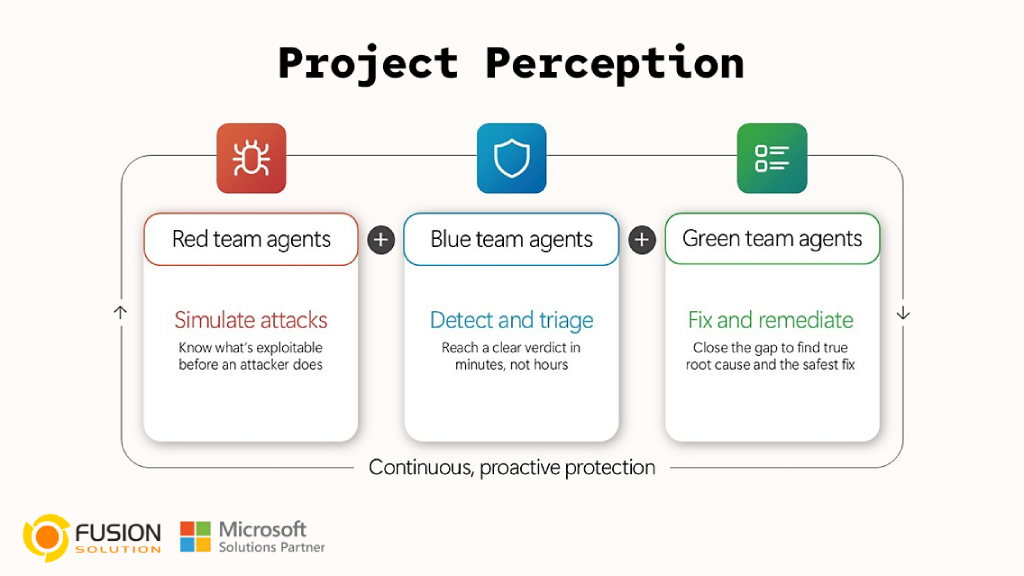
Today's cyber threats are becoming increasingly sophisticated, making traditional security tools insufficient for protecting modern organizations. Security teams must analyze massive amounts of alerts, investigate complex attack patterns, and respond to incidents faster than ever before. Simultaneously, the widespread use of cloud services, AI applications, and numerous connected devices has significantly expanded the attack surface.
Project Perception "...is one of Microsoft's AI-driven security projects, developed to enhance the capabilities of cybersecurity professionals in detecting, analyzing, and responding to emerging threats. By integrating artificial intelligence with Microsoft's Security Intelligence, it helps security teams understand complex environments, prioritize risks, and improve operational efficiency. Rather than replacing experts, the AI serves as an intelligent assistant that supports faster and more accurate decision-making."
What is Project Perception?
Project Perception is Microsoft's AI-powered cybersecurity project focused on improving threat intelligence through in-depth analysis and contextual interpretation of security data.
Instead of simply generating alerts, the system empowers security teams to interpret vast amounts of data, identify meaningful patterns, and discover risks that should be investigated first.
Modern cyberattacks typically involve multiple steps, such as:
- Reconnaissance (Target Survey)
- Credential Compromise (Credit Identity Theft)
- Lateral Movement (Movement within the system)
- Data Exfiltration (Theft of data from an organization)
Analyzing these events solely by humans can be time-consuming and complex. AI therefore helps connect related events, providing analysts with a clearer overall picture of the attack.
The main goal is to reduce investigation time while enabling defense teams to make more effective security decisions.
Why AI is transforming cybersecurity.
Today's organizations process millions of security events every day, and this data comes from...
- Endpoints
- Identity Systems
- Cloud Services
- Applications
- Networks
- User Activities
The security team therefore faces several challenges, such as:
- Numerous security alerts
- Limited time for the investigation.
- Shortage of cybersecurity personnel.
- More complex attack patterns
- Attack techniques that are constantly changing.
AI can help solve these problems by rapidly processing vast amounts of security data, identifying key patterns, and identifying events that should be investigated first.
Instead of replacing security teams, AI will act as a force multiplier, enabling analysts to work more efficiently.
How does AI improve threat analysis?
One of the key strengths of AI is its ability to connect seemingly unrelated events.
Instead of having to manually check thousands of notifications, AI can...
- Linking activities from multiple systems together.
- Identify suspicious patterns of behavior.
- Detect unusual user activity.
- Find possible attack routes
- Suggest areas for further investigation.
Contextual analysis helps reduce alert fatigue and allows analysts to focus on high-priority threats.
The core capabilities of Project Perception.
Intelligent Threat Correlation
Most cyberattacks are not the result of a single event; instead, attackers typically use multiple techniques in combination to achieve their goals.
AI helps to link security data from multiple sources, making it easier to understand the relationships between various events.
Faster investigation of security incidents.
Traditional investigations often require gathering information from multiple tools.
AI helps gather relevant evidence, organize data, and present crucial insights, enabling analysts to understand events more quickly.
Risk prioritization
Not all alerts pose a significant threat.
AI will assess the context of each event and help identify the risks that could have the greatest impact on the business, enabling organizations to allocate resources appropriately.
Increase efficiency in work
When AI helps with repetitive analytical tasks, security experts can spend more time on high-value tasks, such as:
- Threat Hunting
- Incident Response
- Improving safety measures
This results in more efficient and flexible cybersecurity operations.
Benefits for Businesses
Organizations that use AI in security can benefit in several ways, including:
- Provides a better overview of the system.
AI helps increase visibility into data from Identity, Endpoints, Cloud Resources, Applications, and the entire infrastructure. - Responding quickly to threats.
Reducing investigation times allows organizations to respond to threats before they escalate into serious incidents. - Make more accurate decisions.
Contextual information helps security teams make more effective decisions. - Enhance Security Posture
Continuous analysis helps organizations discover weaknesses and regularly improve their cybersecurity strategies. - Increase work efficiency
When repetitive tasks are reduced, the security team can focus more on strategic work.
AI enhances capabilities, not replaces experts.
Many people mistakenly believe that AI can handle all aspects of cybersecurity.
In reality, effective security still relies on human expertise.
Experts still have an important role to play in...
- Validate security findings
- Assess the impact on the business
- Make decisions in response to events.
- Make a plan to solve the problem.
- Develop a long-term security strategy.
AI helps increase the speed, analytical capabilities, and capacity to handle massive amounts of data, while humans still rely on judgment, experience, and understanding of the organizational context to make decisions.
Collaboration between AI and humans is therefore the approach that yields the best security results.
Applications in organizations.
Although Microsoft's AI research continues to evolve, technologies like Project Perception demonstrate that AI can support a variety of aspects of enterprise security, such as:
- Security Operations Center (SOC)
- Threat Hunting
- Cloud Security Monitoring
- Identity Protection
- Vulnerability Management
- Incident Response
- Security Analytics
As organizations expand their digital systems, AI analytics will become a key component of future cybersecurity operations.
Best Practices for Organizations
Organizations seeking to enhance their cybersecurity should consider the following approaches.
- Use AI in conjunction with security experts.
- Combine security information from both cloud and on-premises.
- Prioritize events based on their impact on the business.
- Continuously monitor and investigate security incidents.
- Invest in cybersecurity awareness training for your employees.
- Use a proactive security approach instead of just responding after an incident.
These approaches help organizations maximize the benefits of AI while maintaining appropriate governance and control.
The Future of AI-Powered Cybersecurity
Artificial intelligence is transforming the approach to cybersecurity, shifting from reactive defense to proactive protection.
As AI models become more capable of understanding complex attack patterns, future security platforms will be able to help analysts detect threats, predict risks, and intelligently recommend appropriate responses.
Microsoft's continued investment in AI reflects its vision to empower security professionals with intelligent tools that support—not replace—human work.
Summary
Today's cyber threats are becoming more sophisticated, requiring security teams to analyze vast amounts of data, respond quickly, and make more accurate decisions than ever before.
Project Perception This is Microsoft's approach to leveraging AI to enhance cybersecurity through intelligent threat analysis, understanding event context, and optimizing operations. It empowers experts to interpret complex security data, prioritize risks, and strengthen organizational resilience, while maintaining human oversight and decision-making at every step.
As businesses continue their digital transformation, projects such as... Project Perception This demonstrates that AI can be a key partner in building intelligent, effective, and future-ready cybersecurity strategies.