
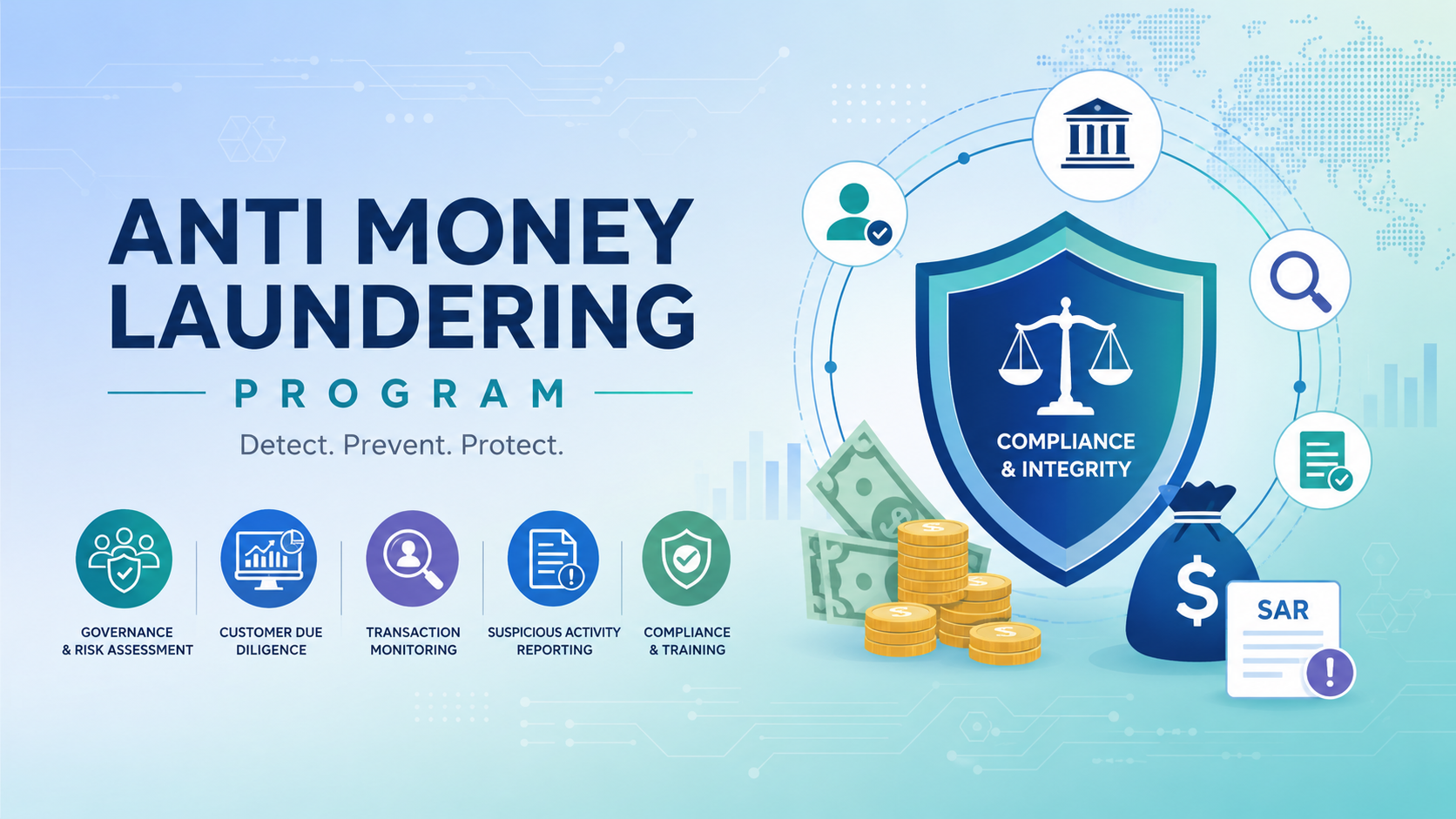
Financial crime has become increasingly sophisticated in a world driven by digital payments, online banking, international trade, and real-time transactions. Criminal groups can transfer money across borders in seconds, making it more difficult for regulators and financial institutions to detect illegal financial transactions. As a result, Anti Money Laundering (AML) Therefore, the prevention and suppression of money laundering has become one of the key approaches to regulatory and risk management in the modern financial sector.
Anti-Money Laundering (AML) is a set of laws, regulations, policies, and procedures designed to prevent criminals from disguising illegally obtained funds as legitimate assets. Beyond regulatory compliance, AML helps build trust in the financial system, protects businesses from financial crime, and prevents criminal networks from benefiting from activities such as fraud, corruption, drug trafficking, cybercrime, and terrorism financing.
What is Anti-Money Laundering?
Basically Anti Money Laundering Refers to the framework used to Detect, monitor, investigate, and report suspicious financial transactions. Money laundering occurs when criminals attempt to make illegally obtained money appear legitimate by moving it through financial institutions, businesses, investments, or complex transaction networks.
AML (Anti-Money Laundering) programs are designed to stop such processes before illicit money is legally introduced into the economy. Organizations can do this through customer verification, transaction analysis, risk assessment, and continuous monitoring of financial activity.
While AML is often associated with banks, its importance extends beyond traditional financial institutions. Insurance companies, payment providers, digital banking platforms, gaming businesses, investment firms, and Fintech organizations all need to prioritize AML measures as these entities could be used as channels for money laundering or other financial crimes.
Why is anti-money laundering important?
Money laundering is not just a financial crime; it's also a mechanism that allows other forms of crime to continue. When illicit money can flow freely through the financial system, criminal groups can use it to expand their activities and evade detection.
Effective Anti-Corruption (AML) programs enable governments, financial institutions, and businesses to detect suspicious activity before serious damage occurs. They also play a crucial role in maintaining social security, preserving market stability, and building confidence in financial institutions.
For organizations, AML compliance is equally important to the business. The lack of proper controls can lead to regulatory penalties, reputational damage, operational disruption, and loss of customer trust. As global financial regulations become stricter, AML is no longer just a compliance matter but has become a crucial part of enterprise risk management.
Three steps of money laundering.
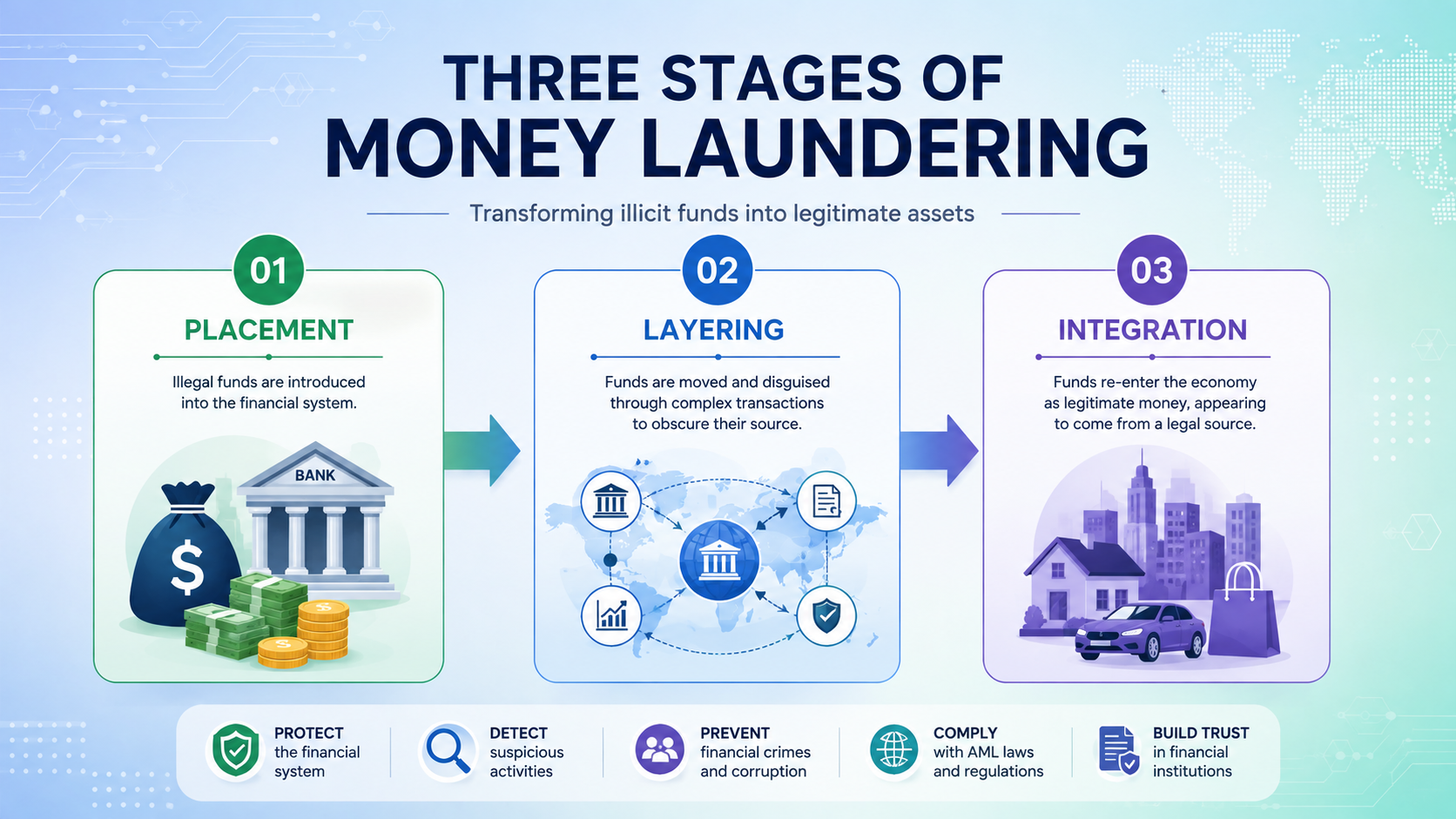
Money laundering is typically described through three main steps:
- Placement – Bringing funds into the system.
Placement refers to bringing illegally obtained money into the financial system.
For example, criminals might deposit the money into accounts, use it to buy assets, or channel the money through various businesses.
- Layering – Hiding the money trail.
Layering is the creation of multiple transaction steps to make it more difficult to trace the source of funds.
Criminals may transfer money between accounts, companies, payment service providers, or different countries in an attempt to conceal the true source of the money.
- Integration – bringing the money back into use as if it were legal tender.
Integration occurs when money is used in a way that makes it appear as legal tender.
The money could be invested, used to purchase assets, or used in businesses that appear legitimate.
However, modern financial crimes do not always follow traditional procedures. Digital payment systems, cryptocurrency, front companies, and international transactions can create extremely complex transaction networks.
Key components of an AML program.
Modern AML programs consist of multiple processes that work together to help organizations. Detect and manage financial crime risks.
Know Your Customer (KYC)
The Know Your Customer (KYC) process helps organizations verify a customer's identity before initiating a business relationship.
Information that may be used for verification includes the customer's name, date of birth, and identification documents. This process helps prevent anonymous individuals or those using false information from accessing financial services.
Customer Due Diligence (CDD)
Customer Due Diligence, or CDD, is the process of gaining a deeper understanding of customers, including their business operations and risk profile.
Relevant information may include geographic location, industry, and source of funds. High-risk clients may require additional verification and ongoing monitoring.
Transaction Monitoring
The Transaction Monitoring system continuously analyzes customer activity in order to... Detect abnormal behavior This may indicate money laundering or other forms of financial crime.
Suspicious patterns, such as unexpected money transfers, unusual transaction volumes, or rapid money movements, may trigger alerts and lead to further investigation.
Suspicious Activity Reporting
When an organization detects potentially suspicious activity, it must conduct an investigation and report the relevant information to the required authorities in accordance with applicable laws and regulations.
These elements work together as a fundamental basis of the strategy. Anti Money Laundering powerful
How is AI transforming AML?
AI is becoming a crucial tool in the fight against financial crime. Modern AML (Agricultural Malware Analysis) systems must handle vast amounts of data, which would be difficult to verify solely by humans.
Real-Time Pattern Detection
AI can analyze transactions quickly and detect anomalies that might be difficult to detect with traditional validation rules.
Machine Learning
Machine learning can learn from past transaction data and detect new patterns that may indicate suspicious activity.
Anomaly Detection
AI can detect activity that deviates from normal customer behavior, such as unusual changes in the amount, location, or frequency of transactions.
Network Analysis
Money laundering can involve multiple accounts and businesses. Network analysis helps examine the connections between transactions, customers, accounts, and various entities.
Natural Language Processing
AI can analyze text data from reports, news, and other sources to find information that may indicate a risk of financial crime.
ลด False Positives
AI can help prioritize alerts and reduce unnecessary checks, allowing compliance teams to focus more on high-risk cases.
The AML challenges that organizations face.
Organizations face several challenges in detecting and preventing financial crime.
Huge transaction volume
Banks and financial institutions process millions of transactions, making human verification alone difficult.
False Positives
Some legitimate transactions may resemble suspicious ones, resulting in numerous alerts and increasing the burden on investigators.
Data Silos
Customer and transaction data may be stored in different systems, making it difficult to see the connections between accounts, individuals, businesses, and transactions.
Cross-border transactions
International transactions involve varying countries, regulations, and risk levels, making verification more complex.
The patterns of crime are constantly changing.
Criminals often change their methods to evade detection, so AML systems must be able to adapt to new threats.
Digital financial services
Online banking, fintech, instant payments, and cryptocurrencies have made financial services more convenient, but at the same time, they can create new avenues for financial crime.
Industries that need strong AML (Anti-Mutual Risk Management) measures.
Although banking is the industry most closely linked to AML (Agricultural Malware Investment), financial crime risks can occur across many other industries.
Insurance companies, payment service providers, investment firms, gaming businesses, cryptocurrency platforms, and professional service organizations are all at risk from money laundering.
Any business that handles client funds, facilitates financial transactions, or manages large amounts of financial data should prioritize AML (Agricultural Malpractice) compliance, as criminals continue to seek new avenues for moving illicit money. This makes AML crucial across a wide range of regulated industries.
Summary
Money laundering is no longer confined to traditional banking transactions. Digital payments, international trade, fintech, and emerging financial technologies have made the financial environment more complex and created opportunities for criminals to move and hide illicit funds.
Therefore, modern AML strategies must go beyond basic transaction verification rules. Organizations should integrate KYC, CDD, customer risk assessment, auditing, sanctions, transaction tracing, investigation processes, employee training, and robust oversight.
AI can help streamline these processes by analyzing large amounts of data, detecting anomalies, linking seemingly unrelated entities, prioritizing alerts, and supporting investigators.
For businesses operating in the financial and regulated industries, investing in modern financial crime prevention systems is not only about compliance but also about protecting clients, reducing financial and reputational risks, building trust, and helping maintain the stability of the overall financial system.
Fusion Solution collaborates with world-class fraud detection solution providers to deliver reliable fraud prevention solutions and expert consulting services. Whether you need to strengthen security, reduce risk, or upgrade your fraud detection capabilities, our team is ready to help. Contact us today to learn more.