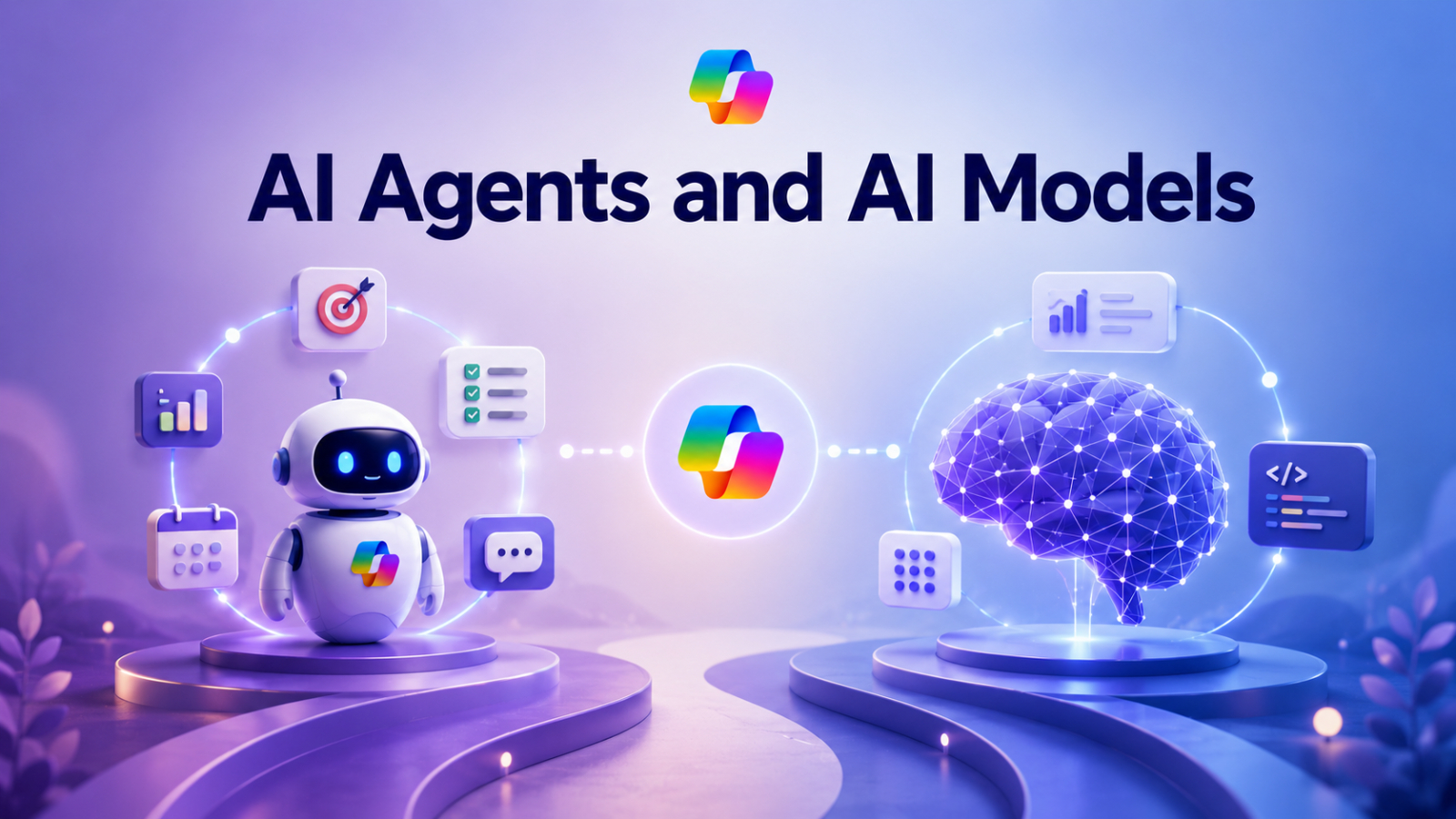
Artificial intelligence has evolved rapidly in recent years, introducing new concepts that are transforming how businesses operate. Two terms that are often used interchangeably but represent very different technologies are AI Agents and AI Models
Understanding the distinction between these concepts is becoming increasingly important as organizations adopt AI-powered solutions. While AI models provide the intelligence behind AI systems, AI agents use that intelligence to perform tasks, make decisions, and interact with business processes.
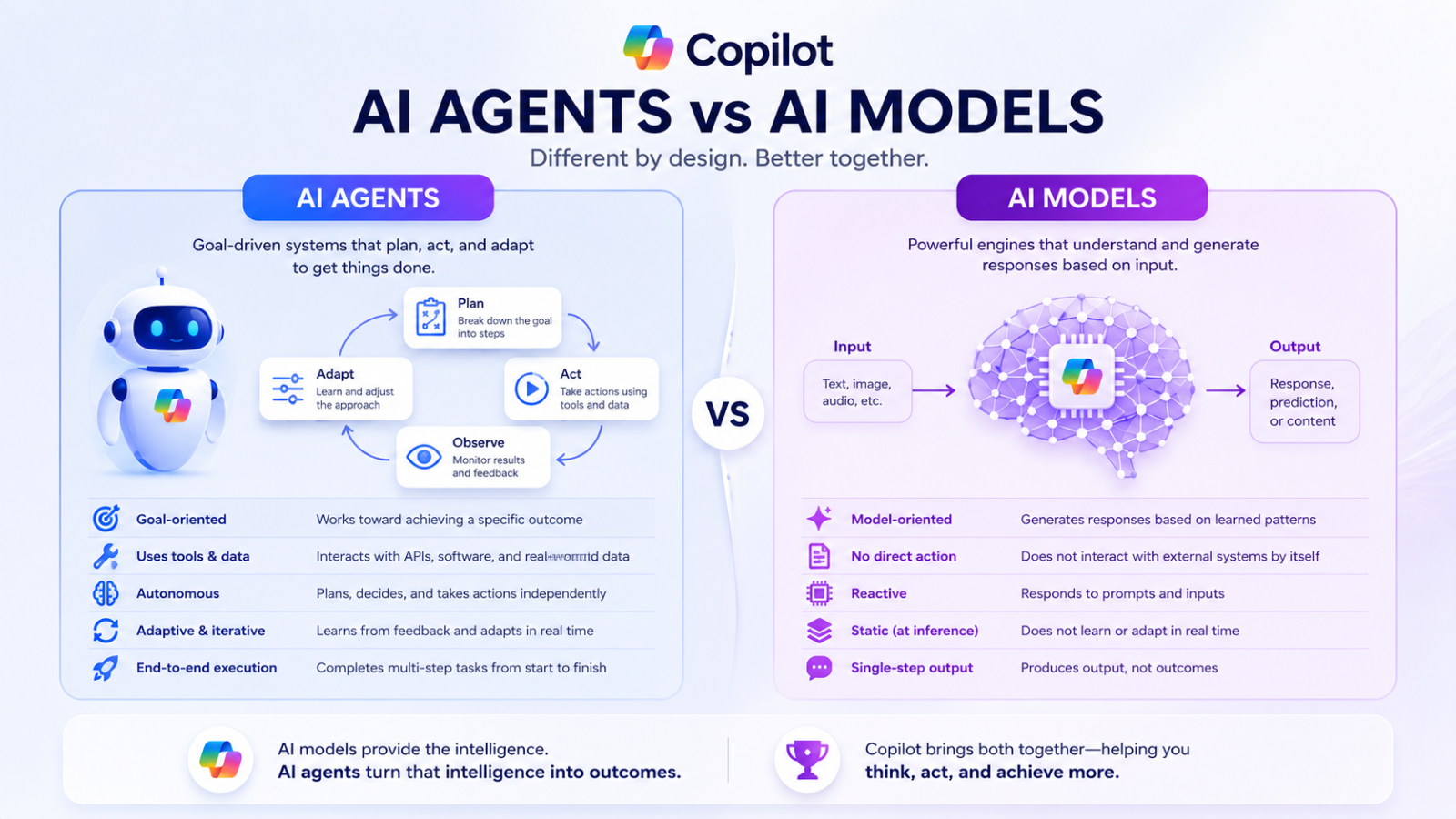
In simple terms, an AI model can think, while an AI agent can think and act.
What Is an AI Model?
An AI model is the intelligent mechanism behind an AI system. It learns patterns from training data and generates results in various forms, such as text, images, language translation, predictions, or answering questions.
However, most AI models tend to operate in a reactive manner; that is, when they receive input, the system processes it and returns the result.
For example, when you ask a question to a chatbot, the AI model will generate an answer based on the trained data and available context.
What is an AI Agent?
An AI agent is a system that uses one or more AI models to achieve a predefined goal.
Unlike AI models that simply generate answers, AI agents can interact with external systems, gather information, make decisions, and perform various tasks.
For example, instead of simply answering questions about sales results, an AI agent can analyze data from the CRM system, generate reports, create presentations, and automatically send results to stakeholders.
In short, the AI Model provides the intelligence, while the AI Agent transforms that intelligence into action.
Main difference between AI Agents and AI Models
The easiest way to understand AI Agents and Models is to compare the roles of the two.
- AI models are responsible for creating intelligence.
- AI agents are responsible for leveraging this intelligence to achieve business goals.
Imagine the AI Model as the "brain," and the AI Agent as the "operator" who uses that brain to complete the task.
The key difference between AI Agents and AI Models
Section | AI Models | AI Agents |
Purpose | Create a prediction, content, or answer | Carry out the work and achieve the goals. |
| Focused on data processing and generating results. | Focusing on business results. |
Autonomy | It requires commands from the user or application. | They can work with different levels of independence. |
| Unable to work independently. | You can start implementing the goals and instructions you've received. |
System Integration | It usually runs within an application. | It can connect to databases, APIs, and various business systems. |
| Interaction with business systems is relatively limited. | It can work seamlessly with multiple systems during operation. |
Multi-Step Execution | Handle requests one at a time. | Multiple steps can be taken to achieve a larger goal. |
|
| Coordinate between different tools and services. |
Decision-Making | Create instructions and answers. | Evaluate options and determine next steps within the defined scope. |
Real-world usage examples
Example 1: Customer Service
AI Model
The customer asks a question, and the AI model generates the answer.
AI Agent
The AI Agent can:
- Reviews the customer's account
- Checks order status
- Creates a support ticket
- Sends a response
- Schedules a follow-up
The agent performs the work, while the model provides intelligence throughout the process.
Example 2: Invoice Processing
AI Model
Extracts information from an invoice.
AI Agent
- Reads incoming invoices
- Extracts information from an invoice.
- Validates vendor information
- Creates accounting records
- Routes documents for approval
This is similar to how modern finance automation solutions operate.
Example 3: Sales Operations
AI Model
Generates a sales summary.
AI Agent
- Collects CRM data
- Identifies opportunities
- Create a report
- Drafts customer communications
- Updates business systems
The agent handles an entire workflow rather than a single task.
How AI Agents and AI Models Work Together
It is important to understand that AI agents and AI models are not competing technologies.
In fact, AI agents depend on AI models.
A single AI agent may use one or more AI models for different tasks, such as:
- Natural Language Understanding
- Data analysis
- Content generation
- Image recognition
- Decision support
The AI model provides the intelligence, while the AI agent coordinates and executes the process.
As AI technology continues to advance, the relationship between AI agents and models will become even more crucial.
The future of Enterprise AI
The next era of AI adoption is shifting from AI that merely answers questions to AI that can perform real tasks.
Platforms such as Microsoft Copilot, Dynamics 365 Agents, Autonomous Business Agents, and the next generation of Enterprise AI systems are all built on this concept.
Many organizations are beginning to use AI Agents that can collaborate with employees, manage workflows, and automate complex business processes.
This trend represents a significant evolution in how AI is used to create value for businesses.
Summary
Understanding the difference between Agents and Models is crucial for organizations strategizing about AI.
AI Models are the source of intelligence that powers modern AI systems, while AI Agents apply that intelligence to operations, manage workflows, and achieve business goals.
As organizations move beyond basic AI assistants to independent digital employees, AI agents will play an increasingly important role in enhancing productivity, increasing agility, and transforming business processes.
AI agents are not meant to replace AI models, but rather to enhance the capabilities of AI models to transform "intelligence" into real "action."