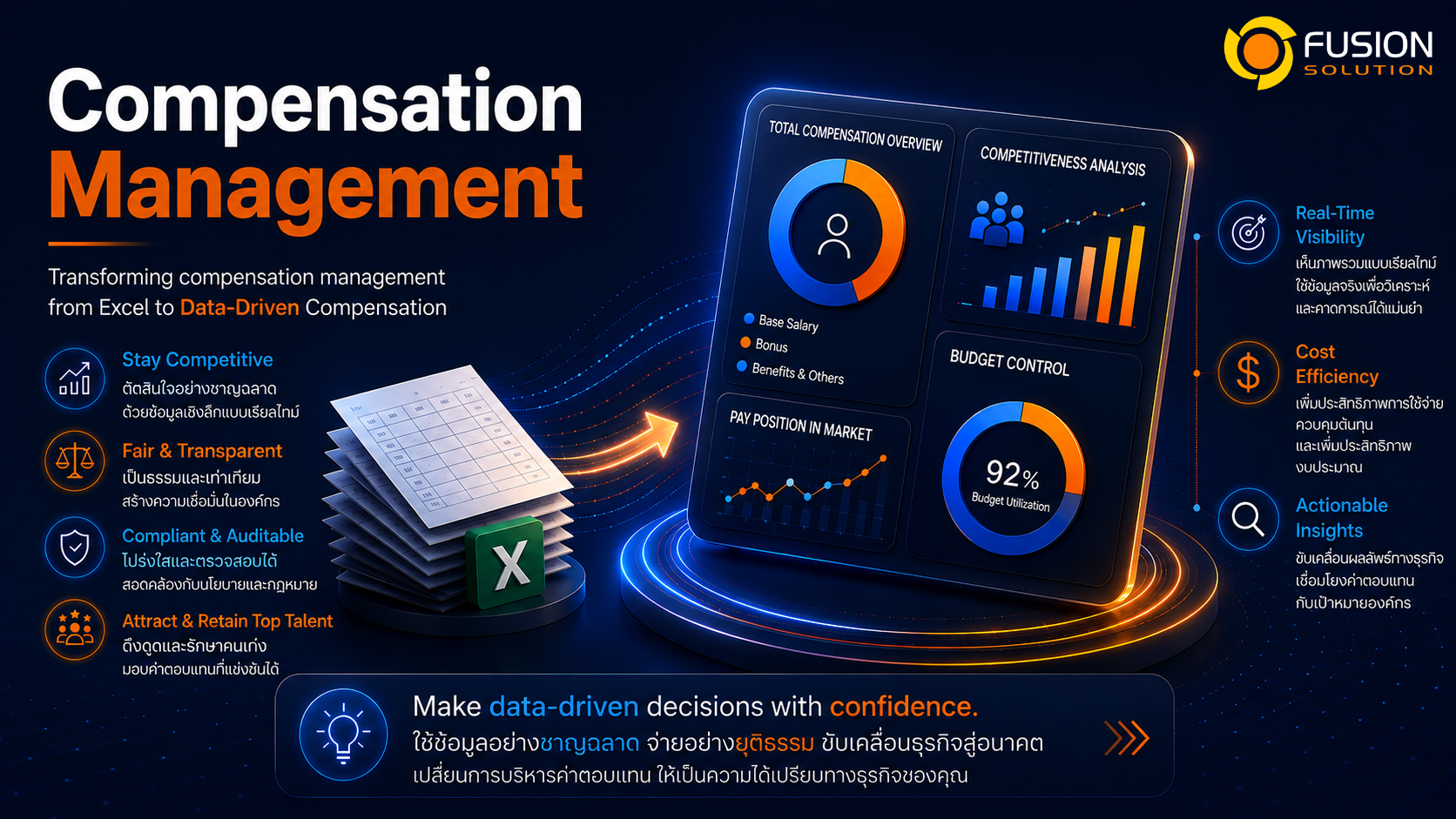
Compensation management directly impacts talent attraction, employee retention, internal fairness, and personnel costs.
However, many organizations still manage salary and bonus adjustments using multiple Excel files, requiring data to be compiled from HR, Manager, and Finance before being reviewed and approved.
When salary, performance, budget, and position structure data are scattered, organizations may not see the real-time impact on their budget, it can be difficult to monitor pay equity, and they risk inconsistent decision-making.
Modern Compensation Management is therefore not just about calculating salary increases, but a process that connects compensation, performance, skills, budget, and Total Rewards to support more accurate, transparent, and fair decision-making.
What is Compensation Management?
Compensation Management is the process of planning, managing, analyzing, and making decisions about employee compensation to align with business goals, competitiveness, and fairness within the organization.
- Salary Structure
- Pay Grade and Pay Range
- Merit Increase
- Bonus and Incentive
- Compensation Review
- Pay Equity
- Pay Transparency
- Total Rewards
- Compensation Analytics
- Budget Planning
How does Compensation Management differ from Payroll?
Issue | Payroll | Compensation Management |
Target | Calculate and pay | Plan and make decisions regarding compensation. |
Job description | transactional | strategic |
Main data | Salary, Earnings and Deductions | Salary, bonus, performance, budget, and pay equity. |
Result | Payment was made correctly and on time. | Reward appropriately and fairly. |
User | Payroll Team | HR, Manager, and Finance |
Payroll is the process of calculating and paying salaries after approval, while Compensation Management is the preceding process that uses data to plan and determine how employees should be compensated.
Why is managing compensation using Excel insufficient?
1. The data is scattered.
Salary, performance, position, and budget data may be stored in different systems, requiring HR to spend time collecting and verifying them before analysis can begin.
2. There are multiple versions of the file.
Sending a spreadsheet between Manager, HR, and approvers may cause issues with Version Controls, incorrect formulas, or data inconsistencies.
3. Budget Impact is not immediately visible.
Salary and bonus adjustments directly impact workforce costs. If this data isn't aligned with the budget, organizations may encounter problems near the end of the process.
4. Analyzing Pay Equity is difficult.
When data is not centralized, comparing compensation between positions, departments, and groups of employees takes more time.
5. The manager does not have complete supporting information.
Managers may only see the budget and performance evaluations, but not the relevant pay range, internal equity, skills, or market benchmarks.
6. HR spends too much time on administrative tasks.
Instead of analyzing reward strategies, the HR team may spend most of their time integrating files, checking formulas, and tracking approvals.
What is Data-Driven Compensation?
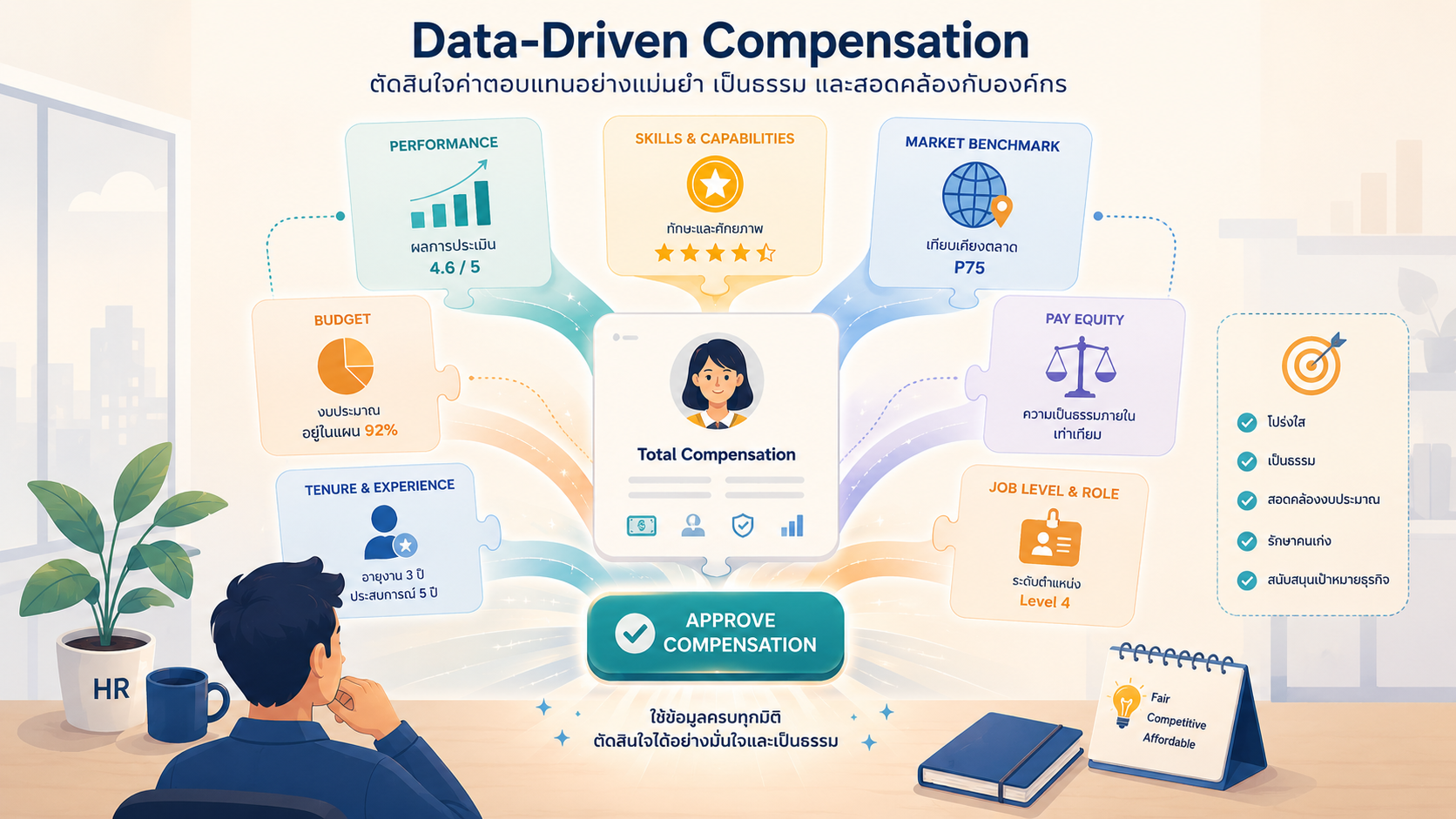
Data-driven compensation is a compensation management approach that uses data as the basis for decision-making, rather than relying on feelings or incomplete information.
- Salary Data
- Performance Data
- Skills Data
- Pay Range
- Budget
- Market Benchmark
- Internal Equity
- Compensation History
- Employee Grade and Job Profile
Data-driven compensation helps organizations determine whether compensation adjustments align with performance, skills, the market, budget, and internal fairness.
What is Total Rewards?
Total Rewards is an overview of the value that an organization provides to its employees, both in monetary and non-monetary forms.
- salary
- Bonuses and Incentives
- welfare benefit
- Health insurance
- Provident Fund
- Paid Leave
- Flexible Working
- Learning and Development
- Career Opportunity
- Recognition
- Employee Experience
Pay Equity and Pay Transparency
Pay Equity is the management of compensation to ensure fairness, considering roles, responsibilities, performance, skills, and job-related factors. It doesn't mean paying everyone the same amount, but rather making decisions based on principles, explainable, and verifiable.
Pay Transparency refers to making compensation management guidelines and processes clear, transparent, and communicable to employees. This includes things like pay ranges, salary adjustment guidelines, bonus consideration methods, and the components of Total Rewards.
What should Compensation Management be linked to?
Core HCM
The position information, including grade, location, manager, and employment status, must be accurate for determining eligibility, pay range, and compensation review.
Performance Management
Performance data provides context for considering merit increases, bonuses, and incentives, but ratings should not be used alone.
Learning Management และ Skills
Skills data helps organizations identify critical skills and developing capabilities, which can be used to inform reward strategies and career planning.
Workforce Planning
Salary adjustments, bonuses, and headcount affect workforce costs, so they should be linked to workforce planning and financial planning.
Payroll
Once the Compensation Decision is approved, the information should be correctly sent to Payroll to minimize duplicate entries and errors.
What should a Compensation Management system include?
Compensation Planning
Supports planning for various types of Merit Increase, Bonus, Incentive, and Award.
Compensation Review
There is a workflow for proposals, reviews, and approvals by the Manager, HR, and authorized approvers.
Budget Control
Show the allocated budget, amount spent, remaining balance, and impact prior to approval.
Pay Equity Dashboard
Please review the compensation discrepancies and any additional considerations.
Compensation Analytics
Analyze Pay Range, Compa-ratio, Promotion Cost, and Merit or Bonus Distribution.
Total Rewards Statement
It helps employees see the overall value they receive, not just their salary or bonus.
Eligibility Rules
Define the eligibility requirements for each type of Merit, Bonus, or Compensation Program.
Reporting and Analytics
It helps HR and Finance track Pay Equity budgets and Compensation Cycle results.
How does Data-Driven Total Rewards help organizations?
- Decisions can be made more consistently based on the same set of data.
- Reduce manual work and approval tracking.
- Better budget control
- Support Pay Equity.
- Link rewards with performance and skills.
- Communicate Total Rewards more clearly.

How can AI help with compensation management?
AI can help support analysis and reduce high-volume tasks, such as detecting pay anomalies, analyzing pay gaps, showing budget impact, comparing offers against guardrails, and identifying items that require further investigation. However, decision-making still requires human oversight, policy, governance, and clear accountability.
How to switch from Excel to Data-Driven Compensation.
- Standardize the data structure.
Clearly define Salary, Pay Components, Grade, Pay Range, Currency, Allowance, and Bonus. - Synchronize data with Core HCM.
Please verify the accuracy of the position information, including Manager, Location, and Employee Status. - Defining the Compensation Philosophy
Specify whether the organization pays based on market rates, roles, performance, skills, or strategies for retaining critical talent. - Design a salary structure and pay range.
Create a framework for salary management and pay progress. - Connecting Performance and Skills
Use performance and skills data as context, and don't rely solely on ratings. - Define Budget and Guardrails.
Define Eligibility, Pay Range, Approval Rules, and Budget before opening the Compensation Review round. - Check Pay Equity.
Track Pay Distribution, Budget Usage, and Compensation Patterns. - Communicate Total Rewards.
It helps employees understand the value they receive in terms of salary, bonuses, benefits, learning, and growth opportunities.
Good compensation doesn't necessarily mean paying the most.
- Was the payment fair?
- Is the compensation commensurate with the role and performance?
- Is the price competitive with the market?
- Is the spending within the budget?
- Does pay reflect critical skills?
- Do employees understand the Total Rewards they are receiving?
Effective Compensation Management must therefore be integrated with a comprehensive People Strategy system, encompassing everything from employee data, performance, and skills to Workforce Planning and Finance.
Summary
Compensation Management is the systematic process of managing compensation, from salary and bonuses to incentives and Total Rewards.
Managing multiple files through Excel can lead to errors, a lack of transparency, difficulty seeing Budget Impact, and difficulty monitoring Pay Equity.
Data-Driven Compensation helps connect compensation data, performance, skills, budget, and fairness to support more accurate and verifiable decision-making.
For organizations looking to elevate their HR department to become a strategic business partner, shifting from a manual compensation cycle to data-driven total rewards is a crucial step in digital HR transformation.