OCR Services for Enterprises: Key Considerations for Large Organizations When Selecting a Solution Provider
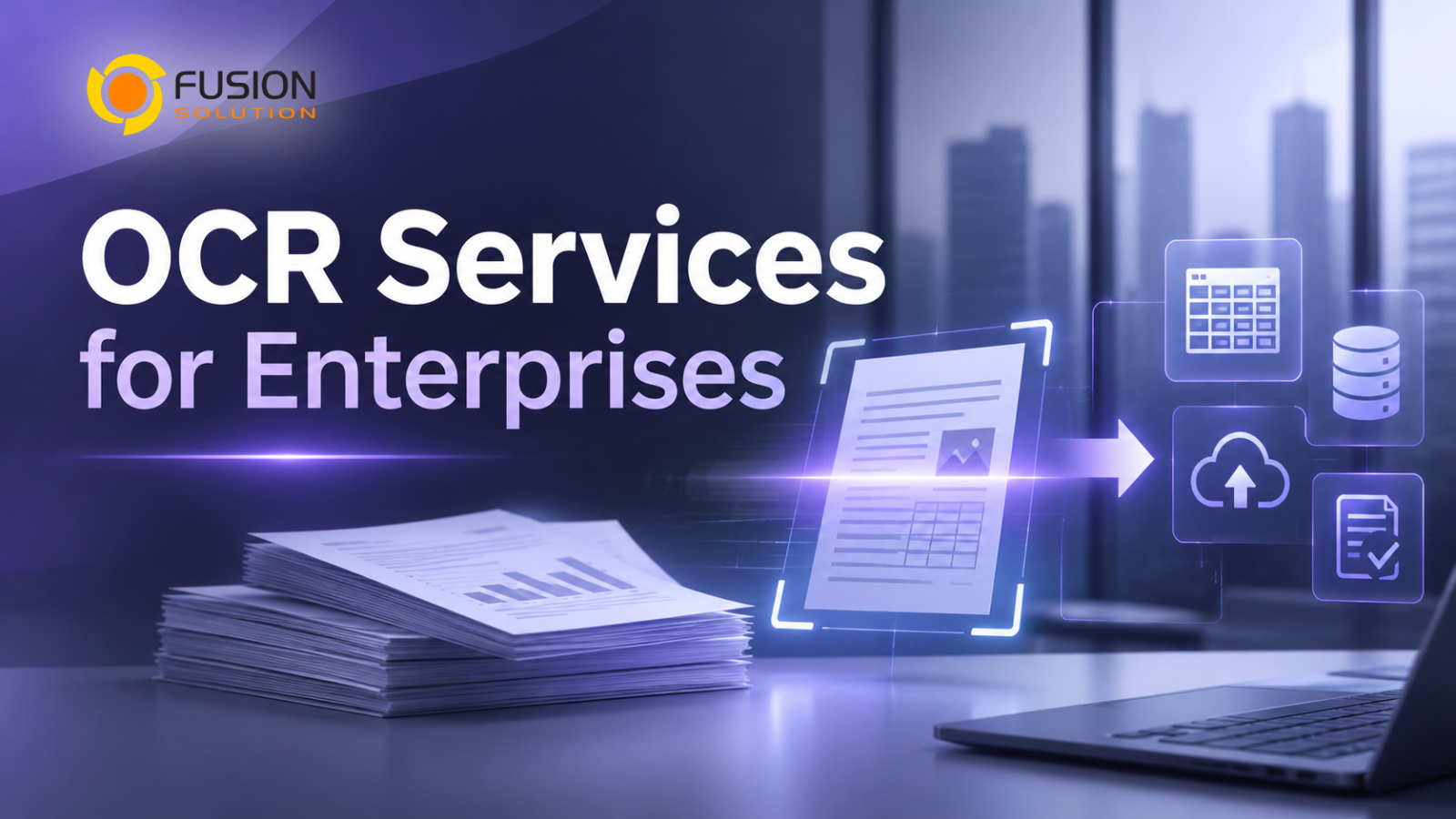
Large organizations handle enormous amounts of documents every day. Invoices, receipts, contracts, purchase orders, employee records, customer applications, and compliance documents all contain information that must be collected, reviewed, and transferred into business systems.
Although many organizations have already digitized their documents, extracting information from scanned files and image-based PDFs can still require significant manual effort.
This is where enterprise OCR (Optical Character Recognition) solutions become valuable. However, implementing OCR at an enterprise level involves more than recognizing text from images. Organizations need solutions that can handle large document volumes, support multiple document formats, protect sensitive information, and integrate with complex business workflows.
Therefore, selecting the right OCR service provider for an organization is a significant investment decision. The provider must understand the requirements of large-scale enterprises and be capable of developing solutions that can scale in line with the organization's business operations.
Here are seven important factors large organizations should consider before selecting an OCR solution provider.
Enterprise-Level Document Processing Capacity
Enterprise organizations may process thousands or even millions of document pages across multiple departments.
An OCR solution designed for small document volumes may struggle when processing requirements increase.
A suitable provider should demonstrate the ability to handle:
- High-volume document processing.
- Batch processing of multiple files.
- Multi-page PDFs and large document collections.
- Concurrent processing requests.
- Automated document ingestion.
- Scalable processing infrastructure.
Ask providers how their solutions handle peak workloads and whether processing capacity can increase as business requirements grow.
Scalability should be considered from the beginning rather than treated as a future upgrade.
Support for Multiple Document Types and Formats
Large organizations rarely work with a single document format.
Different departments may process scanned invoices, tax documents, contracts, application forms, receipts, identification documents, and operational reports.
These documents may contain different layouts, tables, handwriting, stamps, and multilingual content.
A professional OCR provider should offer capabilities that support different document types and extraction requirements.
For example, a finance department may need invoice numbers, supplier details, and payment amounts, while HR may need employee information and application details.
For Thai enterprises, Thai and English recognition capabilities are particularly important. The provider should demonstrate performance using real documents from the organization rather than relying only on standard examples.
Advanced Data Extraction Beyond Basic OCR
Basic OCR converts characters in images into machine-readable text. However, enterprise organizations usually need structured information rather than large blocks of extracted text.
AI-powered document processing can provide additional capabilities, including:
- Document classification: Automatically identify whether a file is an invoice, contract, receipt, or another document type.
- Field extraction: Identify specific information such as invoice numbers, dates, customer names, and financial amounts.
- Table recognition: Extract structured information from tables, including product descriptions, quantities, and prices.
- Data validation: Check extracted values against business rules and reference information.
- Structured output: Convert recognized information into formats such as JSON or database records for downstream applications.
The right solution provider should understand how to combine OCR and AI capabilities to support the organization's actual business requirements.
Integration with Enterprise Systems and Workflows
OCR should not operate as an isolated application.
Its real value comes from connecting extracted information with existing enterprise systems.
Before choosing a provider, evaluate its experience integrating OCR with:
- ERP platforms such as Microsoft Dynamics 365.
- CRM system
- Accounting and financial applications.
- Microsoft SharePoint and Microsoft 365
- Document Management Systems (DMS).
- Enterprise Databases and Data Warehouse.
- Workflow automation platform and custom APIs
For example, an incoming supplier invoice could be automatically captured, processed by OCR, validated, and transferred into an ERP system for approval and payment processing.
A provider should also understand API integration, Authentication, Error Handling, Data Mapping, and Workflow Orchestration.
This is especially important when multiple departments and applications depend on the same document information.
Enterprise Security and Data Governance
Large organizations frequently process sensitive information, including financial records, customer data, employee details, and confidential business agreements.
Security must therefore be a fundamental part of the OCR solution architecture.
Important considerations include:
- Data encryption during transmission and storage.
- Role-based access control.
- User authentication and authorization.
- Audit logs and activity monitoring.
- Data retention and deletion policies.
- Secure API connections.
- Deployment and data residency requirements.
- Support for relevant regulatory obligations, including Thailand's PDPA.
Ask the provider to explain how documents move through the system, where information is processed, and who can access the extracted data.
Enterprise OCR should improve operational efficiency without introducing unnecessary data security risks.
Accuracy, Reliability, and Exception Management
OCR accuracy directly affects downstream business operations.
For example, an incorrect invoice amount may create financial discrepancies, while an incorrectly recognized contract date could affect important business decisions.
A reliable enterprise solution should include more than text recognition.
Look for capabilities such as Confidence Scoring, Field-Level Validation, Exception Handling, and Human Review Workflow.
Organizations should also evaluate performance using different document qualities, layouts, and languages.
Ask potential providers to conduct a Proof of Concept (PoC) using representative business documents. This makes it easier to evaluate actual extraction quality and identify limitations before full deployment.
Implementation Expertise and Long-Term Support
Enterprise OCR projects often involve multiple departments, applications, and stakeholders.
A provider must be capable of managing the complete implementation lifecycle, including:
- Business requirement analysis.
- Document and workflow assessment.
- Solution architecture and technology selection.
- Development and system integration.
- Testing and performance optimization.
- Deployment and employee training.
- Ongoing maintenance and technical support.
Also clarify service-level agreements (SLAs), incident response procedures, system monitoring, software updates, and future customization options.
A long-term technology partner should be able to support changes in document formats, processing volumes, and business workflows as the organization evolves.
How to Compare Enterprise OCR Solution Providers
When evaluating potential providers, large organizations should compare more than software features or initial implementation costs.
Evaluation Area | What to Look For |
Processing capability | Supports high-volume and batch processing |
Document recognition | Handles multiple formats and languages |
AI Capabilities | Provides classification and structured extraction |
Integration | Connects with ERP, CRM, DMS, and APIs |
Safety | Supports enterprise access control and data protection |
Credibility | Includes validation and exception handling |
Installation and Usage | Offers technical expertise and ongoing support |
A practical approach is to shortlist providers and request a PoC based on actual organizational documents and workflows.
This helps decision-makers understand whether the proposed solution can meet enterprise requirements before committing to a large-scale project.
Conclusion
Selecting an OCR provider for a large organization requires careful consideration of processing capacity, document recognition, AI capabilities, system integration, security, and long-term support.
A successful enterprise OCR solution should do more than convert scanned documents into text. It should transform document information into structured business data that can move securely across departments and applications.
By choosing an experienced implementation partner and evaluating solutions through real-world testing, organizations can build scalable document processing workflows that reduce manual work and support broader digital transformation initiatives.
Interested in Microsoft products and services? Send us a message here.
Explore our digital tools
If you are interested in implementing a knowledge management system in your organization, contact SeedKM for more information on enterprise knowledge management systems, or explore other products such as Jarviz for online timekeeping, OPTIMISTIC for workforce management. HRM-Payroll, Veracity for digital document signing, and CloudAccount for online accounting.
Read more articles about knowledge management systems and other management tools at Fusionsol Blog, IP Phone Blog, Chat Framework Blog, and OpenAI Blog.
New Gemini Tools For Educators: Empowering Teaching with AI
If you want to stay up-to-date with the latest technology and AI news, check out this website It's updated daily!
Fusionsol Blog in Vietnamese
- What is Microsoft 365?
- What is Copilot?What is Copilot?
- Sell Goods AI
- What is Power BI?
- What is Chatbot?
- What is cloud storage?
Related Articles
Frequently Asked Questions (FAQ)
What types of documents does DOVA OCR support?
DOVA OCR can assist in processing business documents—such as invoices, receipts, forms, and scanned files—making data management more convenient and efficient.
How does DOVA OCR help reduce the steps in employees' workflows?
A system that reads text and extracts key information from documents, reducing the need for manual data entry and allowing employees to dedicate more time to verifying data and performing tasks that require decision-making.
How accurate is the data read by the system?
Accuracy depends on the quality of the documents, the font styles, and the complexity of the information. You should verify the results before use, especially when dealing with financial data or critical organizational information.
Can DOVA OCR be integrated with an organization's existing systems?
DOVA OCR offers features such as data export to CSV, database storage, and a RESTful API, which can be used to integrate with other systems depending on the specific deployment requirements.
How should a business prepare before starting to use DOVA OCR?
You should begin by identifying the types of documents to be processed, preparing actual document samples, and testing the accuracy of data extraction. Additionally, evaluate security requirements and system integration needs to ensure the chosen solution is well-suited to your organization.