What is Talent Acquisition? Reduce recruitment time and enhance the candidate experience with AI
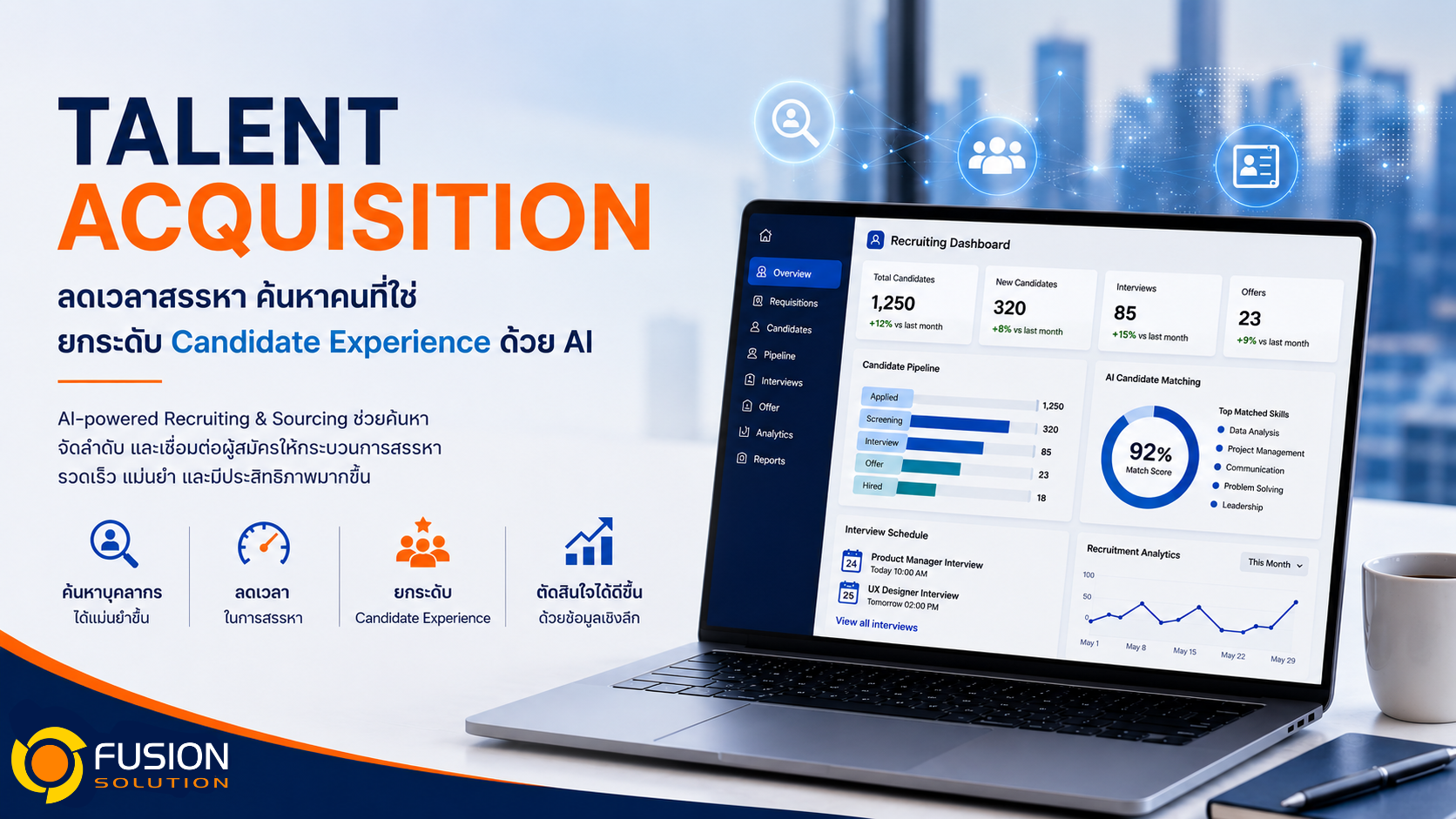
Finding the right personnel isn't solely dependent on the number of applicants, but also on how quickly an organization can identify, evaluate, and build relationships with potential candidates.
Many organizations also face lengthy recruitment processes, from opening positions and searching for candidates to reviewing applications, scheduling interviews, gathering feedback from the Hiring Manager, and finally preparing a job offer.
When these processes are handled via email, Excel files, and unconnected systems, recruiters spend a significant amount of time coordinating, while applicants may experience long waits for responses or receive unclear information about their status.
These issues affect not only the length of employment but also impact candidate experience, employer image, and the organization's ability to compete in attracting skilled personnel.
Talent acquisition is therefore not just a recruitment process, but a strategic approach that links workforce planning, candidate search, talent pipeline creation, selection, and candidate experience.
What is Talent Acquisition?
Talent acquisition is the strategic process of planning, finding, attracting, evaluating, and hiring personnel with the right skills to meet the organization's current and future needs.
Talent Acquisition encompasses key activities such as:
- Manpower requirements planning
- Creating and approving job positions.
- Defining the required qualifications and skills.
- Employer Branding
- Talent Sourcing
- Candidate Engagement
- Recruitment and screening of applicants
- Interviews and assessments
- Preparing an employment proposal
- Creating a Talent Pool
- Internal Mobility
- Recruitment Analytics
Workday offers Talent Acquisition as a recruitment cycle that links Recruiting, Candidate Engagement, and AI for Recruiting, covering Candidate Engagement, Hiring Team Collaboration, Interview Management, Reporting, Compliance, Analytics, and Internal Mobility.
How does talent acquisition differ from recruitment?
Issue | Recruitment | Talent Acquisition |
Target | Fill in the available job positions. | Build the ability to attract and hire long-term talent. |
period | Meet current needs. | Linking current needs with future workforce plans. |
Guidelines | Focus on the recruitment and selection process. | It covers Workforce Planning, Employer Brand, Sourcing, and Talent Pipeline. |
Group of candidates | Applicants for the current position. | Current applicants, potential candidates, and the Talent Pool. |
Measurement | Time-to-Fill and Number of Applicants | Employment quality, candidate experience, and business results. |
The role of data | Track your application status. | Supporting strategic planning, research, and decision-making. |
Recruitment is a key component within Talent Acquisition, but Talent Acquisition has a broader scope because it doesn't begin when a position becomes available and end only when a candidate accepts an offer.
Why is the recruitment process so slow?
1. The position approval process is complex.
Opening a job may require approval from multiple levels. If the process is handled through separate emails or documents, it will be difficult for recruiters to track the status and identify areas of delay.
2. The job description does not reflect the required skills.
Job descriptions that have been used consistently for many years may not reflect the actual work, leading organizations to attract the wrong candidates or spend a large amount of time screening applications that are unsuitable for the position.
3. Rely on searching for candidates through existing channels.
Simply announcing a position and waiting for applications may not be enough for highly competitive roles. Organizations need to seek candidates from their existing talent pool, former applicants, internal staff, and other networks.
4. Screening applications is a manual process.
With a large number of applicants, recruiters need time to review resumes and compare qualifications to the position. Without a tool to help prioritize, this part of the process can become a bottleneck.
5. Recruiters and Hiring Managers work separately.
Waiting for feedback, scheduling meetings, or requesting approval from the Hiring Manager causes applicants to be stuck in each stage for too long.
6. Scheduling interviews takes a lot of time.
Comparing the available time of applicants, interviewers, and the meeting room, especially when there are multiple interviewers, may require several rounds of back-and-forth communication.
7. No information is available to identify the point of congestion.
If an organization only tracks the number of positions closed but lacks information about the time taken at each stage, it becomes difficult to determine whether the delay is occurring at Sourcing, Screening, Interview, or Approval.
What is Candidate Experience?
Candidate Experience refers to the experience an applicant gains from interacting with an organization throughout the recruitment process, from seeing the job posting, searching for information, applying, communicating, interviewing, to receiving the selection results.
The candidate experience doesn't just happen on the interview day, but begins from the moment the applicant learns about the organization and the job position.
This experience was influenced by several factors, including:
- Clarity of the job advertisement.
- Ease of searching for and applying for jobs.
- Suitable for use on mobile phones.
- Time taken to complete the application form.
- Speed of response
- Transparency in the selection process.
- Scheduling and rescheduling interviews.
- Communication quality from the Recruiter.
- Data consistency
- Proper notification of results.
CIPD states that the selection process should be clear, systematic, and transparent, taking into account candidate experience and the timeframe of the process. Organizations should inform applicants in advance how long the process will take, what technology will be used, and what types of evaluations will be conducted.
Signs that the candidate's experience is problematic.
- The applicant had to fill out the information multiple times.
- The application process is lengthy or difficult to use on a mobile phone.
- The applicant did not receive a confirmation message after submitting the application.
- There is no information on the current status of the application.
- Scheduling an interview involves multiple rounds of back-and-forth communication.
- The interviewer provided inconsistent information about the position.
- The process involves multiple rounds without any explanation.
- The applicant was not notified of the results.
- Applicants must contact the Recruiter to inquire about basic matters.
- A potential candidate withdraws before the process is complete.
Workday states that Candidate Experience Agents support conversational job searches, conversational applications, interview scheduling, and mobile-first candidate experiences, as well as answering questions and helping candidates find relevant jobs.
How does a slow recruitment process affect an organization?
Key positions remain vacant for longer periods.
Unavailable positions could increase the workload of team members and slow down the implementation of certain projects or business plans.
A suitable candidate may choose another organization.
Applicants may be involved in the processes of multiple organizations simultaneously. If an organization takes a long time or has inconsistent communication, the applicant may accept other opportunities first.
Recruiters have less time for strategic tasks.
Screening applications, scheduling appointments, following up on feedback, and answering repetitive questions leaves recruiters with less time for talent sourcing, employer branding, and building relationships with candidates.
The hiring manager lost confidence in the process.
If a recommended candidate doesn't meet the requirements or the recruitment status is unclear, the Hiring Manager may resort to off-the-shelf processes, complicating information and oversight.
The employer's image is affected.
The job application process is one of the first experiences an outsider has with an organization. Delayed or unclear communication can negatively impact the perceived employer brand.
What is AI Recruiting?
AI Recruiting is the application of artificial intelligence and automation to support various steps in the recruitment process, such as content creation, candidate search, skills matching, candidate ranking, answering questions, and scheduling interviews.
AI Recruiting should not be viewed as replacing all decision-making by recruiters or hiring managers, but rather as the use of technology to reduce workload, provide relevant information, and help those responsible act faster.
Workday explains that AI in recruitment can assist with resume screening, candidate matching, candidate engagement, and streamlining workflows, while recruiters can dedicate more time to building relationships and finding the right candidates.
How can AI help improve talent acquisition?
1. Help create and improve job content.
AI can assist in drafting job descriptions, interview questions, or recruitment campaign content based on organizational data and conditions. However, recruiters and hiring managers still need to review the drafts before actual implementation.
2. Help find candidates from the Talent Pool.
The system can help find relevant individuals from existing applicant databases, connected networks, or groups of applicants who have previously expressed interest.
3. Help match skills with job positions.
Skill-based matching helps organizations consider relevant abilities and experience, rather than searching based on job titles or just a few keywords.
4. Help rank the applicants.
AI can help present candidates who meet the job criteria, allowing recruiters to start reviewing from the highly compatible group. The results should be supporting information, not a final decision.
5. Reduce repetitive coordination tasks and workflows.
The system can help identify Action Items, track tasks, and suggest next steps to the Recruiter and Hiring Manager.
6. Help answer the applicant's questions.
Conversational AI can provide information about job openings, application processes, and frequently asked questions, helping applicants access information at their convenience.
7. Makes scheduling interviews easier.
The system can help suggest opening hours, send invitations, remind you of interviews, and support time changes to reduce back-and-forth communication.
8. Helps to view Recruitment Analytics.
Linked data helps organizations analyze the channels that generate candidates, the timeframe of each stage, the point at which candidates withdraw, the workload of recruiters, and the stage awaiting hiring managers.
AI Recruiting vs. Human Decision Making
AI can analyze large amounts of data and help reduce repetitive tasks, but decision-making regarding individuals still requires accountability, contextual consideration, and human oversight.
Organizations should not use AI results without verification, as the data or criteria entered into the system may not fully reflect the potential of all applicants.
AI is suitable for...
- High volume and repetitive tasks.
- Searching for related information
- Organizing applicants
- offering advice
- Job alerts
- Answering general questions
- Schedule coordination
- Collection of data for analysis
Recruiter and Hiring Manager are responsible.
- Determining position requirements
- Considering the applicant's context.
- Evaluation using methods appropriate to the job.
- Talking and building relationships
- Checking system instructions
- Making decisions and taking responsibility for the results.
- Ensuring fairness and a positive experience for applicants.
The CIPD (Civil Protection and Development Division) states that the use of AI in recruitment may encompass targeted job advertising, CV screening, and interview transcription, and suggests considering the scale and severity of the impact if the technology malfunctions, as well as developing the necessary skills for responsible AI use.
Principles for responsible use of AI Recruiting.
Transparency
Organizations should communicate appropriately when using AI or automation in processes related to applicants.
Human Oversight
Someone must be responsible for reviewing the instructions, results, and exceptions, especially in steps that affect an applicant's chances.
Job-related evaluation criteria.
The data and criteria used should be linked to the job performance, skills, and capabilities required for the position.
Fairness check
Organizations should track the outcomes of processes to identify unusual variations and systematically review the root causes.
Applicant information protection
The purpose, access rights, data retention period, and use of applicant data should be clearly defined.
A channel for humans to come to the rescue.
Applicants should be able to contact a person when they have questions or when the automated system cannot adequately handle the situation.
The skills that organizations should look for in a Talent Acquisition system.
- Requisition Management
- Career Site and Job Search
- Mobile-friendly Application
- Candidate Relationship Management
- Talent Pool and Talent Sourcing
- Candidate Matching
- Screening and Candidate Prioritization
- Interview Management
- Hiring Team Collaboration
- Offer Management
- Recruitment Marketing
- Internal Mobility
- Reporting and Analytics
- Security and Compliance
- Integration with Core HCM
- Candidate Communication
- AI Governance and Human Oversight
Guidelines for preparing your organization before using AI Recruiting.
1. Clearly identify the pain point.
Organizations should be aware that the main problems are insufficient applicant numbers, slow screening processes, waiting times for Hiring Managers, interview scheduling, or candidate drop-off.
2. Understand the current process.
Create a candidate journey documenting the entire process, from job opening to offer acceptance, including the job owner, systems used, and waiting times at each stage.
3. Review Job Architecture and Skills.
If the job description and skills information are not standardized, AI may not be able to match applicants to positions that meet the requirements.
4. Update Recruitment Data.
Organizations should review applicant information, job title, applicant source, status in the pipeline, and reasons for the applicant leaving the process.
5. Define the roles of AI and humans.
Clearly specify which steps the AI is used to suggest, prioritize, or automate, and which steps require human review or approval.
6. Design Candidate Communication.
Define the message, time frame, channel, and responsible person for contacting applicants at each stage to ensure consistent communication.
7. Start with a measurable use case.
Organizations might start with tasks that are high-volume and have clear criteria, such as scheduling interviews, answering general questions, or searching for talent from existing databases.
8. Monitor both performance and candidate experience.
The evaluation should not consider only speed, but should also track the quality of communication, the convenience for the applicant, and the outcome of the process.
Effective talent acquisition must be faster without compromising quality.
The goal of AI Recruiting should not only be to minimize time, but also to help organizations operate faster while maintaining the quality, accountability, and experience of candidates.
Deloitte identifies trends in AI-assisted, AI-augmented, and AI-powered recruiting, ranging from repetitive tasks and answering questions to helping rank candidates, creating supporting data, and delivering more personalized experiences.
When AI handles high-volume tasks, recruiters can dedicate more time to human-centric tasks, such as understanding the needs of hiring managers, building relationships with candidates, and designing talent acquisition strategies aligned with business direction.
Summary
Talent acquisition is a strategic process that encompasses workforce planning, candidate search and attraction, selection, creating a candidate experience, and developing a talent pipeline for future needs.
Delayed recruitment processes often result from fragmented workflows, manual tasks, inconsistent coordination, and disconnected information. This leads to wasted time for organizations, increased burden on recruiters, and the risk of losing suitable candidates.
AI-powered recruiting can help find and prioritize candidates, match skills, reduce coordination work, answer questions, and support interview scheduling, but it must operate within job-related criteria, incorporate human oversight, and ensure proper data governance.
Organizations that integrate AI with human processes and decision-making in a balanced way can enhance talent acquisition, making it faster, more connected, and creating a better experience for applicants, recruiters, and hiring managers.
External References
- Workday Talent Acquisition Software
- Workday AI for Recruiting
- Workday: What Is AI in Recruiting?
- Workday Candidate Experience
- CIPD: Guidance on AI in Recruitment
- CIPD: Selection Methods
- Deloitte: Talent Acquisition Technology Trends
Related Articles
- Workday – Enterprise HRM Solution
- What is a copilot?
- What is Microsoft 365?
- HR Software (Human Resource Management Program)
- HR Analytics
HR Knowledge
Frequently Asked Questions (FAQ)
What is Talent Acquisition?
Talent Acquisition It is a strategic process of planning. Search draw evaluate, And hire personnel who are suitable for the organization's needs, both now and in the future.
How does talent acquisition differ from recruitment?
Recruitment typically focuses on filling open positions, while Talent Acquisition encompasses workforce planning, employer branding, talent sourcing, talent pipeline, candidate experience, and long-term employment.
What is AI Recruiting?
AI Recruiting is the use of artificial intelligence and automation to support recruitment tasks such as candidate search, skills matching, application ranking, questionnaire processing, and interview scheduling.
Can AI choose candidates instead of recruiters?
AI should be used as a tool to support the search, organization, and presentation of information. Context assessment, exception checking, and decision-making should be the responsibility of humans.