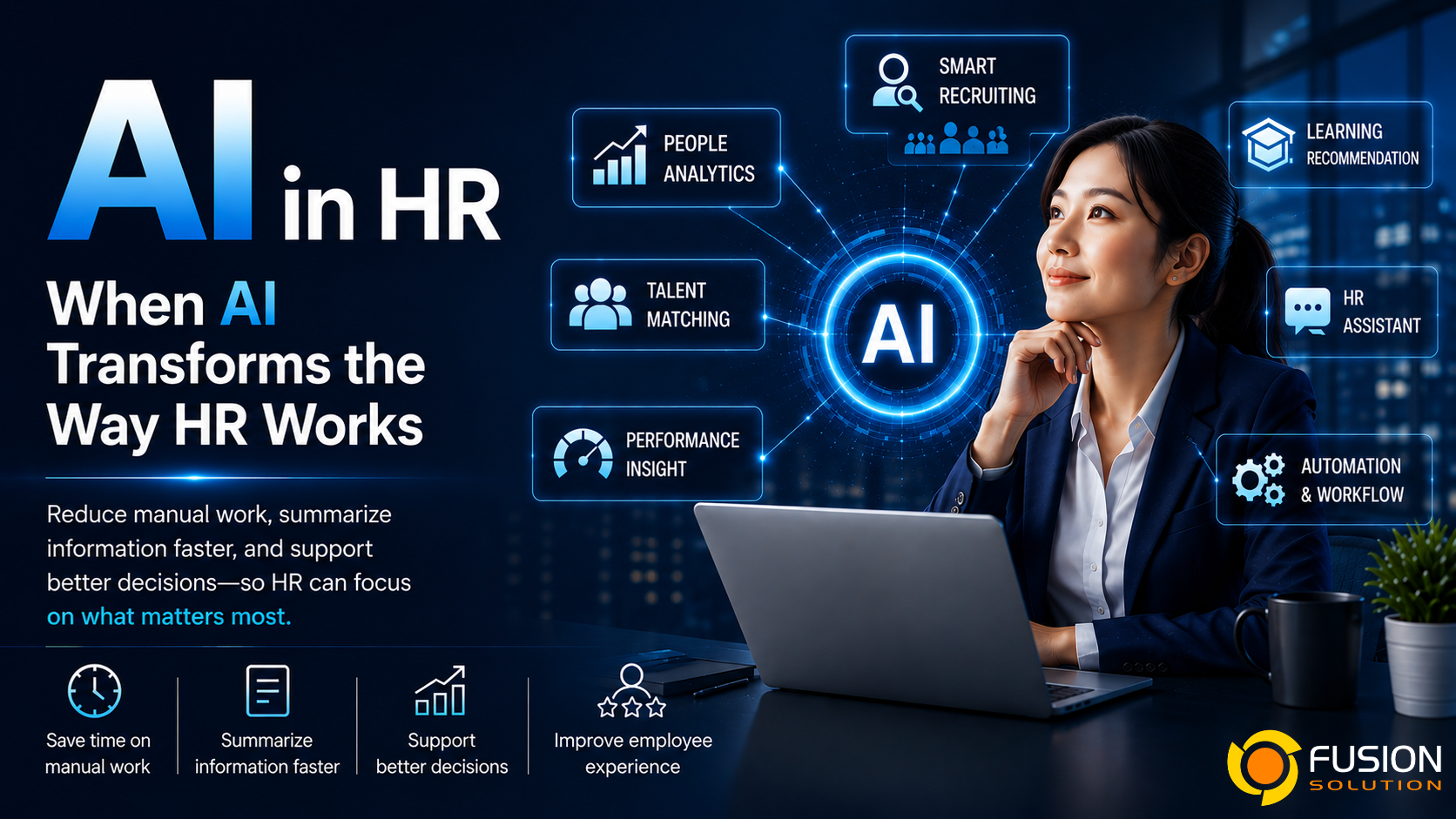
Many organizations have already started using AI in HR, although they may not yet fully call what they're doing an AI strategy. Recruiters might use AI to help draft job descriptions or structure interview questions; learning teams might use it to summarize and refine content; while HR operations might use chatbots to answer policy questions or help employees find information.
Some organizations are beginning to use technology to help summarize dashboards, identify workforce trends, recommend learning content, or match employees with internal opportunities. These use cases can truly reduce time and workload, but the important question isn't just what AI can do for HR.
Organizations also need to answer questions about which tasks are suitable for AI, what data can be used, which results need to be validated, who is responsible when recommendations are incorrect, and how to measure whether AI is actually creating value.
The key change, therefore, is not about having AI replace HR in every aspect, but about redesigning how things work so that technology and humans perform the roles that are appropriate.
HR Pain Point ↓ Relevant AI Use Case ↓ Trusted Data ↓ Human Review ↓ Responsible Action ↓ Measurable Outcome
When AI becomes part of HR work?
AI in HR refers to the application of artificial intelligence technology to support HR processes, data analysis, and employee experience. Related technologies may include Machine Learning, Natural Language Processing, Generative AI, Recommendation Systems, and data analytics tools.
HR doesn't need to understand all the technical details before starting. It's more important to understand how technology assists the task and where human verification is still required.
Usage level | The role of AI |
Assist | Draft, summarize, search, translate, and structure data. |
Recommend | Specify a pattern, arrange the sequence, or suggest alternatives. |
Automate | Implement a workflow with clearly defined boundaries and rules. |
Assist helps with initial preparation, while Recommend provides supporting information for consideration, and Automate executes the defined steps. Tasks with a high impact on employees should have clear checkpoints, approval processes, and escalation.
How is it different from HR Automation?
HR Automation | AI in HR |
Follow the specified rules | Analyze the data and context. |
The workflow is relatively consistent. | You can create, summarize, recommend, or prioritize. |
Suitable for clear, repetitive steps. | Suitable for large amounts of data and pattern searching. |
The results are in accordance with the Rule. | The results may vary depending on the information and context. |
Reduce the manual process. | Add Insight and Decision Support |
Check according to the specified procedure. | Further accuracy and bias testing are required. |
An example of automation is sending welcome emails when employment status changes. AI could help personalize content to suit the role, summarize check-in information, or recommend learning opportunities based on skill gaps. Both approaches can work together.
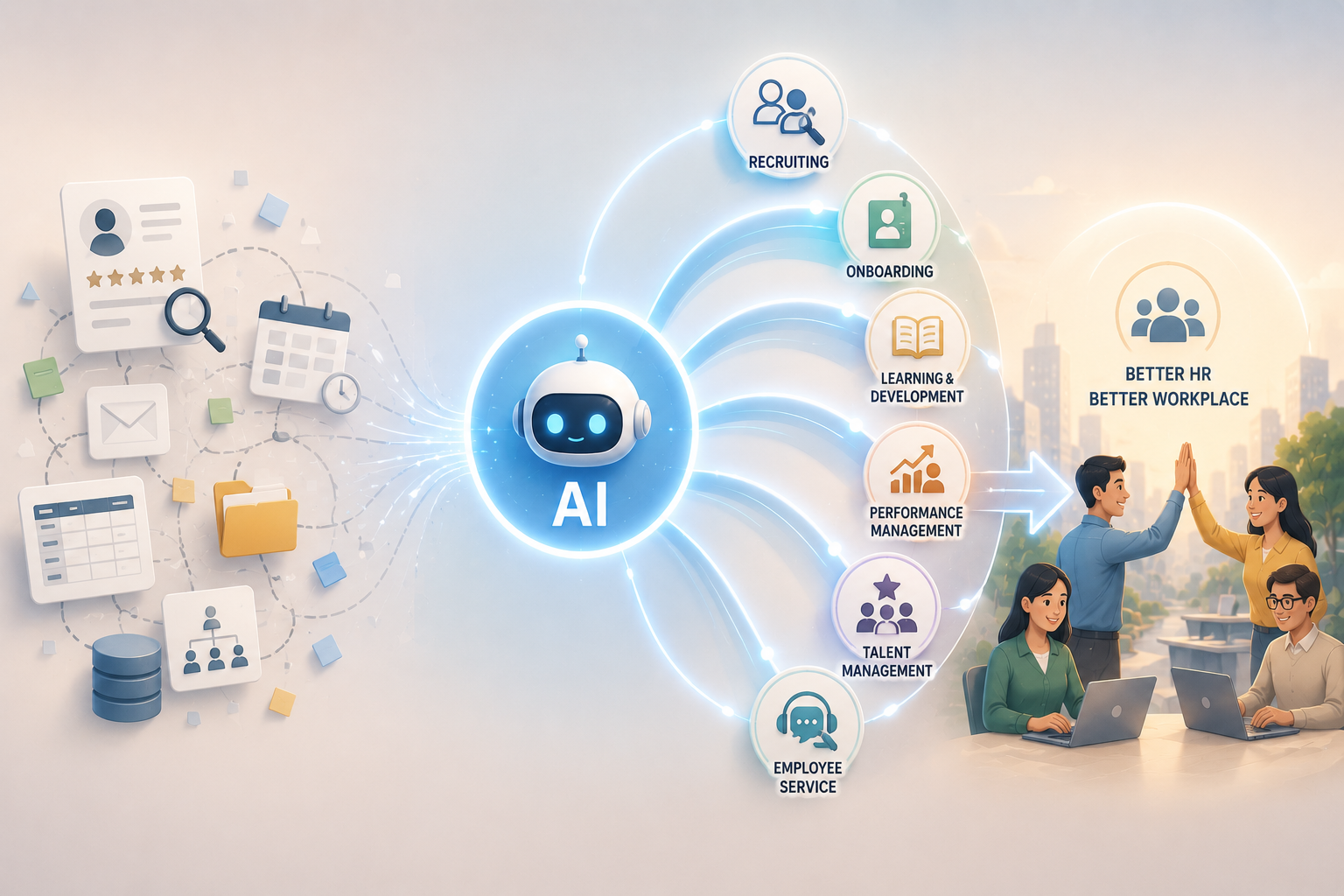
In what ways can AI help HR?
HR process | Examples of AI usage. |
Recruiting | Drafting Job Descriptions, organizing candidate information, candidate matching, and communication. |
Onboarding and HR Service | Answering policy questions, guiding procedures, summarizing tasks, and employee self-service. |
Learning and Development | Suggesting learning based on role or skill gaps and helping to create a learning path. |
Performance Management | In summary, check-in, structuring draft feedback, and compiling goal progress. |
Career and Talent | Skills Matching, Career Recommendations and Internal Opportunity Matching. |
People Analytics | In summary, the dashboard identifies trends or exceptions and creates a basic narrative. |
What benefits does AI bring to organizations?
- Reduce time spent on administrative tasks and repetitive tasks.
- It helps you find and summarize information faster.
- Make the workflow consistent.
- Enhance the convenience of Employee Self-Service.
- Help recruiters and managers prepare information faster.
- Personalize your learning and career experience to suit each individual.
- Please identify a pattern or exception from a large amount of data.
- This frees up HR time for tasks requiring judgment and human interaction.
Value doesn't come from having the most tools, but from choosing the right technology for the right task. Increased efficiency should lead to outcomes such as faster responses to questions, reduced rework, improved data quality, or more time for HR to dedicate to employees and management.
Risks and responsible use of AI
Risk | The controls that should be in place |
Employee data leak. | Approved Tools, Data Classification and Access Control |
The answer or content is incorrect. | Human Review and Source Validation |
Bias or unfair results. | Job-Related Criteria, Bias Testing and Fairness Review. |
Lack of transparency | Employee Communication and Explainability |
Using AI excessively. | Defined Use Cases and Human Decision Points |
No one is responsible. | Governance Owner, Audit Trail, and Escalation Process |
Data Privacy
Resume, Compensation, Performance, or Employee Feedback should not be used with unapproved tools.
Accuracy
Generative AI may generate seemingly credible but incorrect answers, therefore it requires approved data sources and verification.
Bias and Fairness
Historical data may reflect imbalances, so the system must use criteria relevant to the job and be subject to fair review.
Transparency
Employees should be given appropriate information about how AI is being used, especially when processing personal data.
Accountability
Even though the system generates recommendations, those responsible within the organization still need to review, approve, and be accountable for the final results.
Where should Human Oversight fit in?
Simply identifying that there are "Humans in the Loop" is not enough. Organizations should define who checks what, which decisions require approval, and which cases need to be escalated.
AI Can Support | Humans must take responsibility. |
Draft and Summarize | Check for accuracy and context. |
Search and Organize | Specify the appropriate information. |
Recommend | Assess relevance and fairness. |
Flag for Review | Check before proceeding. |
Automate is a low-risk process. | Approve Employment Decisions |
Create initial insights. | Take responsibility for the final outcome. |
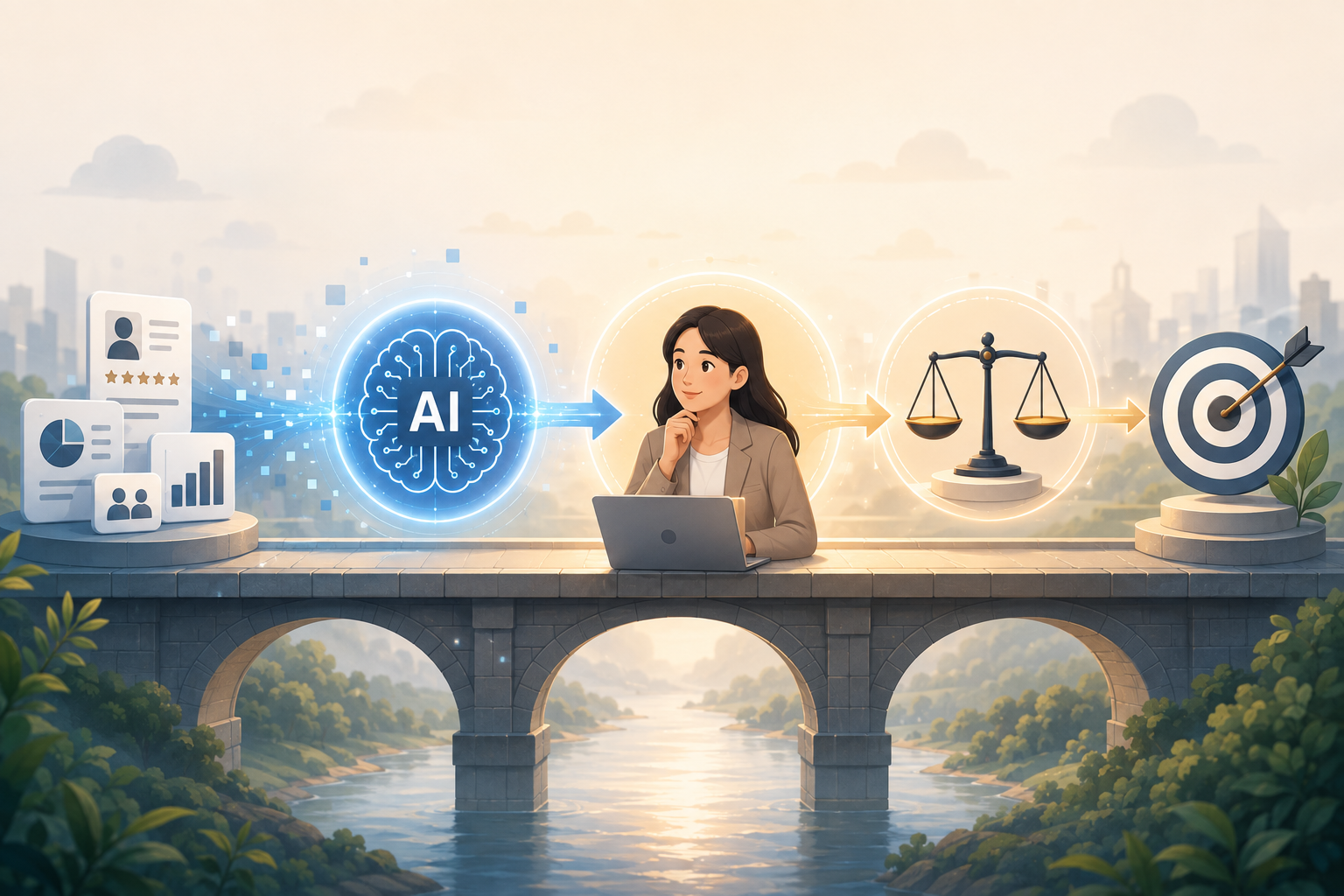
The level of oversight should increase in line with the impact. Drafting general announcements may utilize routine content reviews, but guidance on employment, performance, or career opportunities must include clear criteria, fairness reviews, and responsible parties who can explain the decisions.
How to get started using AI in HR?
- Let's start with HR pain points.
Choose a clear problem, such as repetitive questions, document drafting, or delays in finding information.
- Choose a use case with the appropriate risk level.
Start with Draft, Summarize, Search, or Organize—tasks that directly impact hiring and employee evaluations.
- Specify information and access permissions.
Check what data is being used, who has access to it, and whether the tool has been approved.
- Establish a Human Review.
Specify the checkpoint, edit, approve, or escalate, and the final responsible party.
- Conduct trials with small groups.
Test the Quality, Accuracy, Workflow, User Experience, and risks before scaling up.
- Measuring value and risk.
Measure performance, quality, adoption fairness, and incident, not just the number of users.
- Expand only on what produces the result.
Expand when there is evidence that Business Value and Control are working properly.
How should results be measured?
Dimension | Example Metrics |
Efficiency | Time Saved, Cycle Time, Case Resolution |
Quality | Accuracy, Rework, Human Correction Rate |
Experience | Adoption, Employee Feedback, User Satisfaction |
Risk | Escalation, Fairness Indicators, Privacy หรือ Security Incidents |
Business Value | HR Capacity, Service Improvement, Talent Outcomes |
The number of Prompts or the number of logins alone cannot prove that AI makes a job better. Both time saved, answer quality, human editing, user experience and risk events should be examined.
A good AI is not one that replaces everything.
The success of AI is not measured by the number of steps the system performs instead of humans. Some tasks should be automated because the steps are clear and the risk is low. Other tasks are better suited for AI to prepare data or offer options, which are then reviewed by a human.
Which tasks should be supported by AI, and which require human context, responsibility, and decision-making?
Many types of HR work require listening, trust, contextual understanding, and accountability. Organizations that clearly define the roles between technology and humans will increase efficiency without compromising quality, fairness, or trust.
Summary
AI in HR refers to the application of artificial intelligence to support HR processes, data analysis, and employee experience. The technology helps reduce repetitive tasks, summarize and discover information, recommend content, identify patterns, and support workflows in recruiting, HR service, learning, performance, talent, and people analytics.
However, organizations must clearly define use cases, data, human review rights, fairness, accountability, and performance measurement methods. When AI is responsible for the appropriate tasks while humans still oversee context, fairness, and critical decision-making, HR will work faster without compromising the value of human judgment and human interaction.