

Fraud is becoming increasingly difficult to detect as criminals use more sophisticated techniques to conceal suspicious activity. Traditional rule-based fraud detection systems can detect known fraud patterns, but these systems may become less effective when these patterns change or become more complex. Fraud Detection AI uses artificial intelligence (AI) and machine learning to analyze large amounts of data, detect unusual behavior, and identify potential fraud risks more efficiently.
What is Fraud Detection AI?
Fraud Detection AI is the use of artificial intelligence technology to automatically identify transactions, activities, or behaviors that may be related to fraud.
Unlike traditional systems that rely on manually created conditions or rules, AI-driven systems can learn from historical and real-time data continuously to identify patterns and detect anomalies that may indicate fraud.
These systems can analyze thousands or millions of transactions simultaneously, allowing organizations to discover suspicious behavior faster than manual investigations alone.
Why are traditional fraud detection systems no longer sufficient?
Traditional fraud detection systems often use predefined rules, such as:
- Transactions with a value exceeding a specified amount.
- Multiple login attempts failed.
- Purchasing goods from unusual locations.
- A large number of transactions within a short period of time.
Although these methods can be useful, scams and fraudsters are constantly changing, resulting in hard and fast rules possibly:
- New patterns of fraud cannot be detected.
- Generated a large number of false alerts.
- The rules have to be updated manually quite often.
- There are limitations when dealing with a massive volume of transactions.
Fraud Detection AI overcomes these limitations by learning from data and automatically adapting to new fraud patterns.
How does Fraud Detection AI work?
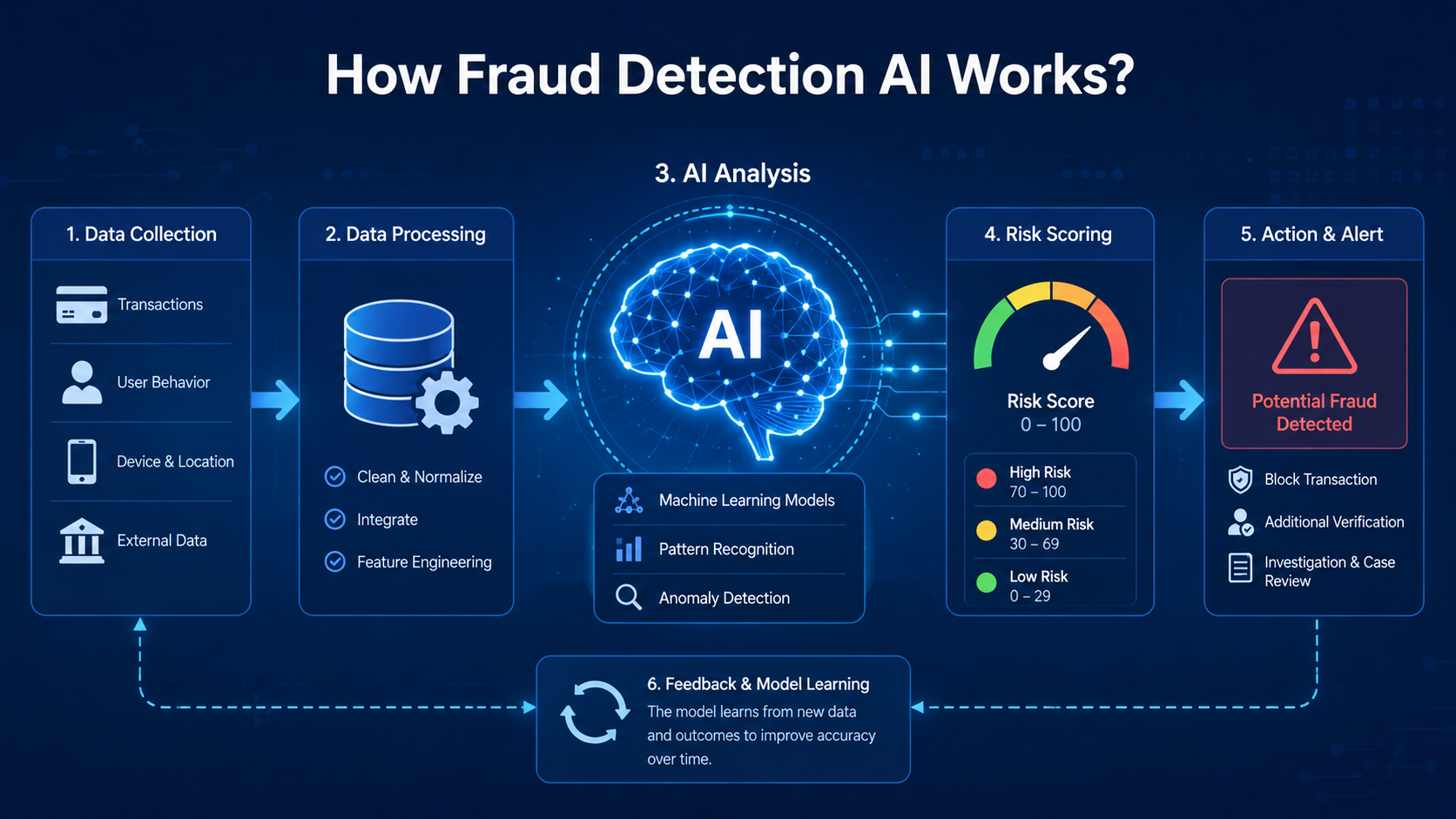
The AI-powered fraud detection process generally involves several steps.
- Data collection
The system will collect relevant information from transactions, user activity, devices, accounts, locations, and other available data sources.
For example, a payment system might analyze data such as the amount of money, transaction time, location, device information, account history, and transaction frequency.
The quality and relevance of data are crucial, as AI models require accurate data to identify meaningful patterns and appropriately assess risks.
- Analyze normal behavior.
The system learns what the typical activity of a customer, account, or transaction looks like.
For example, a customer might regularly purchase low-value items from the same location and use the same device. This data helps create a behavioral baseline to compare with new activities in the future.
Understanding normal behavior helps the system detect abnormal changes.
- Identify suspicious patterns.
The AI model will examine new activity and look for patterns that may indicate fraud.
A single transaction can become more suspicious when several unusual signs occur simultaneously. For example, an account that is normally inactive may suddenly make several high-value transactions from a new location and using an unfamiliar device.
The system can evaluate multiple types of signals simultaneously, instead of relying on a single rule.
- Calculate the risk score.
Many fraud detection systems assign a risk score to various transactions or activities.
Low-risk transactions may proceed as normal, while high-risk transactions may be flagged for additional identity verification or investigation by authorities.
Risk scoring helps organizations prioritize the cases that require the most investigation.
- Implement a response.
When the system detects suspicious activity, it can take appropriate action in response.
Depending on the organization's policy, the actions may include:
- Please provide additional identity verification.
- The transaction has been suspended for investigation.
- Send a notification to the security team.
- Blog of suspicious activity.
- Create a case for investigation.
The goal is to respond quickly to risks while minimizing the impact on users who are conducting transactions correctly.
Key technologies behind Fraud Detection AI.
Machine Learning
Machine learning can discover hidden patterns and predict potentially fraudulent behavior based on historical data.
Artificial Intelligence
AI combines predictive analytics, automation, and decision-making capabilities to help organizations prevent fraud more intelligently.
Big Data Analytics
Fraud detection systems can process vast amounts of data to identify risks from multiple channels and data sources.
Behavioral Analytics
This technology analyzes how users interact with the system and helps identify abnormal behavioral patterns.
Real-Time Processing
It helps organizations analyze activities and detect risks in real-time, increasing the chances of stopping fraud before financial damage occurs.
What types of signals can AI analyze?
Fraud detection systems can consider a variety of signal types, depending on the industry and the data the organization has.
Examples of common signals include:
- Transaction amount
- Transaction frequency
- Account history
- Login behavior
- Device information
- IP or network information
- geographical location
- The time period in which the activity takes place.
- Payment methods
- Changing customer behavior
A single signal doesn't always mean the activity is fraudulent. AI can evaluate multiple types of signals simultaneously to determine if the activity has an unusually high level of risk.
Fraud Detection AI vs. Rule-Based Detection Systems
Traditional fraud detection systems often rely on predefined rules, such as blocking transactions when their value exceeds a certain amount or when transactions originate from specific locations.
Traditional fraud detection systems often rely on predefined rules, such as blocking transactions when their value exceeds a certain amount or when transactions originate from specific locations.
AI can help enhance these systems by discovering complex relationships and behavioral patterns that might be difficult to detect with rules alone.
In practice, organizations can integrate the use of machine learning rules, behavior analysis, and human verification, rather than relying on a single technology.
Benefits of Fraud Detection AI
The use of AI in fraud detection can bring several benefits to organizations.
- Faster detection.
AI can analyze large amounts of activity quickly, helping organizations detect suspicious transactions faster. - Risks can be identified more accurately.
AI can consider multiple types of signals simultaneously and find patterns that might be difficult to detect through manual inspection. - Reduce workload
Instead of having to check every transaction, the fraud detection team can focus on high-risk cases identified by the system. - To support business expansion.
As transaction volumes increase, automated analytics help organizations maintain their ability to detect fraud without relying entirely on manual processes. - Continuous investigation
AI-powered systems can continuously monitor activity, enabling organizations to respond to suspicious behavior even outside of normal business hours.
Real-world applications of Fraud Detection AI.
Banking and financial services.
Banks can use Fraud Detection AI to identify:
- Credit card fraud
- money laundering
- Unauthorized money transfer.
- Synthetic Identity Fraud
E-commerce
Online retail businesses can use AI to detect:
- Payment fraud
- Account seizure
- Fake refund request
- Misuse of promotions.
insurance
Insurance companies can use AI to identify:
- False insurance claims
- Duplicate claims
- Suspicious behavior during insurance applications.
telecommunications
Telecommunications providers can use AI to prevent:
- Subscription fraud
- SIM Swap Fraud
- Unauthorized access to the account.
Healthcare
Healthcare organizations can detect:
- Billing fraud
- Misuse of prescription drugs.
- Misuse of another person's identity.
Challenges of Fraud Detection AI
While AI can improve the efficiency of fraud detection, this technology is not perfect.
One of the major challenges is false positives, or cases where legitimate activity is incorrectly identified as suspicious. A large number of false positives can create difficulties for clients and increase the workload for the audit team.
Another challenge is changing the behavior of fraudsters. Once fraudsters discover how detection systems work, they may modify their techniques to evade detection.
Therefore, organizations need to continuously monitor model performance, improve detection strategies, maintain data quality, and conduct human audits where appropriate.
Summary
Fraud Detection AI works by collecting and analyzing data, learning typical behavior, identifying suspicious patterns, calculating the risk level, and taking appropriate responses.
The ability to process large amounts of data and detect complex behavioral patterns makes AI a crucial tool for preventing digital fraud. However, AI should work in conjunction with traditional rules, security systems, and human expertise.
For organizations, an effective approach focuses not only on detecting fraud faster, but also on creating a continuous and adaptable fraud management process to be ready to respond to ever-changing threats.