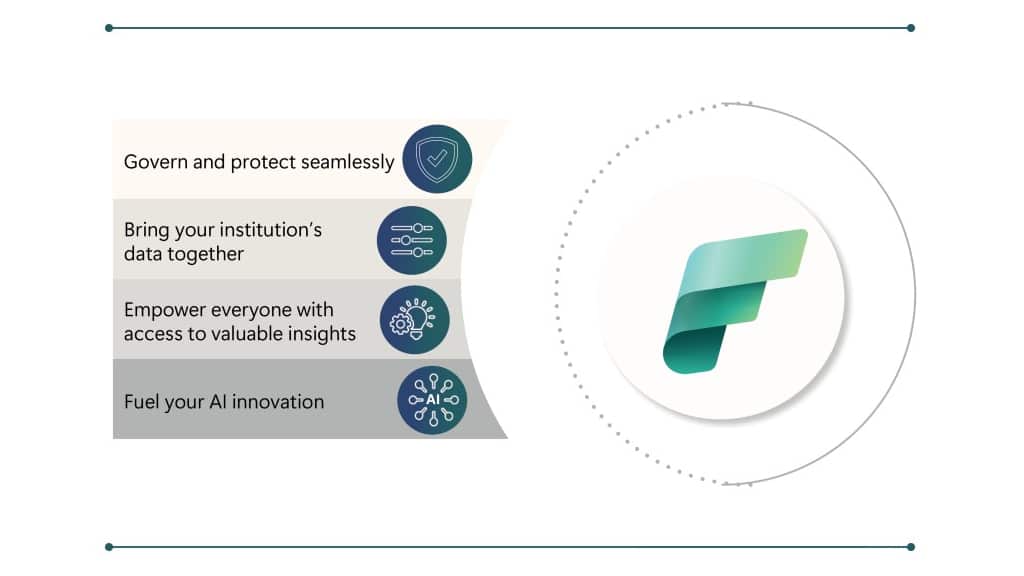
In today's data-driven economy, organizations need more than fragmented analytics tools; they need a unified, intelligent, and scalable data platform. The advantage of Fabric lies in its ability to integrate all data workloads, reduce complexity, and generate insights faster, all within a single SaaS experience.
Microsoft Fabric is a next-generation data analytics platform that seamlessly integrates data engineering, data science, real-time intelligence, and business intelligence into a single ecosystem.
The advantages of using fabric in the context of a Unified Data Platform.
One of the most significant highlights of Microsoft Fabric is its truly unified architecture. Instead of managing multiple separate systems, Fabric integrates everything into a single platform.
The main benefits include:
- A single environment for data engineering, data science, real-time analytics, data warehousing, and reporting.
- Powered by OneLake, a centralized logical data lake, it eliminates data silo issues.
- A single source of truth shared across all analytics workloads.
This approach significantly reduces data redundancy, system integration complexity, and friction between teams.
Advantages of Fabric Production in terms of Cost Efficiency and Return on Investment (ROI)
Microsoft Fabric is not only powerful but also economically viable. Independent research indicates that organizations can achieve a return on investment (ROI) of up to 379% within three years, primarily driven by platform integration.
The organization will benefit as follows:
- Reduce licensing and infrastructure costs by replacing fragmented analytics tools.
- Reduce operating costs with a centralized SaaS model.
- Create value faster using integrated tools and shared data.
Simplifying the analytics stack allows organizations to accomplish more with fewer resources.
Integrating AI and real-time insights.
Fabric is designed to work seamlessly with Microsoft Azure and AI technologies, helping organizations move from descriptive analytics to predictive and intelligent decision-making.
Key skills include:
- Supports built-in machine learning and AI-driven analytics.
- Processing data streams in real-time for instant insights.
- Enterprise security and scalability through Azure infrastructure.
This makes Fabric ideal for organizations that need to work in a rapidly changing environment with large amounts of data.
Integrated data lifecycle management and governance.
Microsoft Fabric supports the entire data lifecycle, from data import to visualization, within a centralized, governed environment.
Our main strengths include:
- A complete workflow, from ingestion, transformation, storage, analytics to reporting.
- An interconnected experience across Data Factory, Data Engineering, Data Science, and Power BI.
- Centralized governance with the OneLake Catalog supports compliance and easy information searching.
This governance model helps organizations meet regulatory requirements while maintaining data flexibility.
Collaboration, expansion, and future readiness.
Fabric is designed for collaboration and long-term growth:
- It supports collaboration between data engineers, analysts, and data scientists in a single environment.
- Elastic scaling on a self-adapting SaaS.
- Suitable for both small businesses and large organizations.
As Microsoft's third-generation data platform, building on the lessons learned from Azure Synapse and Power BI Fabric, it is continuously evolved with new AI capabilities, making it future-ready from the design stage.
Comparison Table: Microsoft Fabric vs. Traditional Analytics Tools
Feature | Microsoft Fabric | Traditional analytics tools |
Data integration | Centralized access via OneLake | Multiple separate systems |
ROI | 379% within 3 years | Lower and scattered |
AI capabilities | It has built-in AI and ML | A splitting tool is required |
Real-time processing | Directly supported | Limited or an add-on |
Supervision | Centralized Catalog | Organize by tool |
Expansion | Elastic on SaaS | It depends on the hardware |
Potential Challenges to Consider
While Microsoft Fabric offers significant advantages, organizations should prepare a plan to address the following issues:
- Learning curve as teams adapt to an integrated environment
- Migration effort when moving from legacy analytics systems
- Vendor dependency, especially for organizations pursuing multi-cloud strategies
With proper planning and training, these challenges can be effectively managed.
Summary
Microsoft Fabric delivers clear strategic value by unifying data platforms, enabling AI-driven insights, lowering costs, and supporting real-time analytics at scale. For organizations looking to modernize their data architecture, Microsoft Fabric provides a powerful, future-ready foundation.