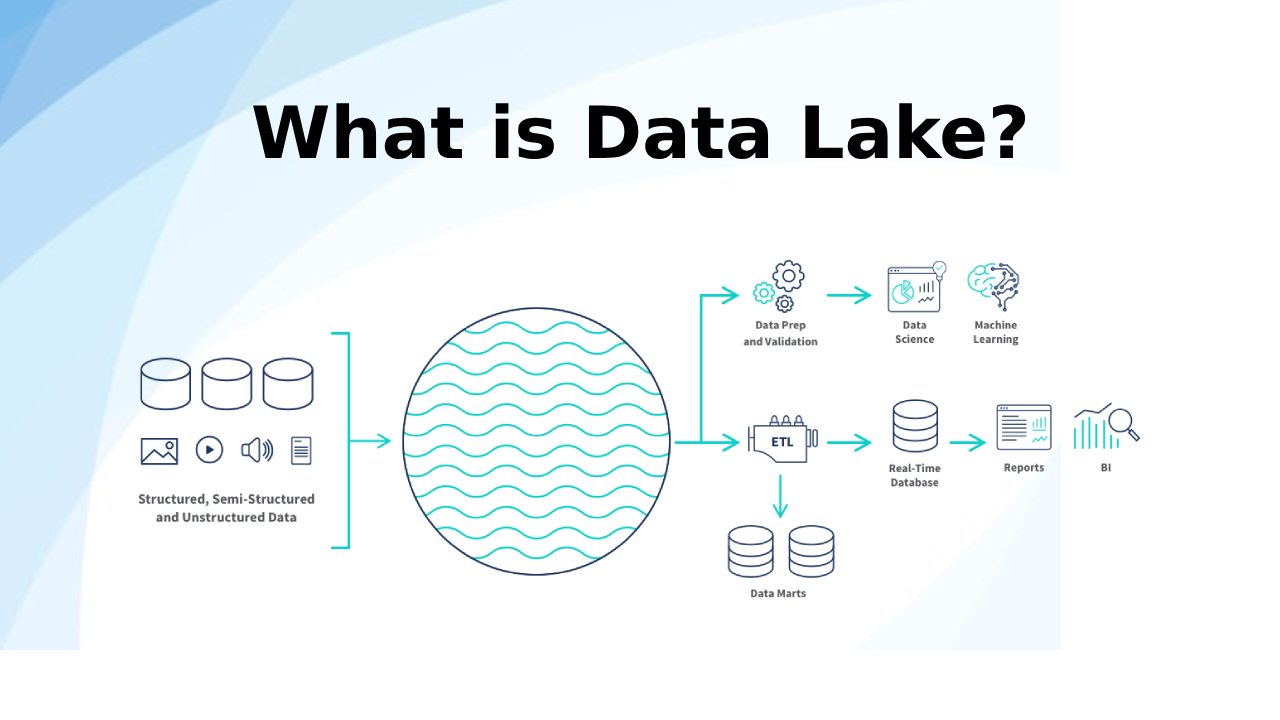
In today's data-driven era, organizations generate and manage vast amounts of data daily. Efficiently managing, storing, and analyzing this data has become crucial. Important strategies for business What is a Data Lake? This term refers to modern data storage architecture that enables businesses to... It can store large amounts of data in various formats, including structured, semi-structured, and unstructured data. Without needing to specify a format in advance.
different from Traditional data warehouse It is necessary to define the data structure before storing it. Data Lake It is highly flexible, expandable, and suitable for various applications. Big Data Analytics, Machine Learning (ML), Artificial Intelligence (AI), and Real-time Data Processing. But how does this structure work? And why are so many organizations starting to use this system? Let's look at the details.
What is a data lake and how does it work?
Data Lake It is a storage system that can It can flexibly collect, store, process, and analyze data from various sources. Without needing to convert the data to a specific format before storage.
Key components of a data lake
- Ingestion Layer – perform duties Gather information from various sources. Examples include IoT databases, APIs, log files, social media, and on-premises applications.
- Storage Layer – used for Store raw data Without format limitations, it supports JSON, CSV, images, videos, and other data types.
- Processing Layer - use Big Data technologies such as Apache Spark and Hadoop. To analyze and process data.
- Consumption Layer – Connect with Business Intelligence (BI), Machine Learning, and data analytics platforms. To retrieve and use the data.
With this architecture, businesses can... Storing large amounts of data is cost-effective and allows for easy retrieval when in-depth analysis is required.
Advantages of using a Data Lake

For organizations that want to leverage big data. Data Lake It has many advantages.
- Supports storage of all data formats without prior conversion.
- Supported Structured, semi-structured, and unstructured data.
- There is no need to define the data format before storing it, making it possible... It offers flexible storage and is ready for later analysis.
- Easily scalable and low cost.
- can Expand storage space as needed. Supported Big Data Storage at full efficiency
- It has lower costs than traditional data warehouses. Because there are no costs involved in managing the data structure.
- Supports AI, Machine Learning, and Predictive Analytics.
- Suitable for Artificial intelligence and machine learning models. This requires a large amount of data for training.
- Supported Deep Learning, Sentiment Analysis, and Predictive Analytics. precisely
- Process data in real time
- can collect Streaming data from IoT, financial transactions, and digital user behavior.
- Suitable for applications requiring Real-time data analysis, such as fraud detection and stock market forecasting.
- Integrates with BI tools and data analytics platforms.
- Supported Power BI, Tableau, Google Looker, and custom data analysis tools.
- Helping businesses to Create dashboards, analyze trends, and accurately track key performance indicators (KPIs).
Data Lake vs. Data Warehouse: Key Differences
Many businesses often confuse the two. Data Lake และ Data Warehouse However, these two systems have different purposes:
Feature | Data Lake | Data Warehouse |
Data type | Raw, unstructured & structured data. | Processed and structured data. |
Data structure specifications | Schema-on-read (formatted as needed) | Schema-on-read (formatted as needed) |
Processing format | Supports AI, ML, and big data analytics. | Suitable for SQL queries and report generation. |
Use cases | Advanced analysis, trend forecasting. | Businesses that require structured reporting. |
Cost efficiency | Below (stores raw data) | Higher (requires data transformation process before storage) |
Data Lake Suitable for AI data analytics, unstructured data storage, and real-time data processing. while Data Warehouse Suitable for Creating structured business reports with traditional analytical systems.
Common challenges and solutions.
แม้ว่า Data Lake There will be many advantages, but there are also some challenges that organizations will face.
- Data governance and security.
- Challenges: Without proper controls, a data lake could be vulnerable to data breaches.
- How to fix: use Access control policies, data encryption, and data masking. to maintain data security
- The risk of a data lake becoming a “data swamp”.
- Challenges: Without proper organization, the data in a data lake can become scattered and difficult to use.
- How to fix: use Metadata management systems and data cataloging tools. To help track and manage data.
- Performance issues
- Challenges: Retrieving large amounts of raw data can be time-consuming if not properly managed.
- How to fix: Use techniques Data Partitioning, Indexing, and Caching to increase processing speed
By systematically addressing these challenges, organizations can... Maximize the performance of the Data Lake. We are committed to maintaining security and complying with data management requirements.
Real-world case studies of Data Lake use cases.
Retail and e-commerce business
- follow Customer purchasing behavior and preferences.
- amend Supply Chain Management According to real-time sales data
Financial and banking sector
- Detect Suspicious transactions Using AI to prevent fraud.
- Analyze Client risk profile and investment trends.
Public health and biotechnology sector
- Analyze Genomic data for personalized medicine.
- Supported AI-driven diagnostics and medical research.
IoT and smart technology industry
- Process data in real-time from... Connected vehicles and industrial sensors.
- Help develop the system Predictive maintenance and smart city infrastructure.
A data lake enables businesses across various industries to... Transform raw data into actionable insights. It helps improve efficiency and drive innovation.
How to get started with a Data Lake in your organization.
To install and use Data Lake To operate effectively, businesses should follow these steps:
- Assess the information needs. - specify Sources of information, quantity, and types of information. To set up a suitable storage system.
- Choose a cloud platform – Microsoft Azure, AWS, and Google Cloud There are Data Lake solutions that are easy to manage.
- Establish a data governance policy. - use Role-Based Access Control (RBAC) and data encryption. to keep safe
- Integrate data processing tools. - use Big Data Frameworks such as Apache Spark and Hadoop. for advanced data analysis
- Track and improve performance - use Tools for metadata inspection, indexing, and query performance improvement.
Following these steps will help businesses to... Build a secure, well-structured, and high-performance data lake.
Summary : What is a Data Lake?
For businesses that need a solution Flexible, scalable, and low-cost data storage. Data Lake It's a great choice, with its capabilities... Stores raw data and supports advanced analysis. The organization can Unlock the potential of big data. effectively
What is a Data Lake? In summary It is a modern data warehouse designed to efficiently store and process massive amounts of data. desired company Enhance real-time analytics, train AI models, and drive data-driven decision-making. We should consider implementing this technology.
For more information on the usage guidelines and benefits of this type of data storage system, please see the details below. Microsoft Azure Data Lake To explore suitable solutions for your business.
Explore our digital tools
If you are interested in implementing a knowledge management system in your organization, contact SeedKM for more information on enterprise knowledge management systems, or explore other products such as Jarviz for online timekeeping, OPTIMISTIC for workforce management. HRM-Payroll, Veracity for digital document signing, and CloudAccount for online accounting.
Read more articles about knowledge management systems and other management tools at Fusionsol Blog, IP Phone Blog, Chat Framework Blog, and OpenAI Blog.