
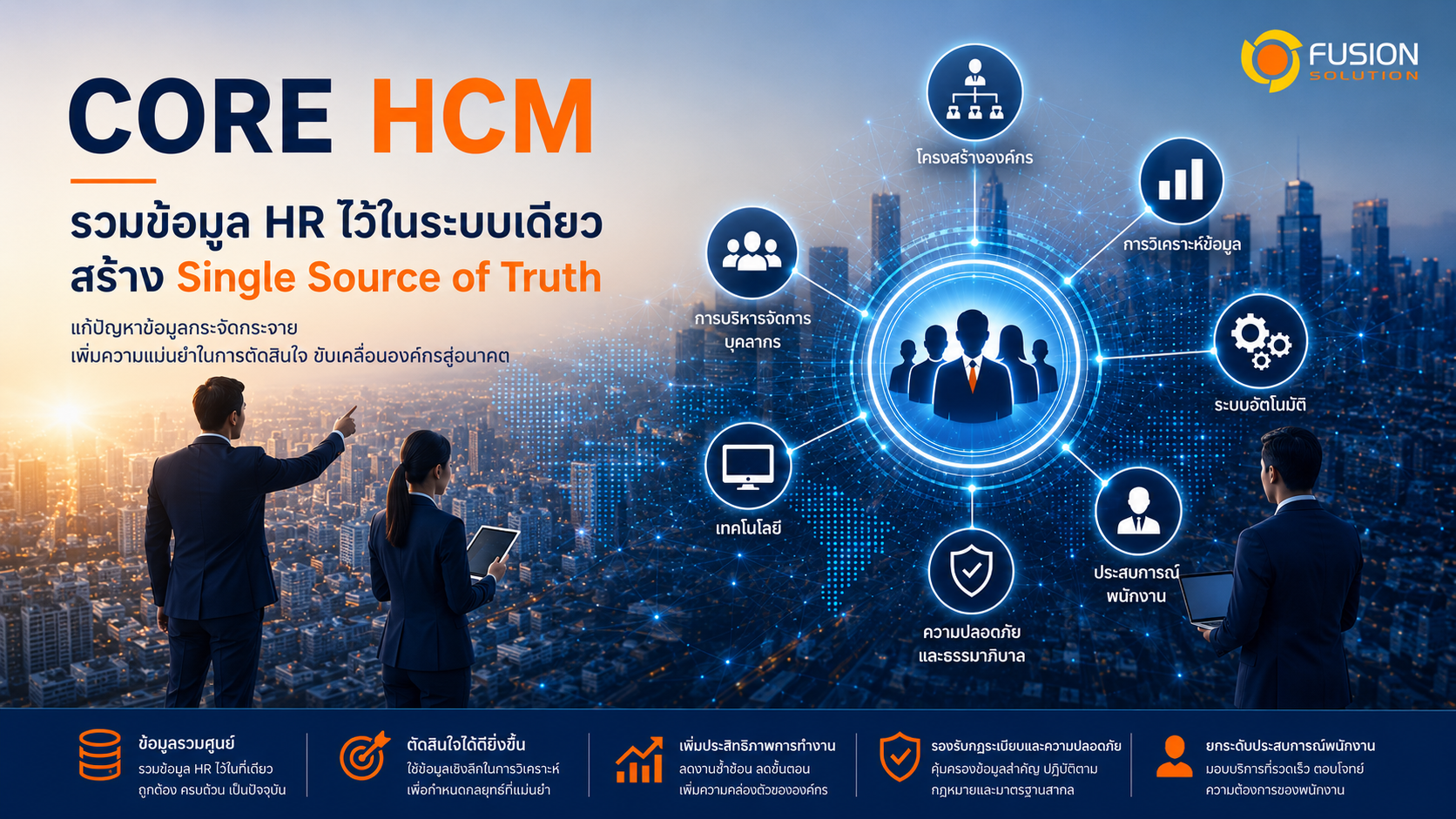
Many organizations are planning to introduce AI, people analytics, and automation into HR. Yet the most significant barrier is often not the technology itself. It is employee data scattered across disconnected systems.
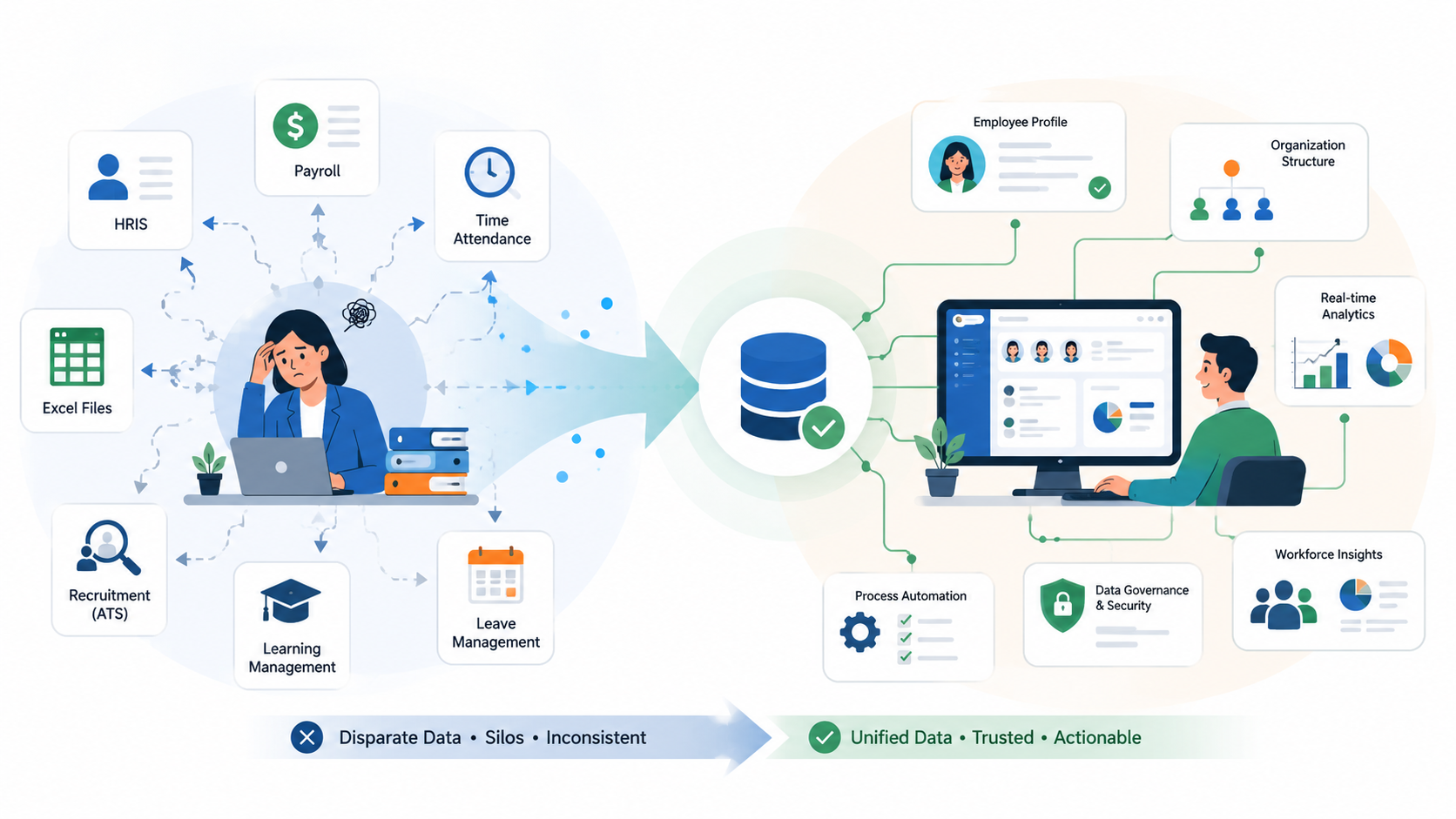
Personal information may sit in an HRIS, payroll data in a payroll platform, attendance records in a time-tracking system, position data in spreadsheets, and learning or performance histories in separate applications.
When each system maintains its own version of employee data, HR teams must determine which file is current, reconcile conflicting records, and spend additional time preparing reports. Leaders are left without a reliable, organization-wide view of the workforce.
Core HCM addresses this challenge by providing a central foundation for workforce data, organizational structures, positions, and employee lifecycle processes. Its central purpose is to establish a single source of truth that people and systems across the organization can use consistently.
What Is Core HCM?
Core HCM, or Core Human Capital Management, is a central system for managing employee data, organizational structures, positions, and workforce changes throughout the employee lifecycle. It connects critical workforce information and provides an authoritative source for HR processes and decisions.
HCM generally refers to end-to-end HR technology that spans the employee lifecycle, while Core HCM provides the foundational records, structures, and transactions on which broader talent, learning, performance, workforce planning, and analytics capabilities depend.
ในบริบทของ Workday ระบบ Core Human Capital Management เป็นส่วนหนึ่งของชุด HCM ที่เชื่อมโยงกับ Workforce Planning & Analytics, Talent Management, Workforce Management ตลอดจน Experience & Engagement บนสภาพแวดล้อมเดียวกัน
What Is Fragmented HR Data?
Fragmented HR data exists when workforce information is stored across multiple systems, files, or departments without a clearly defined authoritative source.
- HR stores employee records in an HRIS.
- Finance relies on employee data from payroll.
- Managers maintain position and headcount information in spreadsheets.
- Recruitment uses a separate applicant tracking system.
- Learning teams operate an independent training platform.
- Leave and attendance data remain in specialist applications.
- Different entities use different employee codes or organizational structures.
The problem is not simply the number of systems. Organizations can operate multiple platforms successfully when the systems are integrated and ownership is clear. Fragmentation becomes a business risk when the same information is created, edited, and stored independently in several places without effective governance.
Six Signs That HR Data Is Fragmented
1. Headcount figures do not match
HR, finance, and leadership receive different workforce totals because reports use different definitions, source systems, or cut-off dates.
2. Reports require manual consolidation
HR teams download data from several platforms and combine spreadsheets before producing monthly or executive reports.
3. The same data must be entered repeatedly
A change in department, position, manager, or work location requires updates in several systems.
4. Data ownership is unclear
When an error appears, teams cannot identify who should correct it or which system holds the authoritative record.
5. Reports are already outdated
By the time data is collected and validated, the report may no longer reflect current workforce conditions.
6. Employees see inconsistent information
Job titles, managers, benefits, or personal details differ across employee-facing channels.
How Fragmented HR Data Affects the Business
HR spends time on low-value administration
Instead of focusing on workforce planning, talent strategy, or employee experience, HR teams reconcile files, clean data, and correct conflicting records.
Decisions rely on information that leaders do not fully trust
Headcount planning, workforce cost analysis, and organizational design require consistent definitions and reporting periods.
Data governance becomes difficult
When employee data is copied across files and applications, controlling access, purpose of use, and retention becomes more complex.
Advanced HR capabilities are harder to scale
People analytics and AI depend on structured information and context. Poor foundational data can undermine the reliability of advanced analysis.
What Is a Single Source of Truth in HR?
A single source of truth, or SSOT, is an agreed authoritative source for each type of workforce data, supported by clear rules for creating, changing, validating, and using that information.
A single source of truth does not necessarily require every data element to reside in one database. It requires the organization to know:
- Which system owns each data element.
- Which version is authoritative.
- Who can create or change the data.
- How other systems receive and use it.
- How data quality and change history are monitored.
How Core HCM Creates a Single Source of Truth
1. Centralizes employee master data
Core HCM establishes core records such as employee ID, employment status, position, organizational unit, cost center, work location, manager, start date, and change history.
2. Manages organizational structures
It connects companies, business units, divisions, departments, teams, positions, managers, and cost centers within a governed structure.
3. Supports position management
Position management separates the position from the person occupying it, improving visibility into filled, vacant, and planned positions.
4. Connects employee lifecycle changes
Promotions, transfers, manager changes, extended leave, and termination can follow governed workflows with approval and change history.
5. Applies security and data governance
Role-based access helps employees, managers, HR business partners, administrators, and leaders access only the information needed for their responsibilities.
6. Integrates with other systems
เชื่อม Core Human Capital Management กับ Payroll, Time Attendance และระบบเฉพาะประเทศ พร้อมกำหนดศูนย์กลางและมาตรฐานการแลกเปลี่ยนข้อมูล
Core HCM vs. HRIS vs. HRMS
system | Typical Focus | Typical Scope |
HRIS | Store and manage HR information | Employee records and core HR administration |
HRMS | Manage multiple HR processes | HRIS capabilities plus payroll, time, benefits, or workflows |
HCM | Manage the Employee Lifecycle | Core HR, talent, learning, performance, analytics, and workforce planning |
Core HCM | Provide the HCM foundation | Employee data, organizational structures, positions, and core workforce transactions |
The terms HRIS, HRMS, and HCM are used differently across providers. Organizations should therefore evaluate actual capabilities, data structures, integration requirements, governance, and supported processes rather than relying on the product category alone.
Business Benefits of Core HCM
More consistent workforce data
Clear points of creation and update reduce duplicate records and conflicting versions of employee information.
Less repetitive administration
Approved data can flow to related processes and systems instead of being re-entered at every stage.
A clearer workforce view for leaders
Connected information about people, positions, structures, and changes gives workforce reports better context.
Employee and manager self-service
A connected platform enables authorized users to view information and complete relevant transactions without unnecessary HR intervention.
A stronger foundation for people analytics
Governed workforce data supports evidence-based analysis and more reliable reporting.
Better preparation for AI
AI requires trusted data and business context. A governed data foundation should precede the expansion of AI use cases.
Which Organizations Should Consider Core HCM?
- Organizations with multiple workforce groups or business units.
- Companies operating across multiple legal entities or countries.
- Organizations using several disconnected HR systems.
- HR teams that rely heavily on spreadsheets for reporting and reconciliation.
- Businesses that frequently reorganize.
- Organizations planning to expand people analytics or workforce planning.
- Companies digitizing HR processes.
- Organizations seeking greater employee and manager self-service.
Guidelines for preparing an organization before implementing Core Human Capital Management.
1. Define the business problem
Identify where the organization loses time, experiences errors, or lacks reliable information.
2. Build a data inventory
Document where each workforce data element resides, who owns it, which systems use it, and where duplication occurs.
3. Assign data owners
Establish accountability for employee master data, organizational data, position data, compensation data, and other critical domains.
4. Standardize definitions and data structures
Align codes, names, fields, definitions, and statuses used across processes and systems.
5. Clean data before migration
Review completeness, accuracy, duplication, and consistency before moving records into a new environment.
6. Design integrations around the source of record
Define which system creates each data element, which systems consume it, and where updates can flow back.
7. Establish governance and security from the start
Design role-based access, approval processes, audit trails, and privacy controls alongside the operating model.
Core HCM as the Foundation of Digital HR Transformation
Organizations may quickly acquire AI tools or dashboards, but if employee data isn't interconnected, those tools may not generate reliable insights. Therefore, Core Human Capital Management shouldn't be viewed merely as an employee record system, but rather as the data foundation of HR transformation, connecting data, processes, roles, and decision-making.
Summary
Fragmented HR data creates more than administrative inconvenience. It complicates reporting, governance, workforce planning, employee service, and executive decision-making.
Core Human Capital Management helps to standardize personnel data, organizational structure, job positions, and employee lifecycle processes on a unified foundation, creating a single source of truth that the system and stakeholders can use as a shared reference.
NEXT STEP If your organization is using With HR systems spanning multiple platforms and the need to integrate reports using Excel, evaluating the current data structure, processes, and integration will provide a clearer picture of readiness before starting a Core Human Capital Management project.