
Voice AI is becoming one of the most important interfaces of modern technology. From customer service systems and intelligent assistants to real-time collaboration systems and AI agents, organizations are looking for systems that can communicate naturally, respond instantly, and better understand the context of conversations.
To support this change, OpenAI has launched new Voice Intelligence capabilities through its API platform, including the development of new Realtime Voice Models designed to create more natural, real-time AI conversations with lower latency.
This update reflects a major transition in the AI industry, moving beyond text-generating systems to fully interactive voice-driven experiences.
What are Realtime Voice Models?
Realtime Voice Models are part of OpenAI's efforts to support live conversational AI experiences via API.
Unlike traditional voice systems that separate the processes of speech recognition, reasoning, and text-to-speech, the Realtime Approach is designed to process voice conversations more smoothly and naturally.
This allows developers to create AI systems that can:
- Respond instantly during live conversations.
- Supports natural interruptions during speech.
- Maintain the continuity of the conversation in real-time.
- Supports more human-like voice interaction.
The result is a more interactive experience than traditional voice assistants, which often feel slow, stiff, or lack continuity.
Moving beyond traditional voice assistants
Traditional voice systems often work in a pipeline fashion, converting speech to text first, then processing it with AI, and finally converting it back to synthesized speech. While this method is practical, it often creates latency and unnatural pauses during conversations.
OpenAI's new Realtime Voice Models architecture focuses on reducing these latency issues and improving conversation continuity.
Users can speak more naturally, interrupt conversations, and interact dynamically without constantly restarting the prompt.
This creates a communication style that is more fluid and closer to a human conversation than the command-based Assistant usage of the past.
Designed for AI agents and real-time workflows
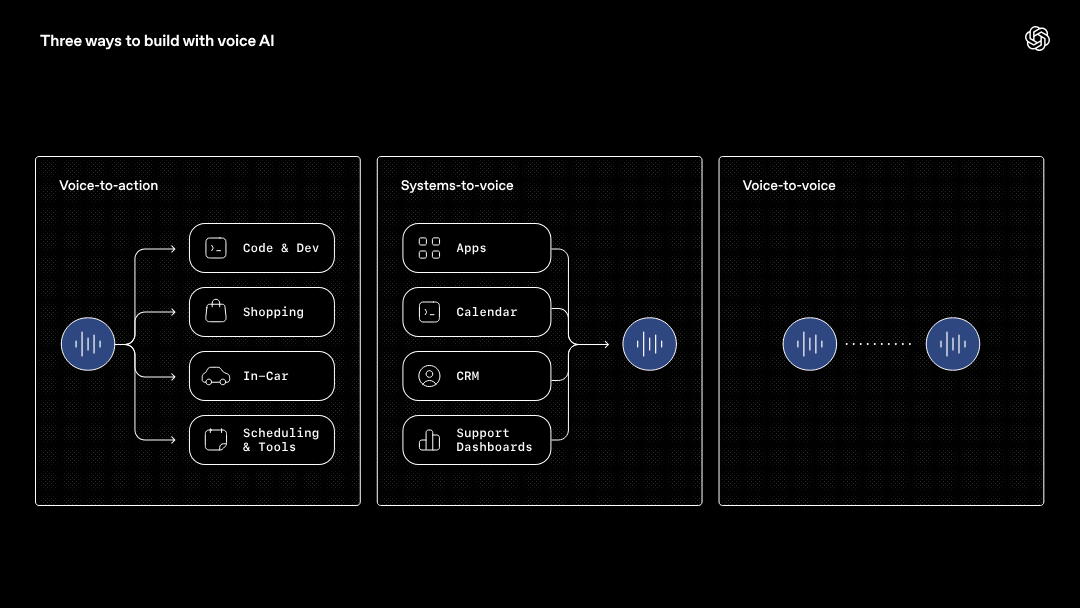
One of the most significant impacts of Realtime Voice Models is its role in the world of AI Agents and Enterprise Workflows.
As businesses increasingly adopt AI-driven automation systems, voice interfaces are becoming more important in areas such as:
- Customer Support System
- Interactive AI Assistant
- Real-time collaboration within the organization
- Voice-activated Enterprise Workflow
- AI-powered Help Desk and Contact Center
With its low-latency architecture, AI can participate in conversations while tasks are in progress, instead of having to wait for prompt-response cycles.
This aligns with industry trends moving towards Artificial AI, which can seamlessly integrate into business processes.
A more natural and contextually aware conversation
OpenAI also places great emphasis on developing Conversational Intelligence.
The new Voice capabilities are designed to help the system better understand tone, pacing, interruptions, and context of a conversation.
Instead of treating every sentence as a separate command, the system can better maintain conversational continuity, allowing Voice AI to sound more natural and flexible during interactions.
Natural speech transitions and reduced response latency are crucial for practical applications such as customer service or collaborative work environments within an organization.
Extend developer capabilities through APIs
These new models are made available through the OpenAI API ecosystem, giving developers greater flexibility to create custom Voice AI experiences within their applications and services.
Developers can use Realtime Voice Models to create:
- Voice-native Application
- Conversational AI Agent
- Real-time Assistant
- ระบบ Interactive Customer Engagement
- AI-driven Productivity Tool
This API-first strategy allows organizations to embed advanced Voice Intelligence directly into their existing products, rather than relying solely on standalone AI applications.
As voice becomes the primary interface of AI, APIs like this one could become a critical infrastructure for the next generation of software experience.
New opportunities for Enterprise Voice AI
Advances in Realtime Voice Intelligence also open up new opportunities for organizations that are adopting AI on a large scale.
Many organizations are beginning to explore the use of Voice AI systems in various areas, such as:
- Internal organizational support system
- Meeting assistance system
- Customer Interaction Automation System
- Real-time multilingual communication
- Workflow Orchestration via Voice Command
Because voice interaction significantly reduces friction between users and AI systems, it may help increase the adoption rate in environments where typing or manual operation reduces productivity.
For industries such as Healthcare, Finance, Customer Service, and Logistics, real-time conversational AI systems may become the primary interface of operations in the future.
The transition to Conversational Computing
The launch of Realtime Voice Models also reflects an even larger trend in the AI industry: the transition from text-first AI to conversational computing.
Instead of communicating with AI solely through typing prompts, users are beginning to expect a system that can:
- Listen continuously
- Respond immediately
- Understand conversational nuance
- Participate naturally in workflows
Voice interaction reduces the friction of traditional software interfaces, making AI more accessible and seamlessly integrated into daily work.
This change could fundamentally alter the way people interact with digital systems in the coming years.
Summary
New Realtime Voice Models from OpenAI represent another significant step in AI-driven voice interaction. By reducing latency, improving conversational continuity, and supporting more natural communication, OpenAI is helping to push Voice AI systems beyond command-based assistants to real-time collaborative experiences.
As organizations increasingly adopt AI agents and conversational workflows, Realtime Voice Intelligence may become one of the most important interfaces for enterprise technology.
The future of AI is no longer just about "generating answers," but increasingly about "participating" in conversations, workflows, and real-time decision-making.