OpenAI has released the GPT-5.3 Codex, the latest and most powerful version of its coding agent model, which goes beyond traditional code generation to become a truly interactive software development assistant. With significant improvements over previous versions, GPT-5.3 Codex offers higher speed and more comprehensive capabilities for tasks requiring reasoning, tooling, complex operations, and long-term workflows.
What makes the GPT-5.3 Codex different?
The GPT-5.3 Codex combines leading-edge coding performance with broader professional reasoning capabilities. It integrates the coding strengths of the GPT-5.2-Codex and the in-depth reasoning capabilities of GPT-5.2 into a single model, resulting in approximately 25% faster and more efficient performance.
This enables the model to better handle complex and lengthy tasks involving multiple stages of research, tooling, and operation, unlike previous models that focused primarily on code generation or review.
Furthermore, the GPT-5.3 Codex enables more team-like functionality. Users can direct, orient, and interact with the model while it is running, maintaining the task context and preventing loss of progress.
The reason why the GPT-5.3 Codex gained popularity so quickly
The GPT-5.3 Codex has become one of the most talked-about AI models among developers, engineers, and knowledge professionals for the following key reasons:
- Performance that feels like being on a real team
Not only is it faster, but it's also more responsive and understands the context of long-term work. It can respond to feedback along the way and adjust its approach immediately according to user instructions. - Fast and efficient for complex tasks
It works approximately 25% faster and uses fewer tokens, making it suitable for highly detailed development tasks such as app and game development, in-depth reasoning, and the use of various tools. - Achieved outstanding scores in real-world benchmarks
The GPT-5.3 Codex performs well on industry-level benchmarks such as SWE-Bench Pro and Terminal-Bench, reflecting the real-world workflow of developers for debugging, deploying, and automation. - It is used for self-development
This model was used during the development, debugging, and performance improvement processes, clearly demonstrating its enhanced potential. - Capabilities that extend beyond the code
Besides developers, other professionals can also use it, whether for drafting documents, analyzing data, preparing reports, or technical documentation throughout the software development lifecycle.
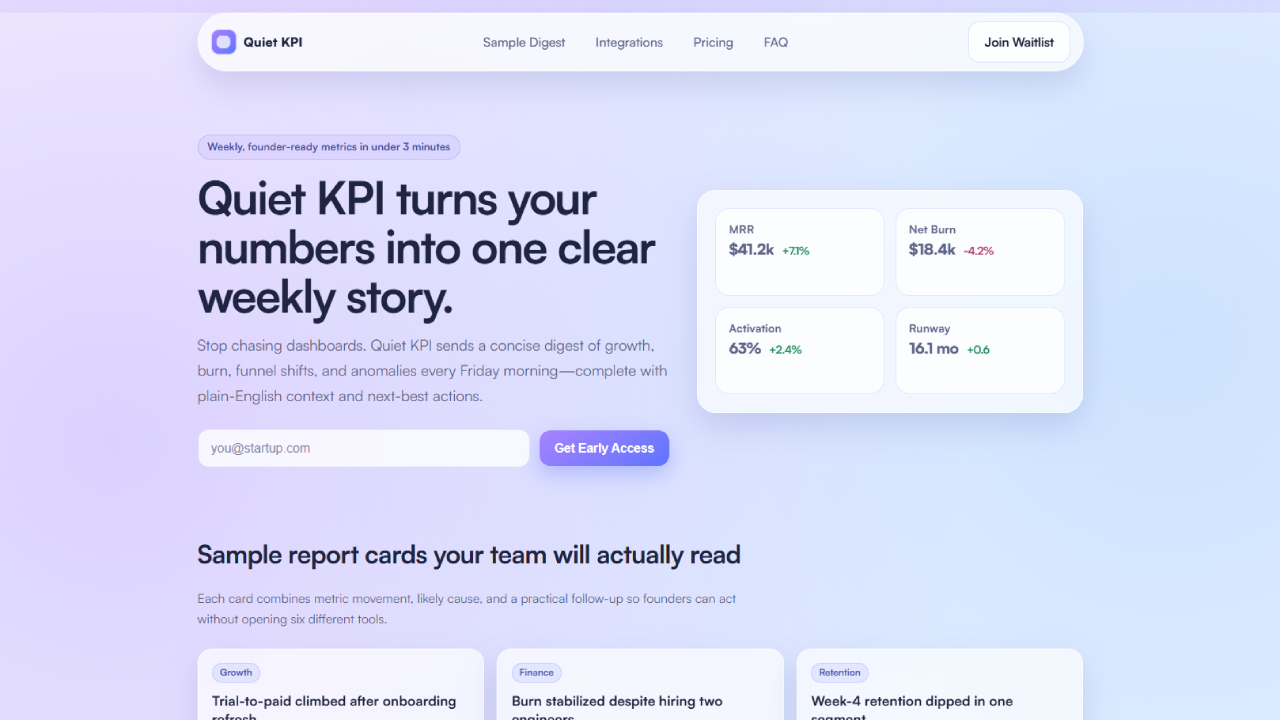
Prompt: Build a landing page for Quiet KPI a founder friendly weekly metric digest. Aesthetic is soft SaaS, glassy cards, lavender to blue gradient, subtle blur. Sections, hero with email capture, sample report cards grid, integrations row, testimonial carousel, pricing toggle monthly yearly, FAQ, footer.
– Typeface Satoshi or similar geometric sans.
– Buttons soft corners, 14px radius, strong focus states.
– Add one tasteful scroll based reveal.
Advanced capabilities that go beyond coding
Coding and development
The GPT-5.3 Codex performs at the forefront of rigorous benchmarks, demonstrating its ability to write and validate code across multiple languages and scenarios.
Complex workflows and long-term tasks
It allows you to build large-scale applications, continuously improve projects at the token level with millions of tokens, and develop results without losing context.
Professional work in the real world
It supports tasks beyond coding, such as documentation, debugging, deployment, data analysis, and creating presentations or spreadsheets.
Combining these skills brings Codex closer to becoming a comprehensive, operational assistant agent throughout the software development lifecycle.
Improved interaction and control
One of the most notable improvements in the GPT-5.3 Codex is in-process responsiveness. Users can ask questions, provide feedback, or prioritize tasks instantly, without waiting for the final result, making collaboration even more real-time.
Practical application and self-improvement
Interestingly, an initial version of the GPT-5.3 Codex was adopted by the OpenAI team to help debug and improve its own model training and deployment processes, reflecting the emerging role of AI in self-development.
Committed to safe and responsible use
Along with enhanced performance, the GPT-5.3 Codex was developed under OpenAI's preparedness framework, which prioritizes cybersecurity, to ensure that the deployment of powerful agents in real-world environments is both efficient and involves appropriate risk management.
Availability
The GPT-5.3 Codex is now available to ChatGPT paid subscribers and is compatible with all Codex-supported platforms, including desktop apps, web interfaces, CLI tools, and IDE extensions. OpenAI is developing a secure API to support future use.
Next step
With the GPT-5.3 Codex, the Codex is no longer just a code-building tool, but a practical partner that fully supports research, analysis, deployment, and complex workflows. This is a significant step towards the era of intelligent agents, enabling experts to build, test, and deliver software more efficiently than ever before.