
AI is no longer just an experimental technology within organizations. Across various industries, teams are using AI to perform tasks that once seemed impossible. A recent organizational survey indicates that 75% of employees say AI helps them complete tasks that were previously impossible.
However, even as AI models evolve rapidly, many organizations still struggle to scale AI beyond the pilot phase to enterprise-level deployment. This is where OpenAI Frontier comes in — a new enterprise platform designed to help businesses build, deploy, and manage AI agents that can work as true digital partners across multiple systems, departments, and workflows.
This is not just a modular AI tool, but a comprehensive approach to systematically and scalably implementing AI within an organization.
The AI gap in organizations: Capabilities vs. Actual deployment.
The capabilities of AI models are developing at an incredibly rapid pace, and OpenAI itself is constantly receiving significant updates. However, in reality, organizations often work on distributed systems, such as...
- Data Warehouse
- CRM system
- Ticket management tool
- Compliance control system
- Multi-cloud environment
The result is:
- Agents are deployed in a modular fashion.
- The information context is incomplete.
- Inconsistent governance.
- Integration becomes complex
Many organizations have found that adding more AI agents increases complexity instead of decreasing it. The gap between "what the model can do" and "what the organization can confidently implement" continues to widen.
OpenAI Frontier was created to close that gap.
What is OpenAI Frontier?
OpenAI Frontier is a unified enterprise platform that helps organizations:
- Create AI agents using shared business context.
- Deploy agents across systems and clouds
- Manage permissions, identity, and governance
- Optimize performance with feedback loops
- Scale AI coworkers without replatforming
Instead of viewing agents as mere conversational tools, Frontier treats them as employees.
- There is an onboarding process.
- Learn about the organization's knowledge.
- Access the system with authorized personnel.
- Work within the defined scope of permissions.
- Improve performance through feedback.
This human-like framework elevates AI from a spot experiment to a trusted digital colleague.
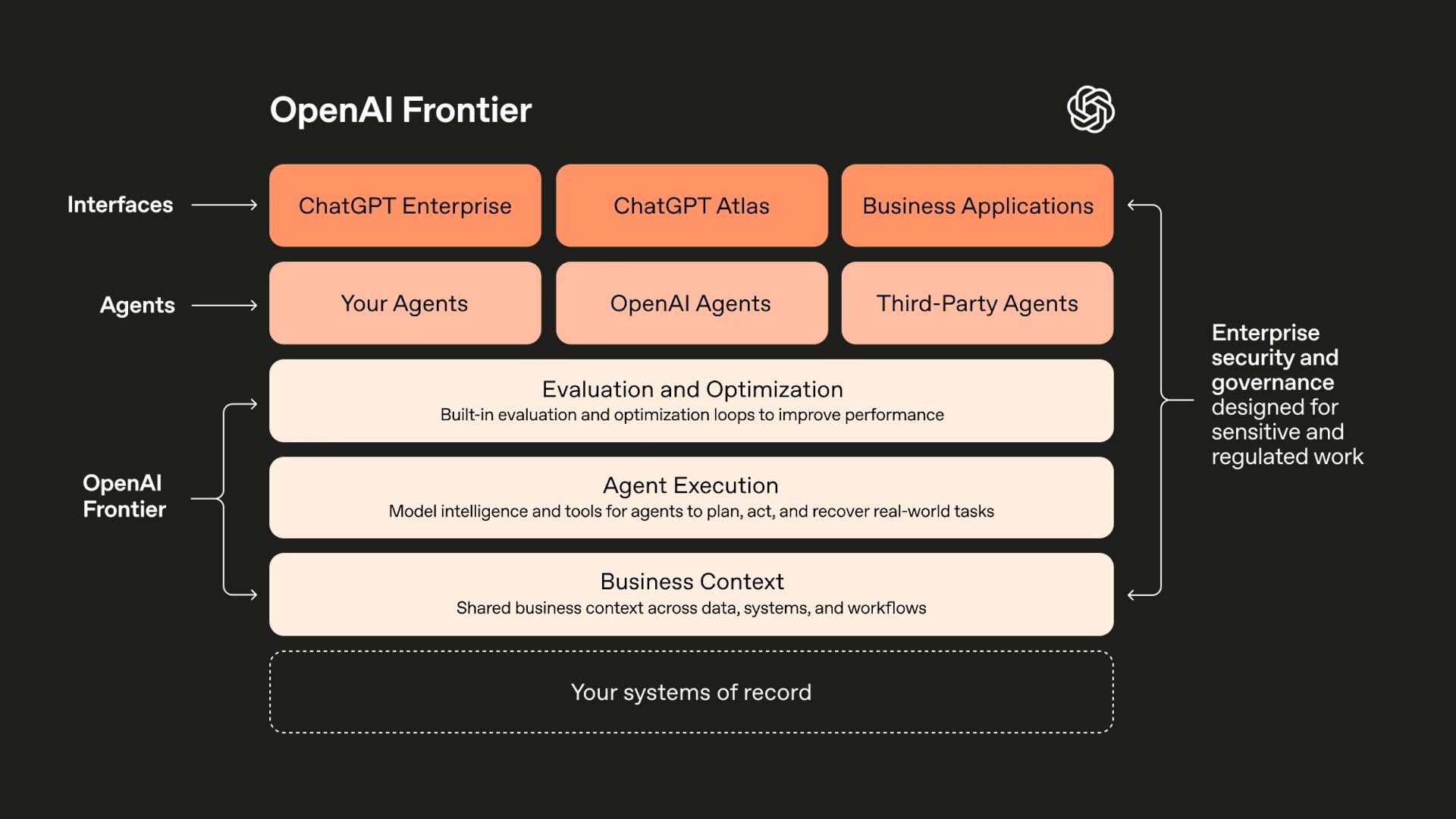
Understand the Work: Shared Enterprise Context
Effective employees need to understand how the business works; the same applies to AI agents.
Frontier connects with
- Data warehouse
- CRM system
- In-house applications
- Cloud infrastructure
- Task and operations management system
This creates a centralized semantic layer across the organization, fostering a shared understanding of the flow of information and its impact on the business.
Instead of creating point-by-point connections for each use case, agents can reference a centralized business context, reducing fragmentation and increasing consistency in decision-making.
Plan, act, and execute — not just chat.
Frontier enables AI agents to do more than just give advice.
Agent can:
- Analyze and reason from both structured and unstructured data
- Working with files and documents
- Run code
- Use enterprise-level tools
- Implement automated workflows
- Create long-term sustained memory
Agents operate in a trusted computing environment that supports cross-functionality.
- Local environment
- Enterprise cloud infrastructure
- The runtime is managed by OpenAI
For tasks requiring speed, low-latency access ensures consistent performance and responsiveness
This is how AI is truly transforming from a passive assistant to a proactive collaborator within an organization.
Improve quality through a feedback system.
In an enterprise environment, quality is not an option, but a requirement for continuous improvement.
Frontier Program includes mechanisms for:
- Performance evaluation
- Human feedback integration
- Behavioral optimization
- Continuous learning loops
Like human employees, AI coworkers will gradually learn and understand more about "what constitutes good performance" over time. This helps transform automation that was once experimental into a reliable operational infrastructure.
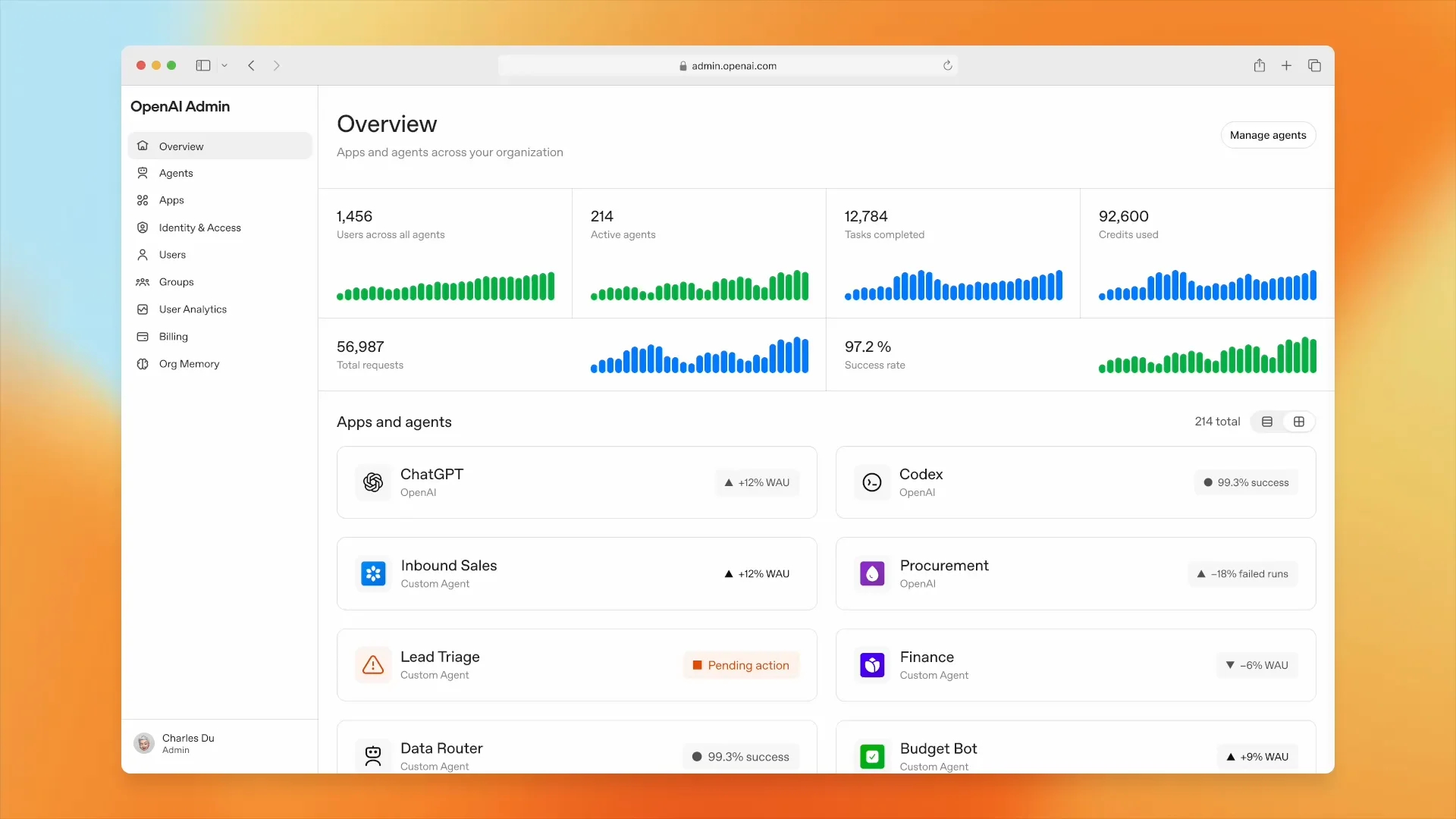
Identity, Permissions, and Governance Built In
Expanding the use of AI securely requires strict controls.
Each AI coworker in Frontier Program has
- Unique identity
- Clearly defined access rights
- The scope of work is clearly defined.
- Built-in guardrails
Enterprise-level governance and security are designed to be an integral part of the system from the outset, enabling organizations to confidently deploy agents even in industries with high regulatory requirements.
Importantly, Frontier works with existing organizational systems, rather than forcing a complete platform upgrade. Businesses can leverage their existing data and infrastructure immediately, through open standards, without having to abandon past investments.
Integrating platforms with expertise.
Technology alone cannot solve the complexity of enterprise-level AI.
OpenAI pairs Frontier deployments with Forward Deployed Engineers (FDEs) who work closely with customer teams. These engineers help organizations to...
- Establish appropriate practices (best practices).
- Deploy agents stably at the production level.
- Establish a governance framework.
- Optimize system performance
Meanwhile, feedback from real-world use within organizations is collected and sent back to OpenAI's research team, creating a development cycle that links real-world business needs with model development.
This collaboration accelerates learning for both parties.
Building an Open AI Ecosystem
Enterprise-level AI can only succeed when platforms and applications work together seamlessly.
Frontier is built on open standards, enabling software teams and AI developers to seamlessly connect to a centralized business context. Frontier partners work closely with OpenAI to deliver deeply integrated agent solutions across a wide range of industries.
The value gained is clear:
- The application can access a systematic business context from day one.
- Organizations avoid long connection cycle times.
- Deployment speed has increased.
- The risk has decreased.
Why is OpenAI Frontier important right now?
AI leaders across various industries are beginning to see measurable results, such as:
- Reduce the time required for the operational process.
- Improve revenue efficiency.
- Better allocation of human resources.
- Meaningful production optimization gains
The question is no longer whether AI will transform work. It is how quickly organizations can convert intelligent models into operational advantage.
OpenAI Frontier represents a shift from AI experimentation to AI infrastructure — from isolated tools to enterprise-wide AI coworkers.
Early access is currently available to select organizations, with broader availability expected in the coming months.
For enterprises ready to scale beyond pilots and close the AI opportunity gap, this may be the moment to rethink how agents are built and deployed — not as features, but as teammates.