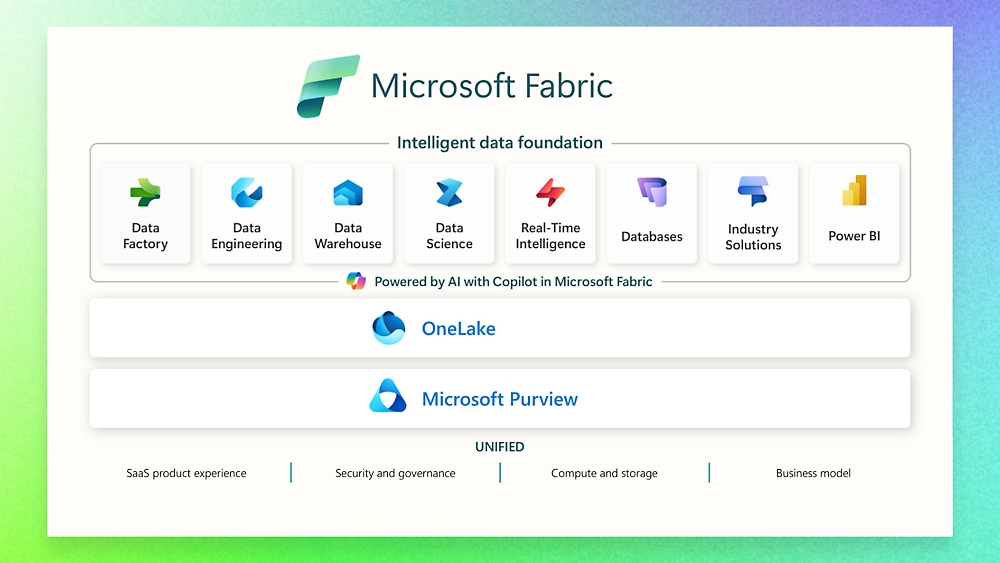
What is Microsoft Fabric? A platform that integrates data and analytics solutions, enabling efficient data management, analytics, and AI applications. Built on the Microsoft cloud, it combines tools for data engineering, real-time analytics, business intelligence, and machine learning into a single platform.
Microsoft Fabric enables organizations to seamlessly receive, send, transform, store, and analyze large amounts of data, whether structured or unstructured, by reducing data fragmentation, promoting collaboration, and accelerating business decision-making.
What is Microsoft Fabric?
Microsoft Fabric is a data management and analytics platform that integrates various tools into a single system, enabling organizations to efficiently store, process, analyze, and utilize data. It supports both structured and unstructured data and offers integration with AI and advanced analytics. With its cloud-based architecture, businesses can reduce data management complexity, accelerate decision-making, and significantly lower infrastructure costs.
Important components of Microsoft Fabric
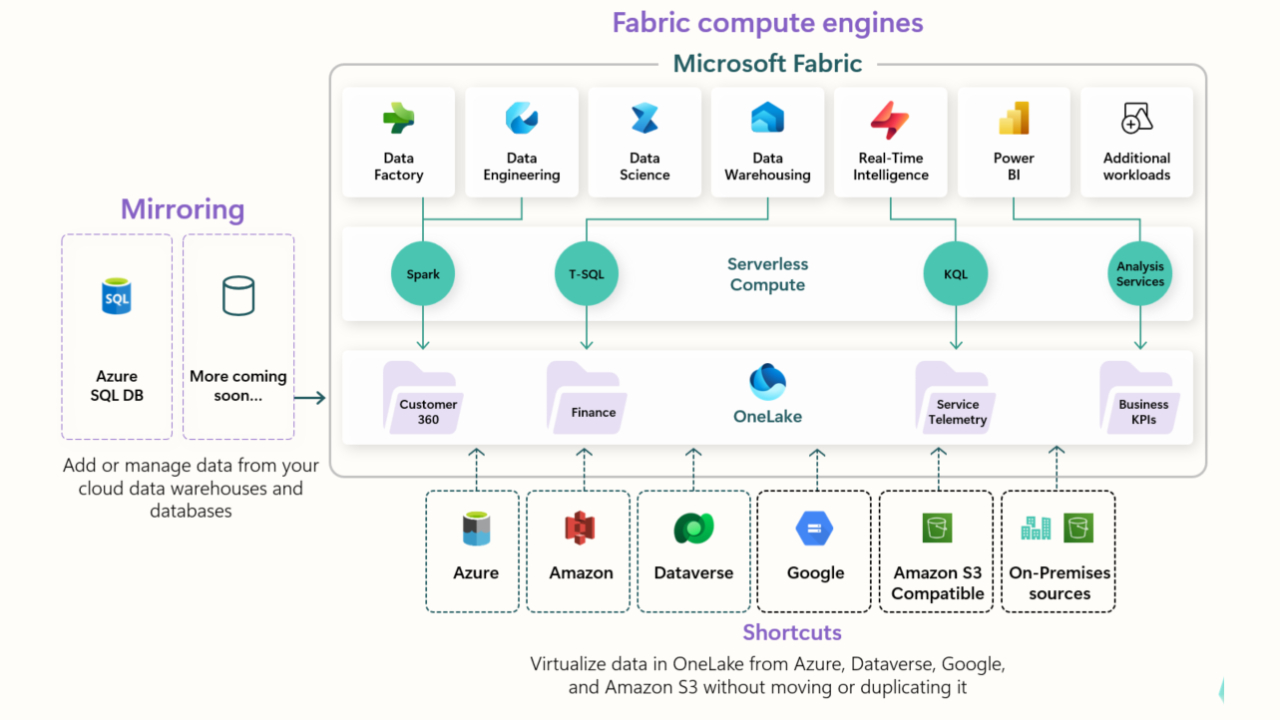
- Data Engineering
- Supports the processing and transformation of large datasets.
- Integrated with Apache Spark and other Big Data technologies.
- Supports both batch and real-time workflows.
- Data Factory
- It is an advanced ETL (Extract, Transform, Load) solution.
- Automatically helps move and merge data from multiple sources.
- Enhance data transformation capabilities with Low-Code/No-Code tools.
- Data Science and AI
- Supports the development and use of machine learning models.
- Supports Python, R, and other AI frameworks.
- Seamless integration with Azure Machine Learning.
- Real-time analytics
- Supports high-speed streaming data processing to gain immediate insights.
- Suitable for IoT, financial transactions, and operational monitoring.
- Reduce the latency for data-driven business decisions.
- Business Intelligence and Data Visualization
- It allows users to create interactive reports with Power BI.
- Presenting insightful information with dynamic visuals.
- Supports self-analysis for business users.
- Data Governance & Security
- Use Role-Based Access Control (RBAC).
- Supports safety standards and compliance with regulations such as GDPR and HIPAA.
- There is a data encryption and activity logging system for security.
Benefits of using Microsoft Fabric
A unified data ecosystem
- Reduce the need for multiple separate data analysis tools.
- It helps reduce operating costs by centralizing data management.
Scalability and Performance
- Supports processing petabytes of data without bottlenecks.s
- Scalable to meet increasing business needs.
Advanced AI and Machine Learning Capabilities
- Integrate with AI models to generate predictive data.
- It helps automate data-driven decision-making processes.
Cost optimization
- We offer flexible pricing models based on actual usage.
- Optimize cloud resources to reduce unnecessary costs.
Seamless integration with the Microsoft ecosystem.
- Works seamlessly with Azure, Power Platform, and Microsoft 365 services.
- It makes it easier for data teams and business analysts to collaborate.
Best practices for using Microsoft Fabric.
in order to get the most benefit from What is Microsoft Fabric? Businesses should adopt the following best practices:
Develop a clear data strategy.
- Define the objectives for data collection, storage, and analysis.
- Establish governance policies to ensure the accuracy and compliance with data requirements.
Use automation to manage data.
- use Data Factory to make the process ETL (Extract, Transform, Load) It is automated and facilitates seamless data transfer.
- customize Data Pipelines To increase processing speed and reduce latency.
Improve data storage and retrieval efficiency.
- Use a hierarchical data storage structure to manage costs efficiently.
- Indexing and caching techniques are used to enable faster data retrieval.
Enhance safety and compliance.
- Use encryption End-to-End For sensitive information
- enforce Multi-Factor Authentication (MFA) And policies on access control.
Enable real-time analytics to enhance business agility.
- lead Streaming Analytics Use this for use cases that require real-time data.
- use AI-Driven Insights to drive proactive decision making
Real-world examples of Microsoft Fabric use.
Retail and ecommerce
- Track customer behavior and sales patterns for targeted marketing.
- Use AI to optimize inventory management and pricing.
Finance and Banking
- Detect suspicious transactions in real time using machine learning.
- Enhance risk management and compliance reporting capabilities.
Healthcare and Life Sciences
- Processing large amounts of patient data to aid in predictive diagnosis.
- Supporting research through AI-powered genome data analysis.
Production and supply chain
- Improve production efficiency with real-time IoT monitoring.
- Predicting equipment maintenance to minimize downtime.
Smart cities and IoT
- Supporting urban planning through real-time analysis of traffic and environmental data.
- Develop energy-saving solutions using predictive analytics.
Summary
Microsoft Fabric It's a platform that transforms how businesses manage data, making it scalable, secure, and AI-driven. By understanding the infrastructure, core features, and best practices, organizations can leverage data to drive innovation, improve operations, and foster long-term growth.
With its ability to integrate into systems. Microsoft smoothly Microsoft Fabric Therefore, it is an ideal solution for businesses that want to improve their data infrastructure and stay ahead in the digital age.
Learn more about the features and capabilities on this page. Microsoft Fabric official
Explore our digital tools
If you are interested in implementing a knowledge management system in your organization, contact SeedKM for more information on enterprise knowledge management systems, or explore other products such as Jarviz for online timekeeping, OPTIMISTIC for workforce management. HRM-Payroll, Veracity for digital document signing, and CloudAccount for online accounting.
Read more articles about knowledge management systems and other management tools at Fusionsol Blog, IP Phone Blog, Chat Framework Blog, and OpenAI Blog.