

Table of Contents

Interactive Learning: A new way to learn Math and Science in ChatGPT

Facebook
X
LinkedIn
Interactive Learning

Artificial intelligence is rapidly transforming education by making learning more accessible, personalized, and engaging. One of the most exciting developments is Interactive Learning a new approach within ChatGPT that helps learners understand complex concepts through dynamic visual explanations and real-time experimentation. 

ChatGPT has become a popular learning tool, with millions of people using it to explore new topics, solve homework, prepare for exams, and understand difficult concepts. 

In fact, there are approximately 140 million people per week use ChatGPT specifically to help with math and science topics. 

However, many students still have difficulty understanding abstract concepts, especially in mathematics and physics. To address this problem, a new interactive visual tool has been introduced, allowing users to adjust formulas, change variables, and see the results of those changes immediately. 

This interactive experience transforms learning from passive reading into self-experimentation and exploration. 

Why is Interactive Learning important? 

The importance of Interactive Learning 

Traditional teaching methods often emphasize rote memorization and static explanations. While these methods may be effective in some cases, they sometimes fail to help students understand how concepts actually work. 

Interactive Learning transforms this by giving learners the opportunity to actively engage with concepts, rather than simply reading explanations. 

Research in educational psychology shows that visual and interactive learning environments can significantly enhance understanding. When learners can adjust variables and see immediate results, they gain a deeper understanding of the relationships between mathematical and scientific concepts. 

This approach helps students move beyond rote memorization of formulas to understanding the logic behind them.

How does interactive visual learning work?

A new interactive feature in ChatGPT allows users to explore key topics in mathematics and science through dynamic visual modules.

When learners ask about any concept, ChatGPT can...

  • Explain the topic clearly.
  • Display an interactive visual module.
  • Allows users to adjust variables and formulas.
  • Displays real-time changes in the graph and results.

This process helps transform abstract equations into interactive experiments that users can explore on their own.

Examples of questions that students might ask include:

  • "Can you explain the Pythagorean theorem to me?"
  • "How does the ideal gas law work?"
  • "How do I calculate the area of ​​a circle?"

Instead of just receiving explanations in text form, users can interact with these concepts and see how the mathematical relationships change when variables are adjusted.

Core Topics Available in Interactive Modules

The initial release focuses on more than 70 core math and science concepts. These topics include foundational ideas commonly taught in schools and universities.

Subject Area

Example Concepts

Mathematics

Geometry, algebra, functions

Physics

Motion, energy relationships

Chemistry

Gas laws and molecular behavior

Statistics

Probability and data relationships

By visualizing these concepts interactively, learners can better understand how formulas relate to real-world behavior.
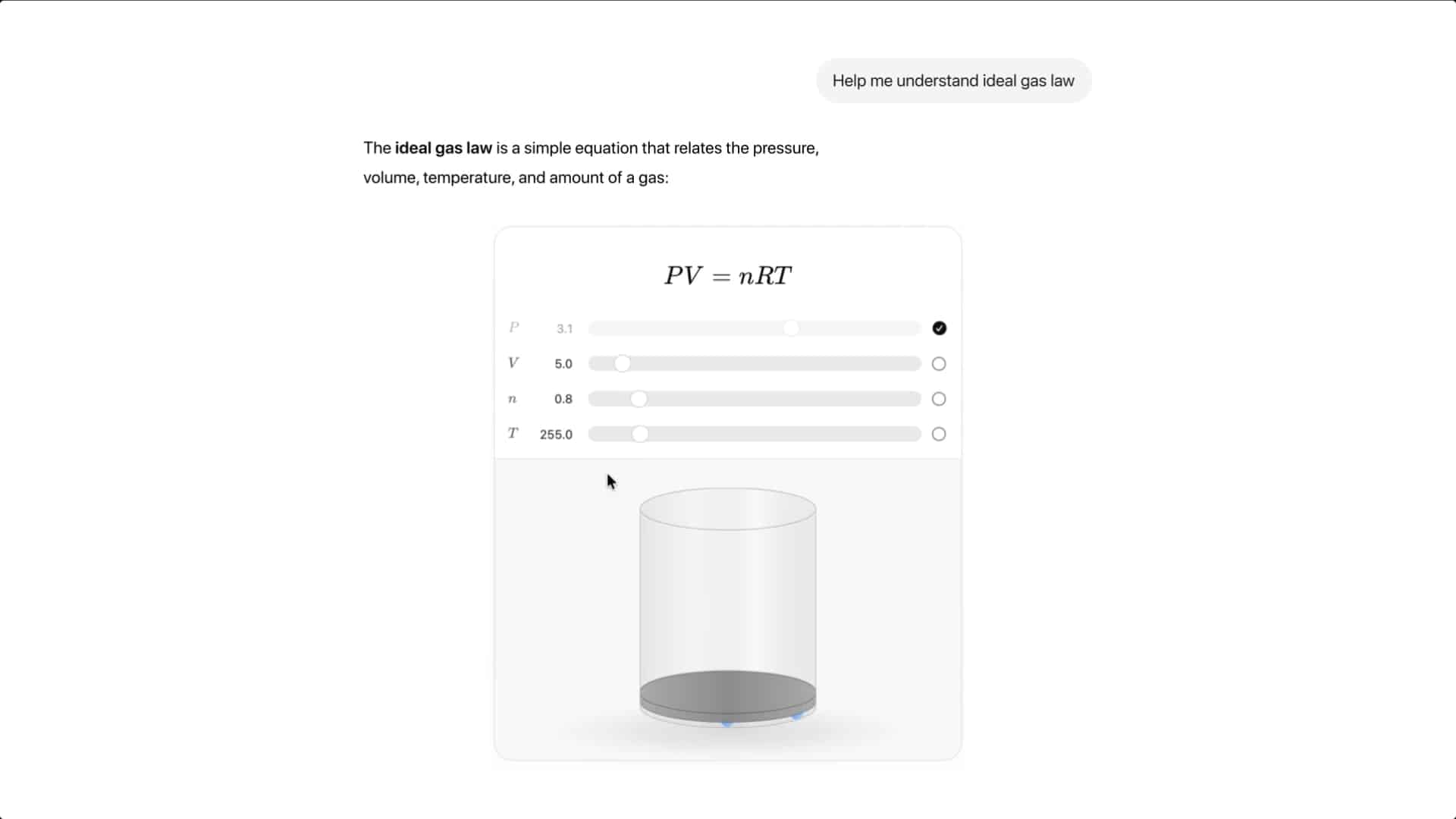
gas law

Benefits for Students, Parents, and Educators

The introduction of interactive tools within AI learning platforms offers advantages for multiple groups involved in education.

Students

Students benefit from more engaging learning experiences that encourage exploration rather than memorization.

Key benefits include:

  • Better conceptual understanding
  • Faster learning through visual feedback
  • Increased engagement with difficult subjects

Interactive modules also help students test ideas and experiment with concepts independently.

Parents

Many parents report that helping their children with subjects like mathematics can be challenging, especially when they feel uncertain about the material themselves.

Interactive learning tools provide a collaborative way for parents and children to work through problems together. By visualizing how formulas behave, both parents and students can understand concepts more easily.

Educators

Teachers often emphasize conceptual understanding rather than rote memorization. Interactive tools align with this goal by allowing students to observe how mathematical and scientific relationships actually function.

Educators can use these tools to demonstrate:

  • How variables interact within equations
  • Why formulas produce certain outcomes
  • How theoretical concepts apply to real scenarios

This helps students develop deeper analytical thinking skills.

Expanding AI-Powered Learning Experiences

The introduction of interactive visual modules represents just the beginning of a broader effort to enhance learning through AI.

Recent developments in AI-assisted education include:

Feature

Purpose

Study mode

Guides learners through problems step by step

Quizzes

Helps reinforce knowledge and exam preparation

Interactive visuals

Improves conceptual understanding

These features work together to create a more comprehensive digital learning environment.

The Role of Research in AI Education

Understanding how AI affects learning is an ongoing research effort. Early studies suggest that interactive AI tools can improve comprehension and encourage deeper engagement with complex subjects.

Educational research programs and collaborative initiatives are working to better understand:

  • How students learn with AI tools
  • The long-term effects of AI-assisted education
  • The best ways to integrate AI into classrooms

These insights will help shape future AI-powered learning experiences and ensure they benefit students across different age groups and educational systems.

The Future of Interactive Learning

How Interactive Learning Could Transform Education

As AI technologies continue to evolve, interactive learning environments will likely expand into more subjects and disciplines.

Future possibilities may include:

  • Interactive simulations for physics and engineering
  • Dynamic biology and chemistry visualizations
  • AI-guided learning paths for personalized education
  • Collaborative learning experiences for classrooms

These advancements may make education more engaging, accessible, and adaptable to diverse learning styles.

Summary

Education is undergoing a major transformation as AI technologies make learning more interactive and personalized. By combining explanations with real-time visual experimentation, Interactive Learning helps students explore concepts in ways that traditional methods often cannot provide.

Instead of simply reading about formulas or memorizing equations, learners can now manipulate variables, observe outcomes, and build deeper conceptual understanding.

As AI continues to integrate into education systems around the world, interactive learning experiences like these could play a crucial role in helping students develop stronger analytical skills and greater confidence in subjects such as mathematics and science.


Interested in Microsoft products and services? Send us a message here.

Explore our digital tools

If you are interested in implementing a knowledge management system in your organization, contact SeedKM  for more information on enterprise knowledge management systems, or explore other products such as Jarviz  for online timekeeping, OPTIMISTIC  for workforce management. HRM-Payroll, Veracity  for digital document signing, and CloudAccount  for online accounting.

Read more articles about knowledge management systems and other management tools at Fusionsol Blog, IP Phone Blog, Chat Framework Blog, and OpenAI Blog.

New Gemini Tools For Educators: Empowering Teaching with AI 

If you want to keep up with the latest trending technology and AI news every day, check out this website . . There are new updates every day to keep up with!

Fusionsol Blog in Vietnamese

Related Articles

Frequently Asked Questions (FAQ)

Microsoft Copilot is an AI-powered assistant feature that helps you work within Microsoft 365 apps like Word, Excel, PowerPoint, Outlook, and Teams by summarizing, writing, analyzing, and organizing information.

Copilot currently supports Microsoft Word, Excel, PowerPoint, Outlook, Teams, OneNote, and others in the Microsoft 365 family.

An internet connection is required as Copilot works with cloud-based AI models to provide accurate and up-to-date results.

Users can type commands like “summarize report in one paragraph” or “write formal email response to client” and Copilot will generate the message accordingly.

Yes, Copilot is designed with security and privacy in mind. User data is never used to train AI models, and access rights are strictly controlled.

Facebook
X
LinkedIn

Popular Blog posts