Cyber threats are evolving rapidly, and traditional security systems are falling behind the sophisticated attack surface of today's era. To address this challenge, Microsoft has launched an AI-powered threat protection platform via the Microsoft Security Blog, under the name Agentic Security System.
This new system, internally codenamed MDASH (Multi-Model Agentic Scanning Harness), represents another significant step for Microsoft in developing automated security systems driven by AI agents. Microsoft states that the platform utilizes over 100 specialized AI agents working together to discover, inspect, and analyze software vulnerabilities at unprecedented speed and scale.
This announcement reflects a major shift in the cybersecurity industry, from manual and reactive defenses to AI-driven automated security systems.
What is an Agentic Security System?
Agentic Security System (MDASH) is an AI-powered vulnerability discovery platform developed by Microsoft's Autonomous Code Security (ACS) team. Unlike traditional AI security systems that rely on a single model, MDASH uses a multi-model architecture that allows numerous specialized AI agents to work together to analyze and protect enterprise-level systems.
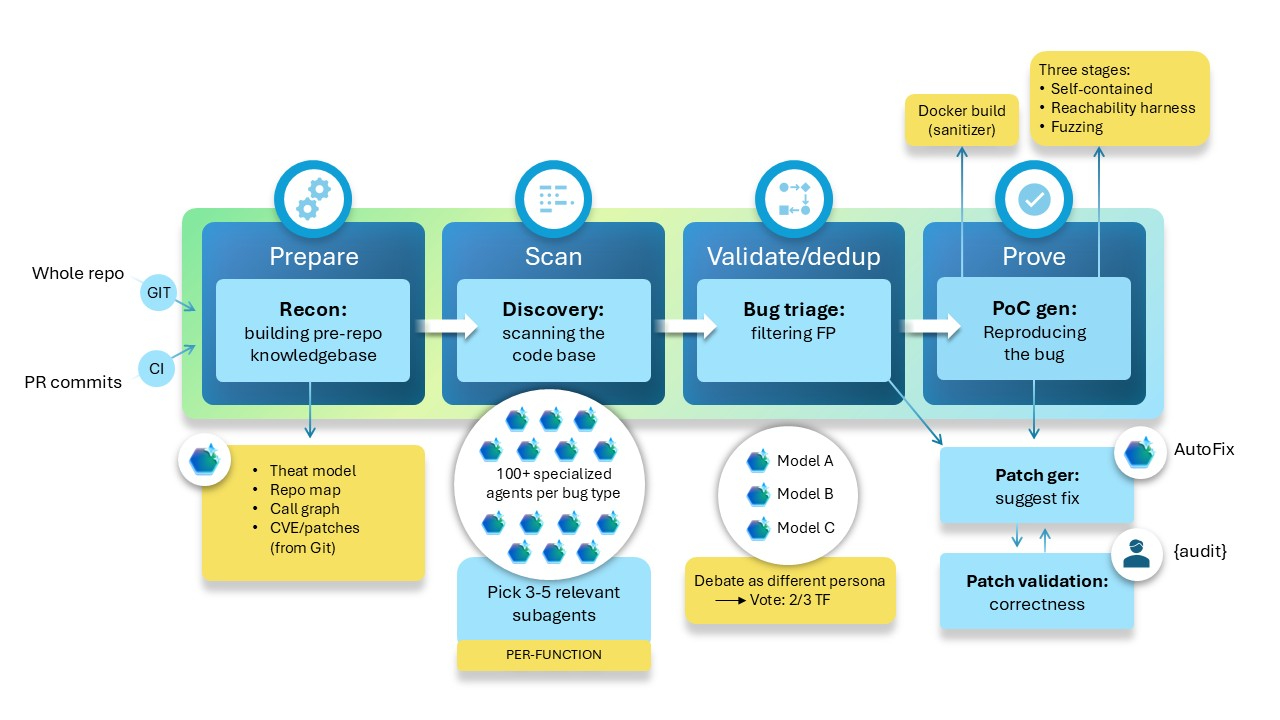
Each AI agent is designed to handle different tasks in the vulnerability discovery and security verification process. The system can scan large codebases, detect suspicious code patterns, analyze whether vulnerabilities can be exploited, and allow multiple AI agents to collaboratively verify or dispute results for increased accuracy.
This collaborative process helps reduce false positives and prioritizes security risks that need immediate attention.
Microsoft explains that MDASH integrates both Frontier AI Models and Distilled Models to balance performance, scalability, and operational costs. The key goal is to elevate cybersecurity by enabling “AI speed” to discover and fix vulnerabilities faster than traditional human-based processes.
Why did Microsoft develop MDASH?
Microsoft developed the Agentic Security System to meet the increasing complexity of modern enterprise systems.
Many organizations today manage massive cloud infrastructure, hybrid systems, AI-powered applications, IoT systems, a vast number of endpoint devices, and highly complex proprietary codebases. As these environments scale, traditional vulnerability scanning methods are becoming insufficient.
Many modern security tools generate a large number of false positives, causing security teams to waste time investigating alerts that may not represent real threats. This results in slower response times and increases the workload for security teams that are already heavily burdened.
To address these challenges, Microsoft designed MDASH to automate vulnerability discovery and validation. The system is optimized for highly specialized enterprise environments such as Windows, Hyper-V, Azure, the Enterprise Networking Stack, and Microsoft's built-in services.
These environments are difficult to secure because much of the code and infrastructure is not publicly available, making general-purpose AI incapable of efficient analysis without specific customization.
MDASH has discovered 16 new Windows vulnerabilities
One of the most important points of this announcement is that MDASH can discover:
- Sixteen new vulnerabilities in Windows have been identified.
- Of these, four are Critical Level Remote Code Execution.
AI systems can detect vulnerabilities in various areas, such as:
- Windows TCP/IP Stack
- IKEv2 Service
- HTTP.sys
- Netlogon
- DNS Resolution System
Several vulnerabilities were fixed in the May 2026 Patch Tuesday update.
This demonstrates that AI-driven security systems are no longer just experimental research, but are beginning to play a real role in enterprise-level security processes.
How does an Agentic Security System work?
The MDASH architecture is considered one of the most advanced parts of the system.
Instead of relying on a single large AI model, Microsoft uses an Ensemble system composed of more than 100 specialized AI agents.
Each agent is responsible for different tasks, such as:
Role of AI Agents | Duty |
Vulnerability Detection | Finds suspicious code patterns |
Exploit Validation | Tests exploitability |
Risk Analysis | Evaluates severity |
Debate Agents | Challenge findings |
Verification Agents | Confirm vulnerabilities |
Patch Reasoning | Suggest mitigation paths |
This collaborative architecture helps improve both:
- Detection accuracy
- False positive reduction
Microsoft stated that the system found:
- 21 out of 21 planted vulnerabilities
- With zero false positives in testing
They also scored:
- 96% recall on historical MSRC cases
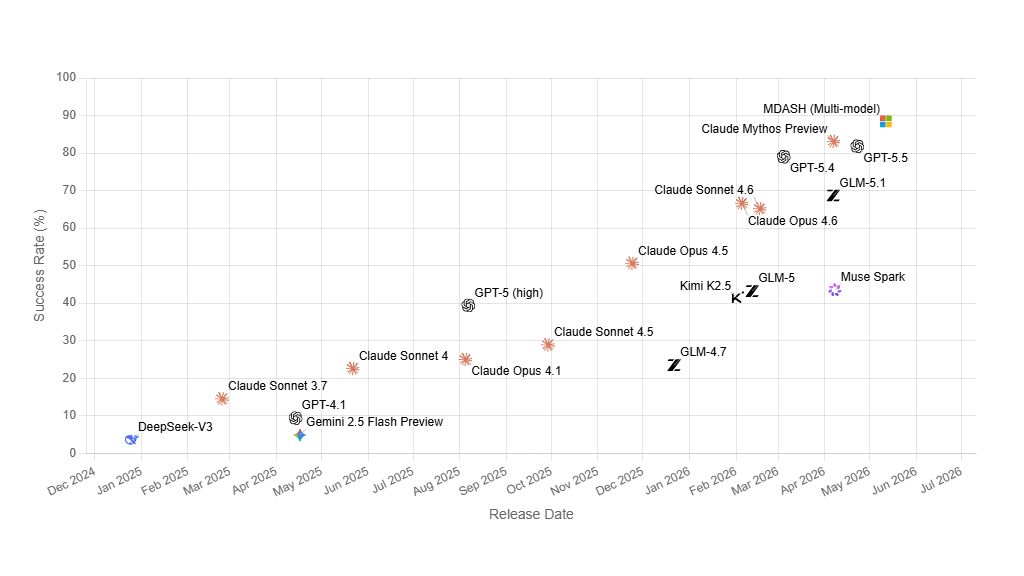
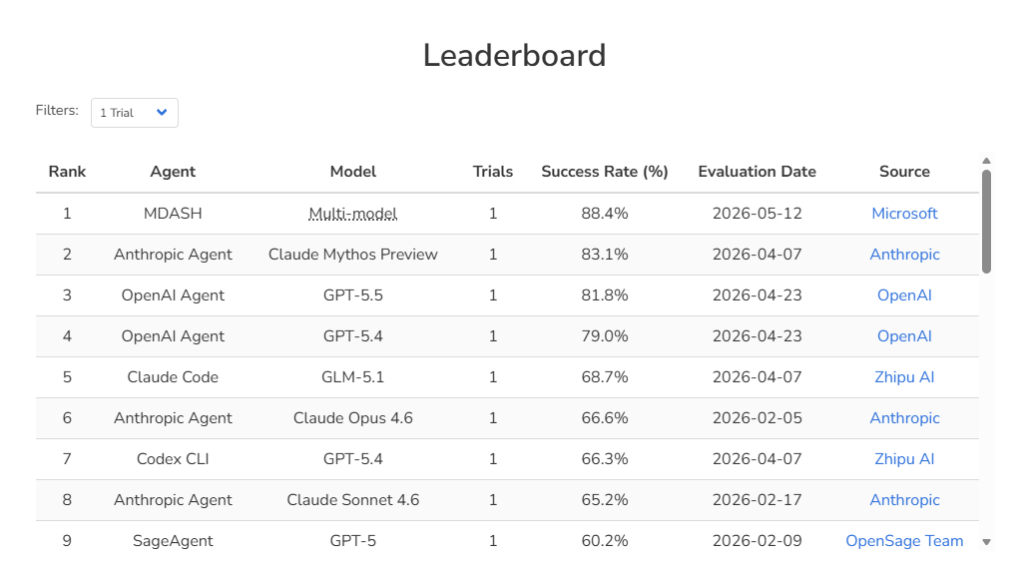
- 88.45% score on the CyberGym benchmark
This caused the system to rank at the top of the Public Leaderboard, according to information released by Microsoft.
Defense at AI Speed
The phrase "Defense at AI Speed" reflects Microsoft's cybersecurity vision.
Today's threats move faster than human response capabilities. Attackers are increasingly employing automation, AI-assisted phishing, and autonomous malware.
To combat these threats, defense systems must also evolve towards automation.
The Agentic Security System is designed to support:
- Continuous vulnerability research
- Automated reasoning
- Faster security validation
- Scalable code auditing
- Autonomous investigation workflows
This could significantly reduce the time between:
- Vulnerability introduction
- Vulnerability discovery
- Security patch deployment
Significantly
Multi-Agent AI VS Single-Model AI
A major theme in Microsoft’s announcement is the advantage of multi-agent systems over single-model AI.
Traditional AI security tools often struggle because one model must handle:
- Analysis
- Reasoning
- Verification
- Exploit generation
- Prioritization
MDASH distributes these tasks across specialized agents.
Microsoft argues that the “agentic system around the model” is more important than any individual AI model itself.
This architecture resembles how human security teams operate collaboratively, but at machine scale and speed.
Industry Reactions to MDASH
The cybersecurity community has reacted strongly to the launch of MDASH.
Many researchers consider MDASH to be:
- A significant step for Autonomous Security
- Production-level AI Defense System
- A new era of AI-assisted vulnerability research
Some discussions on Reddit mentioned impressive benchmark results, particularly the very low false positive rate and the ability to find sophisticated vulnerabilities in Windows.
Others pointed out concerns such as:
- Overreliance on AI
- Closed-source AI security systems
- Potential misuse of offensive AI techniques
- AI-powered cyber arms races
These concerns are increasingly common as AI capabilities rapidly expand across the cybersecurity industry.
The Future of Agentic Cybersecurity
Future cybersecurity platforms may include:
- Autonomous SOC Operations
- AI-Driven Incident Response
- Self-Healing Systems
- Automated Patch Validation
- Continuous Vulnerability Discovery
- Multi-Agent Defensive Ecosystems
Research communities are already exploring secure agentic AI architectures for future enterprise environments.
This suggests that AI agents will increasingly become active participants in enterprise defense strategies rather than simply acting as assistant tools.
Microsoft’s Bigger AI Security Vision
MDASH is just one part of Microsoft's larger AI Security strategy.
The company is expanding its security ecosystem across platforms such as Microsoft Defender, Microsoft Security Copilot, Microsoft Entra, and Microsoft Intune to support more autonomous and agentic security operations.
Microsoft's long-term vision is to build an Intelligent Security Ecosystem that integrates AI Automation, Human Oversight, Enterprise Governance, and Security Telemetry on a large scale.
By combining these capabilities, Microsoft aims to create a security platform that is proactive, responds faster to threats, and helps organizations manage complex digital environments more effectively.
Summary
By coordinating the work of over 100 specialized AI agents, MDASH demonstrates how a multi-agent AI system can effectively accelerate vulnerability detection and enhance enterprise-level protection.
The system's ability to discover 16 new Windows vulnerabilities also reflects the significant role AI will play in future cybersecurity strategies.
As cyber threats continue to evolve, systems like Agentic Security Systems may become critical infrastructure for modern enterprise security in the future.